

Audio By Carbonatix
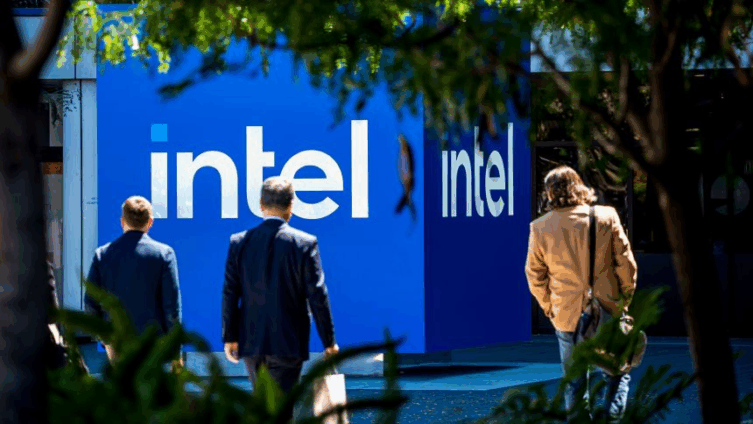
The White House confirmed on Tuesday that the Trump administration is working on a deal that could see the US government taking a 10% stake in chip giant Intel.
"The president wants to put America's needs first, both from a national security and economic perspective," White House press secretary Karoline Leavitt told reporters.
The potential deal could involve swapping government grants for Intel shares, according to US Commerce Secretary Howard Lutnick.
The highly unusual move could help Intel as it struggles to compete with rivals like Nvidia, Samsung and TSMC, particularly in the booming artificial intelligence (AI) chip market. Intel has been contacted by the BBC for comment.
The US wants a stake Intel in exchange for grants approved during the Biden administration, Lutnick said on CNBC on Tuesday.
"We should get an equity stake for our money," he added. "We'll get equity in return for that... instead of just giving grants away."
The potential deal, which was first reported last week, aims to help Intel build a flagship manufacturing hub in the US state of Ohio. At the time, a White House spokesman told the BBC that the reports "should be regarded as speculation" unless officially announced.
Last week, Intel did not comment directly about reports but said it was "deeply committed to supporting President Trump's efforts" to strengthen manufacturing and technology in the US.
On Monday, Japanese investment giant Softbank said it would buy a $2bn (£1.5bn) stake in Intel, in a move that some analysts said is a sign of confidence in the firm's turnaround.
After that announcement,the firm's shares rose by almost 7% in New York on Tuesday.
Intel is one of the few US companies capable of producing high-end semiconductors at scale but the company has fallen behind global rivals.
The government potentially taking a stake in Intel reflects the firm's "unique position" as America's main producer of high-end chips domestically, said Dan Sheehan from Telos Wealth Advisors.
But political involvement could slow down decision making and shift priorities, adding challenges to an already tough turnaround for Intel, said Mr Sheehan.
Some other experts have expressed concerns over the potential deal and whether companies may be pressured to follow political agendas.
The developments came as the US chip industry is under intense scrutiny by the White House.
Last week, Nvidia and AMD agreed to pay the US government 15% of their Chinese revenues as part of an unprecedented deal to secure export licences to China.
Latest Stories
-
AFCON 2027Q: Black Stars to depart Accra for Bouaké ahead of Ivory Coast clash
4 minutes -
Who to allow into your home, who should come into your cyberspace? Trust is becoming unbecoming
6 minutes -
At least 11 dead in mass shooting at house party in South Africa
23 minutes -
MoMo Fintech Lab attracts close to 1K entries from innovators across, applications end on Sept 30
34 minutes -
Black Stars face Ivorian test as injuries force major squad changes
48 minutes -
Save Nations Foundation donates learning materials to Nooria Islamic Basic School, calls for more support
55 minutes -
From selling food to solving problems: How Esther Owusu Nkwantabisah rethought entrepreneurship
1 hour -
Explained: Ghana’s water plant deal that produced a $235m judgment debt instead of water for 500,000 people
1 hour -
High Cost of Domestic Airline Fares: Can government do something about it?
1 hour -
Inflation, cedi depreciation put BoG’s MPC under pressure as policy rate decision looms
2 hours -
Lawyer denies Salomey Baffoe received money from ‘Ghana Jollof’ account operator
2 hours -
Beyond politics: Why Kwame Nkrumah’s ideals still matter for today’s leaders
2 hours -
Top South African policeman charged with sexual offences
2 hours -
More than 170,000 respiratory cases recorded in haze-choked Indonesia
2 hours -
Narrowed space, intolerance – Sammy Crabbe says NPP is driving talented members away
3 hours