

Audio By Carbonatix
The safety of Kenyans caught up in post-election violence in neighbouring Tanzania must be guaranteed, Kenya's foreign minister has told his Tanzanian counterpart.
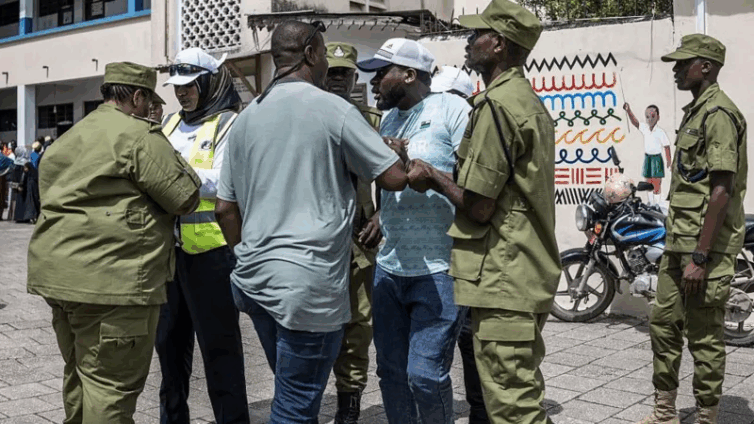
Kenyan citizens are living in fear in Tanzania after being reportedly targeted in a brutal crackdown on the protests that followed last week's disputed election.
President Samia Suluhu Hassan won the poll with 98% of the vote - and in her inauguration speech condemned the violence and blamed foreigners for stoking the unrest.
Kenya's Foreign Affairs Minister Musalia Mudavadi said the rights of some Kenyans had been violated and that "formal reports" had been submitted to the Tanzanian authorities "for appropriate action".
During a phone conversation, Mudavadi said he had told Tanzanian Foreign Minister Mahmoud Thabit Kombo that concerns would be "addressed through the established diplomatic and consular channels".
But he had reaffirmed "the importance of safeguarding the rights, safety, and dignity" of Kenyans living in Tanzania.
In May, Mudavadi had said that about 250,000 Kenyans lived, worked or did business in Tanzania.
The Tanzanian government has come under intense international scrutiny for allegedly using excessive force to quell post-election protests, which reportedly left hundreds of people dead.
It has sought to downplay the scale of the violence and has dismissed the number of deaths given by the opposition as greatly exaggerated.
Earlier a Tanzanian police spokesman said the country had intelligence that some foreigners had crossed the border through illegal points "with the intention to commit crimes, including causing unrest".
Several families in Kenya have expressed concern for the safety of their relatives in Tanzania, following reports that some Kenyans have been killed, injured, or detained, while others are nursing injuries allegedly inflicted by Tanzanian security officers.
Kenyan human rights activist Hussein Khalid urged the government to take urgent measures to protect them, saying that Tanzanian authorities were using Kenyans as "scapegoats for the atrocities committed by police against Tanzanians".
"Kenyans in Tanzania are not safe. They are being targeted and harassed," Mr Khalid told Kenya's Daily Nation newspaper.
John Ogutu, a Kenyan teacher working in Tanzania's main city of Dar es Salaam, was shot dead by police while on his way to buy food, his older sister told the BBC.
But rights groups say his body can not be traced for repatriation and burial.
On Tuesday, a doctor at Muhimbili Hospital in Dar es Salaam told the BBC that vehicles marked "Municipal Burial Services" had been collecting bodies of those believed to have died in the protests.
Kenya's foreign affairs ministry has now asked relatives of Kenyans who may be in distress in Tanzania to share their names, addresses and emergency contacts.
It acknowledged rising public concern over the government's perceived slow response in tracing Kenyans possibly affected by the Tanzanian unrest and said it was taking steps to ensure all nationals abroad were accounted for.
Reports say many Kenyans, especially those working in private schools, are now fleeing Tanzania after the government warned employers not to engage people without work permits.
Election observers say the polls fell short of democratic standards, but the government insists the election was fair and transparent.
President Samia faced little opposition with key rival candidates either imprisoned or barred from running.
Her inauguration ceremony was held at a military parade ground in the capital, Dodoma, instead of a stadium as in previous years. It was closed to the public but was shown live on state TV.
She first came into office in 2021 as Tanzania's first female president following the death of President John Magufuli - and was initially praised for easing political repression, but the political space has since narrowed.
Tanzania and Kenya, which are both part of the Economic African Community, have experienced periodic political and economic tensions.
In May diplomatic relations were strained over Tanzania's treatment of Kenyans who had gone to Dar es Salaam to observe the treason trial of opposition leader Tundu Lissu.
Several of them were deported while prominent Kenyan activist Boniface Mwangi, along with Ugandan activist Agather Atuhaire, went missing and were later reported to have been tortured and sexually mistreated.
Latest Stories
-
Ghana concludes evacuation of citizens from South Africa; total returnees reach 1,900 – Ablakwa
16 minutes -
Africa must define its own green transition path – Prof Fatima Denton
38 minutes -
WASSCE 2026: English Language performance falls to 62.4% – WAEC
1 hour -
WASSCE 2026: Social Studies records sharp rebound as Maths, Science also improve
1 hour -
2026 WASSCE entry rises by 11% as 512,862 candidates sit exams
1 hour -
WASSCE 2026: English Language performance falls to 62.4% – WAEC
2 hours -
WAEC cancels 2026 WASSCE results of 8,295 candidates over examination irregularities
2 hours -
WAEC releases provisional 2026 WASSCE results for 512,862 candidates
2 hours -
CJ’s remarks on SOEs were made in good faith, not to undermine judicial independence – Judicial Service
5 hours -
Bright Future Alliance pays courtesy call on Akufo-Addo, invites him to African Leaders of Influence Lectureship Series
5 hours -
This is an attempt to break the Minority caucus – Patricia Appiagyei on alleged GH¢70k payment
6 hours -
‘OSP hasn’t contacted me’ – Patricia Appiagyei assures cooperation if invited
6 hours -
I find it strange that this memo was purportedly written by me – Patricia Appiagyei
6 hours -
Ayariga calls for stronger church partnership to tackle sanitation, environmental challenges
7 hours -
I don’t think we have an industry – Patchbay Band manager
7 hours