

Audio By Carbonatix
A Tanzanian court has charged at least 240 people with treason following last week's deadly election protests.
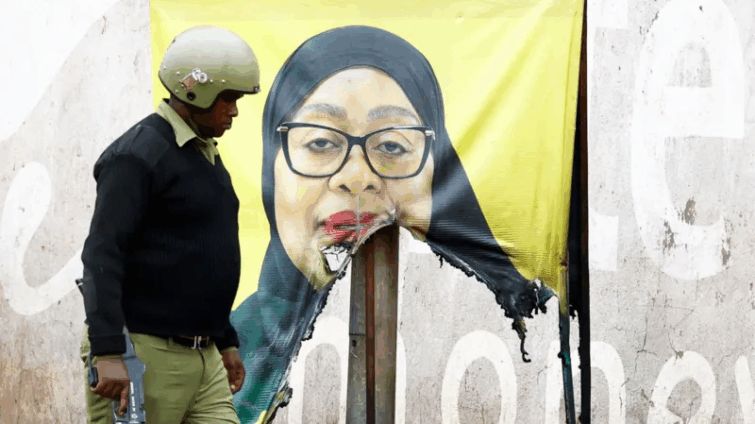
President Samia Suluhu Hassan was declared the winner of the election with 98% of the vote, but the opposition - which was barred from contesting - denounced the poll as a sham.
Security forces clashed with those protesting against the vote and, according to various sources, hundreds were killed. The authorities have downplayed the scale of the violence and maintained the election was free and fair.
Many people were arrested and have now been charged with treason at a court in the economic capital of Dar es Salaam. They were not been asked to enter a plea in court.
According to a charge sheet seen by the BBC, the defendants are accused of inciting demonstrations with the intention of obstructing the election.
The defendants could receive the death penalty if found guilty. However, in Tanzania, the majority of those sentenced to death eventually have their sentence commuted to life in jail.
The East African nation's last execution took place in the 1990s.
Among those charged on Friday was prominent Tanzanian businesswoman Jenifer Jovin.
She has been accused of encouraging protesters to buy gas masks in order to protect themselves from the police's tear gas.
The defendants also include social media influencers. The court has been adjourned until 19 November.
During her inauguration speech, President Samia condemned the violence and also blamed foreigners for stoking the unrest.
It has left many Kenyans in Tanzania fearful for their safety after being reportedly targeted in the brutal crackdown - and has prompted Kenya's Foreign Minister Musalia Mudavadi to ask his Tanzanian counterpart that their safety be guaranteed.
During a phone conversation, Mudavadi said he had told his Tanzanian Foreign Minister Mahmoud Thabit Kombo that concerns would be "addressed through the established diplomatic and consular channels".
But he reaffirmed "the importance of safeguarding the rights, safety, and dignity" of Kenyans living in Tanzania.
In May, Mudavadi had said that about 250,000 Kenyans lived, worked or did business in Tanzania.
Earlier a Tanzanian police spokesman said the country had intelligence that some foreigners had crossed the border through illegal points "with the intention to commit crimes, including causing unrest".
Several families in Kenya have expressed concern for the safety of their relatives in Tanzania, following reports that some Kenyans have been killed, injured, or detained, while others are nursing injuries allegedly inflicted by Tanzanian security officers.
John Ogutu, a Kenyan teacher working in Dar es Salaam, was shot dead by police while on his way to buy food, his older sister told the BBC.
But rights groups say his body can not be traced for repatriation and burial.
On Tuesday, a doctor at Muhimbili Hospital in Dar es Salaam told the BBC that vehicles marked "Municipal Burial Services" had been collecting bodies of those believed to have died in the protests.
Kenya's foreign affairs ministry has now asked relatives of Kenyans who may be in distress in Tanzania to share their names, addresses and emergency contacts.
Reports say many Kenyans, especially those working in private schools, are now fleeing Tanzania after the government warned employers not to engage people without work permits.
Election observers say the polls fell short of democratic standards, but the government insists the election was fair and transparent.
President Samia faced little opposition with key rival candidates either imprisoned or barred from running.
Her inauguration ceremony was held at a military parade ground in the capital, Dodoma, instead of a stadium as in previous years. It was closed to the public but was shown live on state TV.
She initially came into office in 2021 as Tanzania's first female president following the death of President John Magufuli - and was initially praised for easing political repression, but the political space has since narrowed.
Tanzania and Kenya, which are both part of the Economic African Community, have experienced periodic political and economic tensions.
In May diplomatic relations were strained over Tanzania's treatment of Kenyans who had gone to Dar es Salaam to observe the treason trial of opposition leader Tundu Lissu.
Several of them were deported while prominent Kenyan activist Boniface Mwangi, along with Ugandan activist Agather Atuhaire, went missing and were later reported to have been tortured and sexually mistreated.
Latest Stories
-
‘You promised 24-Hour economy not 24-hour cocaine trafficking’ – Nana B to Mahama
2 minutes -
Nana Konadu dedicated her life to community transformation — Yaa Asantewaa Agyeman-Rawlings
2 minutes -
Protect the customer by changing who owns the loss
10 minutes -
Counterfeit currency syndicates used churches to hide printing operations – National Security Council Secretariat
20 minutes -
NPP press conference on drug busts should be treated with contempt – NDC
20 minutes -
Don’t abandon working policies because of politics – Asiedu Nketiah
25 minutes -
National Security arrests 16 and seizes millions in counterfeit currency and printing equipment
26 minutes -
NPP links resurgence of drug trafficking cases to NDC’s return to power
27 minutes -
KGL Foundation and GNPC Foundation partner to expand educational scholarships for Ghanaian students
27 minutes -
Asiedu Nketiah urges journalists to report fairly at all times, and not based on politicians’ complaints
31 minutes -
Finance Ministry to write off $120m of TOR’s $400m legacy debt – MD reveals
39 minutes -
Mahama: MiDA is Ghana’s gateway to global philanthropy
41 minutes -
NPP alleges illicit drug-processing laboratories operating at Ghana’s main ports
43 minutes -
‘A serious country cannot start afresh every four years’ – Asiedu Nketiah
43 minutes -
National Horticultural Seed Roadmap launched to strengthen Ghana’s vegetable seed sector
56 minutes