

Audio By Carbonatix
At first, everything seemed perfect. Abilolo was a rising star in Ghana’s music scene who had signed with BigHit Records. He got ‘a big advance’, a recording contract, a distribution deal, and a shot at stardom. He was eager to make it big, so he signed away his future for a taste of the high life.
BigHit Records threw parties in his honour, and his songs played on every television and radio station. Abilolo basked in glory, spending his advance on flashy lifestyle. But as time went on, reality set in. His royalties were a trickle, and BigHit controlled every note he sang.
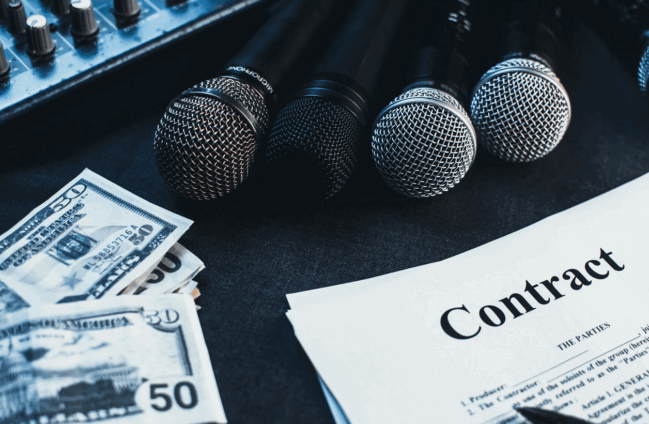
Abilolo’s story is just one note in the dissonant melody that plagues Ghana’s music industry. The music industry in Ghana has, over the years, been characterised by high-profile contracts between artistes and record labels, often with terms that starkly favour the latter.
Just like Abilolo, many Ghanaian artistes bypass lawyers when signing contracts, prioritizing short-term gains over long-term creative control and financial stability. This can lead to unfavorable terms, including 360 deals, excessive termination clauses, and unfair royalty structures.
A 360 deal, for instance, allows a record label to take a percentage of an artist’s entire revenue streams, including touring, merchandise, and endorsements, often without contributing equally to production costs.
This can lead to a situation where the artist is bound to the label for years, with little control over their creative direction or financial affairs. Excessive termination clauses can also allow labels to terminate contracts at will, while artistes are bound for years, leaving them vulnerable to exploitation.
The law provides recourse for artistes who sign unconscionable contracts. In Ghana, courts may void contracts found to be oppressive or contrary to public policy. Contracts signed under duress or undue influence can also be voided. Ghanaian artistes may argue that they lacked bargaining power, with labels dictating terms and leaving them with no room for negotiation.
Financial pressure can also lead artistes to sign desperate deals, unaware of the contract’s implications. In Ghana’s music industry, where opportunities for financial stability are often limited, artistes may feel pressured to sign contracts that favour the labels. The lure of an advance payment or a recording deal can be overwhelming, leading artistes to overlook red flags in the contract.
For instance, an artist struggling to get his work out there and make ends meet may sign a contract with a label that offers a modest advance, only to discover later that the label takes a significant percentage of his future earnings. The courts may consider these factors when determining the validity of a contract.
In Ghana, the doctrine of unconscionability is recognized, and the courts may set aside contracts found to be grossly unfair or one-sided. To establish unconscionability, Ghanaian artistes may need to show that they were under pressure to sign the contract, lacked independent legal advice, and did not understand the terms of the agreement. If the court finds that the contract is unconscionable, it may declare it void or order the label to renegotiate the terms.
The involvement of a lawyer, therefore, is crucial in protecting artistes’ interests. Lawyers ensure that artistes understand contract terms, negotiate fair deals, and protect their intellectual property. Key areas of focus include split sheets, clearance, and contract review, which identify red flags such as unfair termination clauses and excessive royalties.
Split sheets define revenue-sharing terms, ensuring artistes receive fair compensation for their work. Clearance involves obtaining necessary permissions for samples and copyrighted materials to protect artistes from potential lawsuits.
The consequences of not seeking legal counsel can be devastating. Artistes may find themselves trapped in unfavourable contracts, with little control over their creative direction or financial affairs. This can stifle their creativity, hinder their career growth, and ultimately lead to financial instability. The music industry is littered with examples of artistes who have suffered, or still suffering as a result of poor contract negotiation.
In contrast, artistes who prioritize their rights and interests can build sustainable careers, protect their creative work, and secure their financial futures. The involvement of a lawyer is not a luxury, but a necessity. Artistes who sign contracts without a lawyer are like the prodigal son, squandering their inheritance on empty promises and finding themselves in a distant land, hungry for an escape.
However, just like the father in the parable of the Prodigal Son, the law offers a path to redemption. Seeking sound legal counsel can help artistes break free from unfair deals, protect their creative work, and secure their financial futures. It is not too late to get expert guidance and turn things around.
Ghana’s music scene can really take off if artistes get proper legal help before signing deals. Musicians need expert advice to understand contracts and protect their work. It is time for the industry to move from exploitation to fair play.
In summary, before putting pen to paper, ensure you have a lawyer on speed dial. Get that contract scrutinized, negotiated, and sanitized. Your music, your rights, and your future depend on it. It is time for Ghanaian artistes to take control of their careers, protect their art, and build lasting legacies. The path forward is clear.
Like the father who welcomed back his prodigal son, saying “My son was lost, but now he is found’’, there is hope for artistes who have signed contracts without seeking legal guidance. Seek legal advice and you might just find your way back home. You were lost, but now, you are found.
Do not let a bad contract be the offbeat in your symphony.
The author, Jesse Akelimbona Adongo, is a legal practitioner with interests in Litigation, Corporate and Commercial Law, Intellectual Property Law, Entertainment Law, and Fintech.
Email: j.akelimbona@gmail.com
Latest Stories
-
Volta Region described as cleanest so far in Parliament’s nationwide sanitation monitoring
3 minutes -
Parliament urges MMDAs to enforce sanitation bylaws to curb indiscriminate waste disposal
8 minutes -
Mohammed Kudus drops out of Ghana squad for AFCON 2027 qualifiers against Côte d’Ivoire and Gambia
44 minutes -
Africa World Airlines unveils first Embraer E190 as part of 10-aircraft fleet expansion
2 hours -
Civilian hospitalised after alleged machete attack by prison officers, inmates
2 hours -
Toobu rejects calls to recall Parliament over 3.9-tonne cocaine shipment
3 hours -
Residents in 5 Northern Regions warned of approaching rainstorm
3 hours -
Constituency Games still a work in progress – Sports Minister
3 hours -
Team Ghana set for historic Karting Africa Showrun in Angola
3 hours -
52-year-old South African arrested with suspected heroin after arriving from Accra
3 hours -
Shatta Wale challenges UPSA students to build entrepreneurial mindsets
4 hours -
Finance Minister advises African governments to strengthen regional tax cooperation
6 hours -
NPP accuses NDC of master-minding demolition of Ho regional office fence
6 hours -
Ghana plans stronger regional power trade with Nigeria
6 hours -
GRA Commissioner-General calls for stronger tax cooperation to boost regional revenue mobilisation
6 hours