

Audio By Carbonatix
An Israeli strike has destroyed a building in central Beirut, as missiles continue to hit areas far from where the Iranian-backed Hezbollah group has its strongest presence.
A BBC team was jolted awake around 05:00 (03:00 GMT) by the sound of the blast. The Israeli military had issued a warning at 04:00 to evacuate the building and nearby areas, saying it was a facility affiliated with Hezbollah that Israel would target.
There are no known casualties so far from the strike near downtown businesses and hotels.
War started in Lebanon on 2 March when Hezbollah fired missiles at Israel to support Iran in the ongoing regional conflict. Israel responded with bombing and then troops entering Lebanon's south.
The Lebanese health ministry says that 912 people, including at least 111 children, have been killed since 2 March.
More than a million people have been forced to leave their homes, mainly in the south and east of the country and southern Beirut, where Hezbollah's presence is strongest. But strikes have not been limited to those areas.
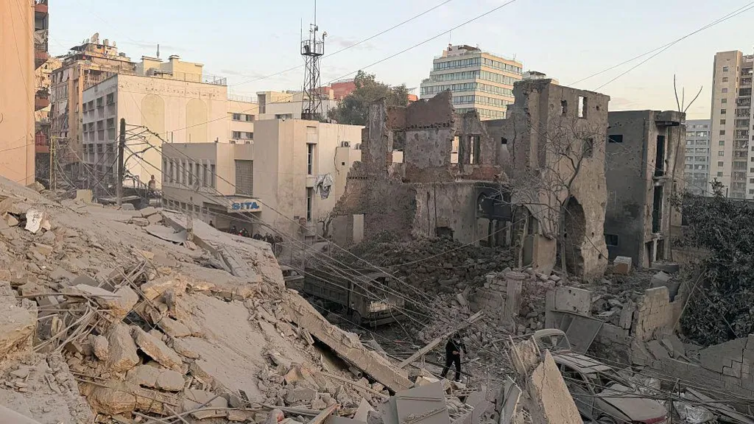
The building hit in the Bashoura neighbourhood of Beirut on Wednesday had already been targeted several times in recent days - and has now been completely demolished and reduced to a pile of rubble.
Video footage shows a missile hitting the base of the multi-storey building and the structure collapsing.
The strike hit just a few hundred metres from residential buildings and hotels.
The area was immediately shrouded in smoke, with debris scattered across the street and the smell of burning lingering in the air.
Bystanders stood in shock, surveying the destruction. Emergency responders were on site, though prior warnings are believed to have prompted many residents to evacuate before the hit.
Tensions quickly rose among onlookers. Some shouted angrily, directing blame at Israel, while a group of men raised a tall poster of Hezbollah's slain leader, Hassan Nasrallah, marching it to the top of the pile of rubble.
"Long live Nasrallah," they chanted.
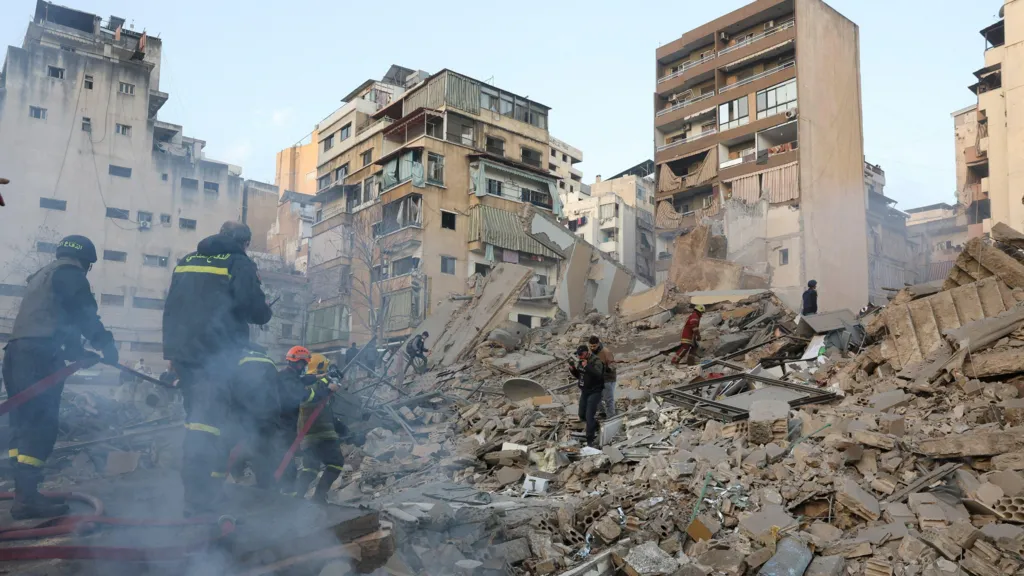
Several other airstrikes rocked the country's capital and suburbs overnight - including the neighbourhoods of Zuqaq al Blat and Basta.
No warning was reported ahead of those earlier strikes, which officials said killed 12 people and wounded 27.
The escalation marks a widening of Israeli strikes beyond the southern suburbs into central Beirut, following the start of the latest phase of the conflict earlier this month.
Israel says it is targeting not only Hezbollah fighters and leaders, but also businesses it claims are linked to the group and help finance its military operations.
In the early days of this conflict, Israel was mainly bombing targets in the Hezbollah stronghold of south Beirut known as Dahieh.
That part of the city continues to be bombed relentlessly, forcing thousands to flee their homes and reducing parts of the city, in the words of some locals, to a scene "resembling Gaza".
But Israel is now, with increasing regularity, targeting other parts of Beirut - sometimes with prior warning, on other occasions without warning in what appear to be targeted assassinations.
Israel says it is committed to destroying financial structures and institutions linked to Hezbollah, including the Al Qard Al Hassan "bank" which has offices across the city and many of which have been blown up, sometimes with repeated airstrikes.
On at least two occasions, Israel has also struck hotels in other parts of the capital - either with precision strikes or blanket bombing - in what are believed to be assassination attempts against Hezbollah figures or individuals linked to Iran.
Often, civilians are killed too.
One reported Israeli "double tap" airstrike - where a location is hit twice in quick succession - on a car near Beirut's Corniche seafront last week killed at least 12 people, many of them said to be displaced people from elsewhere in the country who had been sheltering in tents on the seafront.
The regional conflict began on 28 February, when Israel and the US attacked Iran, triggering retaliatory Iranian strikes at Israel and sites in US-allied Middle Eastern countries. Hezbollah drew Lebanon into the conflict two days later.
Latest Stories
-
2026 U-20 WWC: Sarah Nyarko targets knockout stages with Black Princesses after victory over South Korea
6 minutes -
President Mahama warns: Poor refereeing, match manipulation are destroying Ghana football
24 minutes -
Businessman rejects GH¢79.7m judgment windfall – He says actual claim was below GH¢10m
29 minutes -
Mahama calls on GFA, clubs to raise standard of domestic football
30 minutes -
Ghana’s Rahim Ibrahim makes Champions League debut in PSG thrashing
54 minutes -
Tariq Lamptey suffers another injury setback at QPR
1 hour -
PRESEC, Augusco and Accra Academy battle for 2026 NSMQ crown today
1 hour -
GH₵12 addition to cement price: GPHA clarifies attribution to port congestion
1 hour -
Pythagoras won’t balance your books
2 hours -
Pay me by Sept. 11 or face the court – Kow Essuman demands salary, benefits from Finance Minister
2 hours -
Bawumia’s destiny lies in the hands of God; not you – Muslim Forum for Peace and Unity replies Rev. Owusu Bempah
2 hours -
NPP NEC meets today to discuss and approve party’s position paper on Constitution Review proposals
2 hours -
Today’s frontpages: Thursday, September 10, 2026
2 hours -
Ghana Garden and Flower Show returns on Sept 11 with focus on green jobs, business and wellbeing
2 hours -
Titus-Glover camp says Mustapha Salam wasn’t pressured to withdraw from National Organiser race
2 hours