

Audio By Carbonatix
While recent data indicates an improvement in some economic buffers, a development economist has urged caution against declaring the economy fully resilient.
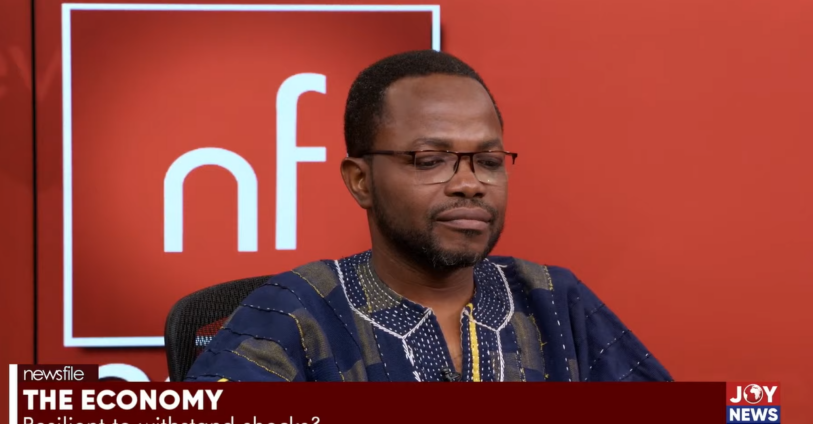
Prof Fred Dzanku is arguing that true resilience requires long-term structural strength beyond short-term stability.
The fellow at the Institute of Statistical, Social and Economic Research (ISSER), University of Ghana, shared his analysis on JoyNews’ Newsfile on Saturday.
Prof Dzanku's comments come in the wake of assertions by the President that the economy has become more resilient.
“Well, I think that it's always important to, as I say, go back to the fundamentals,” Prof. Dzanku stated. He explained that a resilient economy is one that can absorb shocks without significant swings in key indicators such as inflation, exchange rates, and growth.
To assess this, he outlined three critical benchmarks: shock absorption capacity, transmission mechanisms, and the long-term nature of resilience.
On the first benchmark of shock absorption, Prof. Dzanku noted a mixed picture. He pointed to the country’s fiscal space, foreign exchange reserves, and debt sustainability as key components.
“On these three, the president seems, I mean, suggests, and as the data shows, that at least for reserves, we are at a better position than we were a couple of years ago,” he acknowledged.
However, he raised a red flag regarding the nation’s fiscal space. “Fiscal space is not looking good, right? Because you have a situation where your tax to GDP is still low, around 15 percent, and it's been so for some time. What it means is that your economy is not generating enough revenue,” he explained.
Regarding the second benchmark, transmission mechanisms—the economist highlighted how external shocks, such as fluctuations in oil prices, quickly permeate the Ghanaian economy.
Citing analysis from ISSER, Prof. Dzanku noted that when economic fundamentals are weak, the transmission of these shocks tends to be “very fast.” He provided a stark example: “For about a 10 percent increase in fuel prices, you see, I mean, inflation going up, food inflation going up to about 6 percent,” often within two months as it feeds into transportation costs.
Despite the positive signs in reserves, Prof. Dzanku concluded that the economy has not yet achieved true resilience, warning against conflating short-term stability with long-term durability.
“Resilience is not just a short-term phenomenon. It's something that you build into the system over a long period of time,” he emphasized. “So, we are not yet resilient, particularly depending on how long the crisis will last.”
He characterized the current state as a step in the right direction but not the final destination. “I would say that stability is necessary, but it's not resilient. It's a step towards resilience, and at this point, I would say that our buffers, some of it are looking good, others are not looking great, and therefore we still should be worried.”
Latest Stories
-
Conflicts among care providers linked to maternal, neonatal deaths – Expert
53 minutes -
GIS marks 10th TIME conference, champions improved teaching practices
1 hour -
BRICS Or Balance? What Ghana’s bid really means
1 hour -
GPRTU wants full TRAFFITECH-GH implementation to start in 2027
2 hours -
Mahama announces plans to import electric wheelchairs for PWDs
2 hours -
KGL U17 Colts 2026: Western beat Prempeh Elite Academy to set up final final with Greater Accra Region
2 hours -
Late Solanke strike salvages 10-man Spurs draw at Man United
2 hours -
Gender Ministry to monitor welfare of Nana Akua Addo’s children amid domestic violence case
2 hours -
Benedict Okyere Yeboah: Ghana’s football problem goes beyond sacking a coach
3 hours -
GPL 2026/27: Darkwah Wiafe’s winner sees All Blacks beat Kotoko
3 hours -
ITF World Tour : Patel Wins Boys’ Singles Final at J100 Accra
3 hours -
Ghana must pursue BRICS partnership if it brings economic benefits – Kpebu
3 hours -
Success and Wright Claims J100 Accra Girls’ Doubles Championship
3 hours -
ITF J100: America’s Wright wins J100 Accra Girls’ Singles Title
3 hours -
Expedition hopes to find aviator Amelia Earhart’s plane on remote island
3 hours