

Audio By Carbonatix
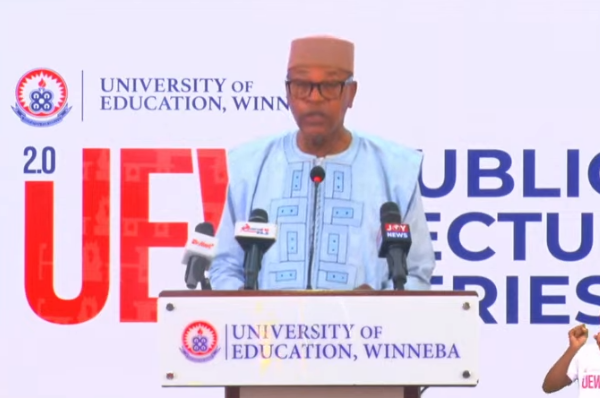
The African Union High Representative for Silencing the Guns, Dr. Mohammed Ibn Chambas, has called for a national shift in attitudes towards technical and vocational education, stressing that artisans and skilled workers are central to Ghana’s long-term development.
Delivering a keynote address at the 2026 Public Lecture Series at the University of Education, Winneba on Friday, April 10, Dr. Ibn Chambas said Ghana must reframe how it values practical skills if it is to build a self-reliant and industrialised economy.
Elevating skilled professions
“We need a national mindset shift that celebrates the plumber, the electrician, the solar engineer, technician, the agro-processor, and the artisan as national assets,” he stated.
He described such professionals as “the backbone of an industrialised, self-reliant Ghana,” urging policymakers, educators, and society at large to move away from the long-held perception that Technical and Vocational Education and Training (TVET) is inferior to academic pathways.
According to him, recent trends suggest progress, noting that enrolment in TVET institutions has increased significantly in recent years.
“With TVET schools recording an almost 100 per cent increase in enrolment to about 14,000 in the last few years, the perception that TVET is a second-class option is hopefully gradually changing,” he said.
Building resilience through education
Beyond skills development, Dr Ibn Chambas emphasised the importance of resilience as a core objective of modern education.
“Education must prepare learners for uncertainty,” he noted, highlighting the need for climate literacy, digital competence, critical thinking, and mental well-being.
He explained that a resilient learner is one who can “adapt, unlearn, and relearn,” qualities he described as essential in an era defined by rapid technological change and global uncertainty.
Climate change as a present reality
Dr. Ibn Chambas also drew attention to the growing impact of climate change on Ghana, warning that it is no longer a distant or abstract concern.
“Climate change is not a distant threat to Ghana. It is our current reality,” he said.
He cited rising sea levels threatening coastal communities, erratic rainfall patterns affecting agricultural productivity, and recurring floods and droughts disrupting livelihoods across the country.
Referencing urban experiences, particularly in Accra, he highlighted the contrasting realities faced by different groups.
“Many times when it is about to rain, some of us in Accra are wishing it does not because of the threat that floods will pose, whereas many farmers will be yearning for it,” he observed.
Call for forward-looking education reform
Dr. Ibn Chambas noted that Ghana’s education system must not only equip students with knowledge but also prepare them to navigate uncertainty, respond to environmental challenges, and contribute meaningfully to national development.
Latest Stories
-
+233 to host Pat Thomas’ 80th birthday concert
8 minutes -
EPA warns climate resilience plans face $22.6bn financing demand
8 minutes -
Today’s front pages: Tuesday, September 22, 2026
9 minutes -
Alan: ‘NPP has abandoned values of UP tradition, but I believe in those values’
10 minutes -
Sustaining economic gains is Mahama’s real test – Alan Kyerematen
12 minutes -
‘We won political independence, but global power remained elsewhere’ – Mahama
19 minutes -
Mahama to take Accra Reset agenda into AU framework in 2027
21 minutes -
Drugs cases disgracing Ghana before the world – Catholic Bishops Conference tells Government
30 minutes -
Accra Reset must move from ‘design to execution’ – Mahama
44 minutes -
Dangote praises Mahama’s handling of Ghana’s economic recovery
49 minutes -
Mexico beckons as Ghana calls 20 to chase World Cup glory
59 minutes -
The Air we cannot see: Why Ghana must start taking its atmosphere seriously
1 hour -
The Hidden Balance Sheet: Why Ghana’s buy-now-pay-later boom is a household solvency problem, not a consumer convenience story
2 hours -
Prof. Kwofie urges publishers to use indigenous knowledge systems to decolonise AI
8 hours -
NDC’s two years of economic gains not enough to establish stability – Alan Kyerematen
8 hours