

Audio By Carbonatix
Ghana has begun processes to endorse the Political Declaration on Strengthening the Protection of Civilians from the Use of Explosive Weapons in Populated Areas (EWIPA).
The move forms part of the country’s broader commitment to strengthening civilian protection and enhancing regulatory frameworks governing arms and security.
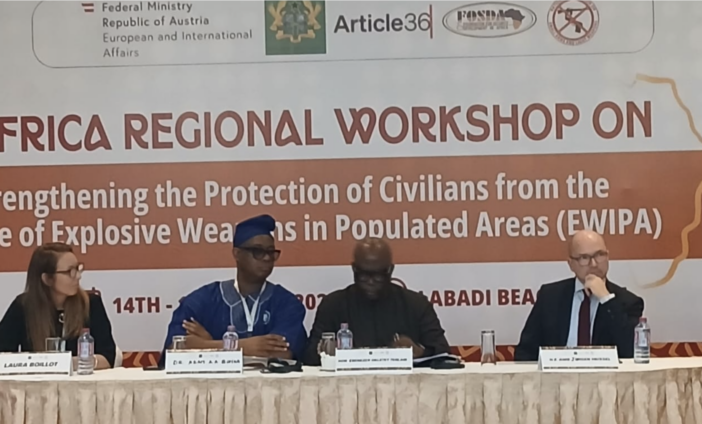
Mr Ebenezer Okletey Terlabi, Deputy Minister of the Interior, disclosed this at the opening of a two-day Africa Regional Workshop on Strengthening the Protection of Civilians from the Use of Explosive Weapons in Populated Areas in Accra.
“As a nation that has consistently championed African unity, multilateralism, and peaceful dispute resolution, we recognise that our voice must be matched by our actions. We have therefore triggered the process of getting Ghana to endorse the EWIPA declaration within the shortest possible time,” he said.
Mr Terlabi explained that although the declaration was not legally binding, it carried significant moral and political weight and aligned with Africa’s peace and security priorities.
He noted that Ghana’s ongoing review of its draft National Arms Bill and National Control List demonstrated its commitment to strengthening the regulatory architecture underpinning civilian protection.
The EWIPA declaration, adopted in Dublin in November 2022, seeks to reduce civilian harm during armed conflict by encouraging states to restrict or refrain from the use of explosive weapons with wide area effects in populated areas.
It also promotes improved data collection, victim support, humanitarian access and stronger international cooperation.
Currently, 91 states have endorsed the declaration, including 14 African countries, with Nigeria being the latest.
Mr Terlabi stressed the need for African countries to take a unified approach to shaping global norms on civilian protection, citing devastating humanitarian consequences in Gaza, Sudan, Ukraine and Myanmar.
“The consequences do not end with an immediate blast but linger on as entire generations are scarred by injuries, deaths, displacement and trauma,” he said.
Mr Terlabi said that although Ghana had not experienced armed conflict involving explosive weapons, incidents such as the Konongo and Abieti explosions underscored the country’s vulnerability and the need for proactive measures.
He urged participants to approach discussions with urgency and unity, warning that civilian protection was not merely a technical or legal obligation but a reflection of national values.
Mr Jurgen Heissel, Austrian Ambassador to Ghana, said the declaration provided a practical framework for states to strengthen civilian protection and mitigate the impact of explosive weapons.
“The EWIPA declaration offers a practical toolbox for states to do better in protecting their population from civilian harm,” he said.
Dr Adam Bona, Executive Secretary of the National Commission on Small Arms and Light Weapons, called for stronger African leadership and practical action, stressing that Africa was not immune to the effects of explosive weapons in populated areas.
“The question is not whether Africa has a stake in this declaration, but how we engage with it in ways that strengthen military doctrine, improve civilian harm tracking, and enhance victim assistance,” he said.
Laura Boillot, Director of Article 36, emphasised that the use of explosive weapons in populated areas caused predictable and preventable harm.
“When explosive weapons are used in towns and cities, the harm to civilians is not accidental. It is predictable, and it is preventable,” she said.
The two-day workshop, co-hosted by Ghana and Austria in collaboration with Article 36 and the Foundation for Security and Development in Africa (FOSDA), is expected to explore measures for adapting military doctrine, improving civilian harm tracking, strengthening victim assistance and enhancing regional cooperation.
Participants will also share experiences and develop strategies for advancing implementation of the EWIPA declaration across Africa.
Latest Stories
-
Kodua dismisses rift fears, says he and John Boadu are focused on NPP victory
1 hour -
Why Canada is preparing for a (long shot) US invasion
2 hours -
Dangote’s planned Kenya refinery faces legal challenge by consumer-rights group
2 hours -
Hawa Koomson stands by pepper spray plan, vows to bring rival on board
2 hours -
‘There is no competition’ – Justin Kodua confident of NPP General Secretary re-election
3 hours -
J100 Accra Doubles Champions : Kolesolva/ Ndukwa, Agarwal/Patel seal title victories
3 hours -
Sydney Wright crowned J100 Accra Champion
3 hours -
J100 Accra Boys’ Singles: Verma denies Beckles back-to-back titles to claim crown
3 hours -
Two friends fined GH¢12,000 for stealing
3 hours -
Son jailed for threatening to stab mother
3 hours -
Drive constitutional reform – GJA urges journalists
4 hours -
NPP Delagates Congress: Confusion delays voting at Ashanti Region TESCON centre
5 hours -
Fire ravages shops, houses near Koforidua Central Police Station
5 hours -
NPP Delegates conference: The wisdom of the masses will prevail – Napo
5 hours -
Flydubai co-pilot attacked captain with axe, UAE official says
5 hours