

Audio By Carbonatix
The World Bank has lauded Ghana’s macroeconomic stabilisation efforts, expressing its readiness to back initiatives that align with the country’s long-term growth agenda.
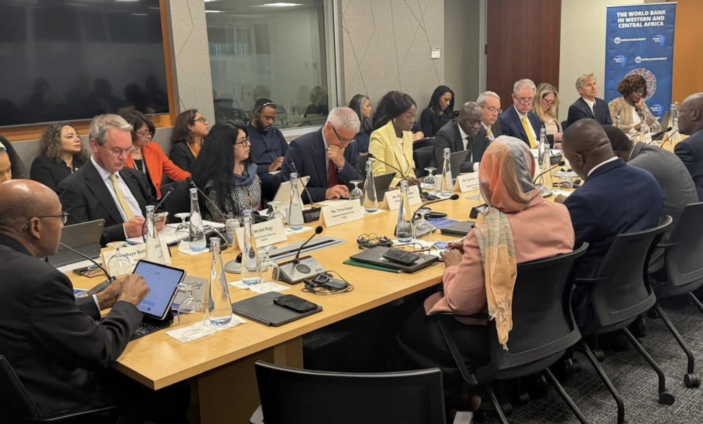
Mr Ousmane Diagana, the World Bank Vice President for Western and Central Africa, highlighted the energy and agriculture sectors as the Bank’s priority areas under the new Country Partnership Framework.
He said this when he met with Dr Cassiel Ato Baah Forson, the Finance Minister, at the ongoing 2026 World Bank Group (WBG)/International Monetary Fund (IMF) Spring Meetings in Washington.
Mr Diagana said macroeconomic stabilisation was essential for unlocking investment and ensuring that Ghana’s reforms delivered tangible benefits to households and businesses.
Meanwhile, Ghana’s economic recovery story took centre stage at the ongoing IMF/WBG, as the Finance Minister presented the country’s turnaround experience at the 13th African Fiscal Forum’s High-Level Roundtable.
Addressing the session on “Macro-Fiscal Developments and Outlook in Sub-Saharan Africa,” Mr Forson said the country’s experience over the past 15 months demonstrated that African economies could navigate and leverage crisis for deep structural reform.
He recalled that Ghana faced severe economic challenges in 2022/2023, but a combination of bold policy measures and sustained reforms since 2025 had helped to restore macroeconomic stability and rebuilt the fundamentals of the economy.
He cited strong improvements across key macroeconomic indicators, including real Gross Domestic Product (GDP) growth, which rose to six per cent in 2025, up from 5.8 per cent in 2024 as an example.
The Minister mentioned inflation declining from 23.8 per cent in 2024 to 5.8 per cent in 2025, falling further to 3.2 per cent as of March 2026, and the cedi appreciating by more than 40 per cent against the US dollar in 2025, with gains continuing into 2026.
On the fiscal front, Dr Forson noted that Ghana’s primary balance, measured on a commitment basis and serving as the country’s fiscal anchor, improved from a deficit of 2.9 per cent of GDP to a surplus of 2.6 per cent of GDP in 2025.
He said public debt levels had declined markedly, with the debt-to-GDP ratio falling from 61.8 per cent to 45.3 per cent at the end of 2025 – well ahead of the initial 2034 target.
The country’s international reserves have strengthened, now covering 5.8 months of imports, while policy credibility has been reinforced through stronger institutions and the adoption of clear fiscal rules.
Dr Forson emphasised disciplined fiscal management, which the gains reflected, and a deliberate strategy to anchor economic policy in credible institutions, ensuring sustainability over the medium term.
Latest Stories
-
Food inflation never responded – Dr Yamson says Ghana must stop throwing money at short-term fixes
43 minutes -
Oil set for second weekly rise as unsettled US-Iran war crimps supply
1 hour -
US teen drops lawsuit against Meta, Google and Snap ahead of trial
1 hour -
Meghan could return to acting once back in UK
1 hour -
Bali jails Swiss tourist for insulting sacred Day of Silence
1 hour -
At least 50 killed, mostly children, as overloaded boat capsizes in Nigeria
2 hours -
Cameroon president returns home after 10-week absence
2 hours -
Stability must last 10 years, not 4 – Dr Yamson challenges gov’t to make boom-bust economy last
2 hours -
Tunisia opposition protests against president amid economic discontent
2 hours -
Nii Lante Vanderpuye apologises to Sammy Gyamfi, NDC over GoldBod comments
4 hours -
US sanctions more Cuban companies and officials
4 hours -
There is something different this time – Dr Yamson hails Mahama govt’s economic management
5 hours -
Gold for Reserves has risky, but necessary – Dr Yamson backs Mahama govt’s gold strategy
5 hours -
‘You want the trade, but not the people?’ – Dr Yamson tears into South Africa’s xenophobia
5 hours -
Walmart sales under strain as US shoppers pull back
6 hours