

Audio By Carbonatix
Government is advancing reforms to make Technical and Vocational Education and Training (TVET) more digital, inclusive and demand-driven despite persistent infrastructure gaps.
The reforms target digitalisation, expansion of dual TVET pathways and increased female participation, alongside measures to align training with labour market needs and improve access across institutions.
Madam Wilma Titus-Glover, Principal Programmes Officer for Inclusive Education at the Ministry of Education, announced this at a forum on TVET delivery and inclusion at the pre-tertiary level in Ghana in Accra.
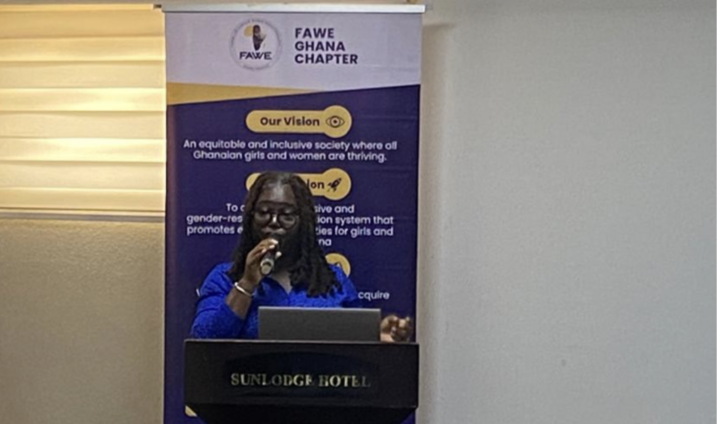
The event, organised by the Forum for African Women Educationalists (FAWE) Ghana Chapter with support from the Mastercard Foundation, aimed to popularise the Gender Responsive Pedagogy for TVET model and build stakeholder consensus for its adoption.
Madam Titus-Glover said the Ministry, through the TVET Directorate, oversaw the sector, with the Commission for Technical and Vocational Education and Training (CTVET) as regulator and the TVET Service managing pre-tertiary delivery.
She said the Free TVET Policy had expanded access, with 231 public institutions enrolled nationwide, and enrolment rising from 32,407 in the 2020/21 academic year to 50,049 in 2022/23, indicating growing interest in skills-based education.
Madam Titus-Glover said 108 Competency-Based Training programmes were currently available, with 115 more under development to meet industry needs.
However, infrastructure and inclusion gaps persisted, with nearly 25 per cent of institutions reporting poor classroom conditions and 73.6 per cent lacking adequate assistive devices for learners with special needs.
Madam Titus-Glover said some institutions relied on community or private workshops for practical training.
She said the government was implementing interventions such as the Ghana TVET Voucher Project and the Ghana Jobs and Skills Project to support apprentices and master craft persons, particularly in the informal sector.
Presenting gender gaps and system challenges, Madam Hannah Okyere, Principal Manager, Policy Planning, Project Research, Monitoring and Evaluation at CTVET, said disparities remained in access, participation and employment outcomes.
She said females constituted about 36 per cent of TVET enrolment, with less than 20 per cent in technical fields.
Madam Okyere attributed the gaps to cultural norms, weak policy implementation, limited female role models and inadequate gender-sensitive infrastructure, noting that poor sanitation, safety concerns and lack of mentorship affected retention.
She called for stronger gender policies, improved infrastructure, increased female participation in non-traditional trades and the use of gender-disaggregated data to guide decisions.
Madam Dora Mochiah, Programmes Officer, FAWE Ghana, presenting on the Digitised Gender Responsive Pedagogy Tool, said the training resource was designed to improve teaching and learning by making education more inclusive, equitable and responsive to the needs of both girls and boys.
She said the free, self-paced online course was developed jointly by FAWE Ghana, UNICEF and the UNESCO International Institute for Capacity Building in Africa, based on FAWE’s Gender Responsive Pedagogy Toolkit.
Madam Mochiah said the course covered 12 thematic areas, including human rights, learner-centred pedagogy, gender-responsive language, classroom management, sexual and reproductive health, gender-based violence, stakeholder engagement and monitoring and evaluation.
She said the approach sought to go beyond equal access by transforming harmful attitudes, norms and power structures that created inequality in education systems.
In remarks at the forum, representatives from the Ghana Tertiary Education Commission, the Ministry of Education and partner institutions described gender-responsive TVET as critical to Ghana’s human capital development and the attainment of Sustainable Development Goal Four on quality education.
They said initiatives that strengthened pedagogy, improved learning outcomes and widened participation of young women deserved the support of all stakeholders.
The representatives reaffirmed their commitment to inclusive access, stronger collaboration and evidence-based reforms to improve quality outcomes across Ghana’s TVET system.
Latest Stories
-
GAEC must retain nuclear scientists for Ghana’s nuclear ambitions – Minister
8 minutes -
Man reportedly mistaken for game and shot by hunter dead in forest
10 minutes -
19-year-old mason jailed 15 years for defiling seven-year-old pupil
15 minutes -
Ghana’s banking sector assets rise 20.47% to GH¢500.2bn – BoG Governor
19 minutes -
22 injured as Sprinter bus overturns at Sege after tyre burst
20 minutes -
UN housing expert urges Ghana to strengthen Rent Control Department amid housing affordability concerns
29 minutes -
Delta-BCI partnership reaches 166,000 people with breast cancer education
38 minutes -
Power restoration fault suspected in Kumasi Central Market fire
6 hours -
The 7-foot giant of Ngleshie Amanfro: Seven-foot Ghanaian Ephraim Saawa dreams of joining the national basketball team
6 hours -
Government promises support for Kumasi Central Market fire victims
7 hours -
Vibes The Movie: Big Ghun’s Ghanaian film earns five nominations at 2026 REFFA
7 hours -
‘I’m a fulfilled man’—Justice Korbieh on missing out on Supreme Court despite two nominations
7 hours -
MamaCare CEO warns unresolved conflicts among health workers could undermine maternal and neonatal care
7 hours -
Health professionals urged to translate medical knowledge into practice to save mothers
8 hours -
Retired judge Justice Francis Korbieh charges 1,568 new lawyers to uphold integrity
9 hours