

Audio By Carbonatix
Amsterdam has become the world's first capital city to ban public advertisements for both meat and fossil fuel products.
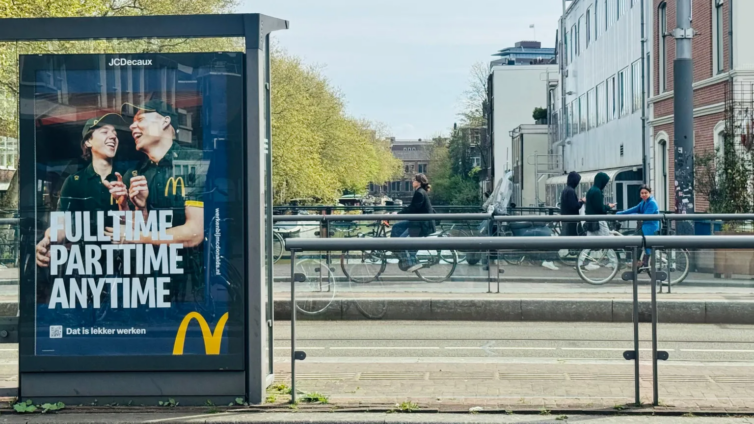
Since 1 May, adverts for burgers, petrol cars and airlines have been stripped from billboards, tram shelters, and metro stations.
At one of the city's busiest tram stops, adjacent to a grassy roundabout bursting with vibrant yellow daffodils and orange tulips, the poster advertising landscape has changed.
They now promote the Rijksmuseum, the Netherlands' national museum, and a piano concert. Until last week, it was chicken nuggets, SUVs and low-budget holidays.
Politicians in the city say the move is about aligning Amsterdam's streetscape with the local government's environmental targets.
These aim for the Dutch capital to become carbon-neutral by 2050 and for local people to halve their meat consumption over the same period.
"The climate crisis is very urgent," says Anneke Veenhoff from the GreenLeft Party. "I mean, if you want to be leading in climate policies and you rent out your walls to exactly the opposite, then what are you doing?
"Most people don't understand why the municipality should make money out of renting our public space with something that we are actively having policies against."
This view is echoed by Anke Bakker, the Amsterdam group leader for the Dutch political party Party for the Animals, which focuses on animal rights.
She instigated the new restrictions and rejects accusations that they are nanny-state.
"Everybody can just make their own decisions, but actually we are trying to get the big companies not to tell us all the time what we need to eat and buy," says Bakker.
"In a way, we're giving people more freedom because they can make their own choice, right?"
Removing that constant visual nudge, she says, both reduces impulse buying and signals that cheap meat and fossil-heavy travel are no longer aspirational lifestyle choices.
Meat was a relatively small slice of Amsterdam's outdoor advertising market – accounting for an estimated 0.1% of ad spend, compared with roughly 4% for fossil-related products.
The advertising was instead dominated by clothing brands, movie posters, and mobile phones.
But politically, the ban sends a message. Grouping meat with flights, cruises and petrol and diesel cars reframes it from a purely private dietary choice to a climate issue.
Unsurprisingly, the Dutch Meat Association, which represents the industry, is unhappy at the move, which it calls "an undesirable way to influence consumer behaviour". It adds that meat "delivers essential nutrients and should remain visible and accessible to consumers".
Meanwhile, the Dutch Association of Travel Agents and Tour Operators says that the ban on advertising holidays that include air travel is a disproportionate curb on companies' commercial freedom.
For activists like lawyer Hannah Prins and her environmental organisation Advocates for the Future, which worked closely with campaign group Fossil-Free Advertising, the ban on meat advertising is a deliberate attempt to create a "tobacco moment" for high-carbon food.
"Because if I look back now at old pictures, you have Johan Cruyff," says Prins. "The famous Dutch footballer.
"He would be in advertisements for tobacco. That used to be normal. He died of lung cancer.
"That you were allowed to smoke on the train, on restaurants. For me, that's like, whoa, why did people do that? You know, that feels so weird.
"So it really is like what we see in our public space is what we find normal in our society. And I don't think it's normal to see murdered animals on billboards. So I think it's very good that that's going to change."

The Dutch capital is not starting from scratch.
Haarlem, 18km (11 miles) to its west, was in 2022 the first city in the world to announce a broad ban on most meat advertising in public spaces. It came into force in 2024, together with a prohibition on fossil fuel adverts.
Utrecht and Nijmegen have since followed with their own measures that explicitly restrict meat (and in Nijmegen's case also dairy) advertising on municipal billboards, on top of existing bans on adverts for fossil fuels, petrol cars and flying.
Globally, dozens of cities have, or are moving to, ban fossil-fuel advertising. Such as Edinburgh, Sheffield, Stockholm and Florence. France even has a nationwide ban.
Campaigners hope that the Dutch approach - linking meat and fossil fuels - will act as a legal and political blueprint others can copy.
Stand at a tram stop in Amsterdam, and you might no longer see a juicy burger or a 19 euro ($18.70; £14.90) flight to Berlin on the shelter.
Yet the same eye-catching offers can still pop up in your social media algorithm. And, let's face it, many of us would be looking down at our screens until the tram trundles along.
If municipal bans leave digital platforms untouched, how much real-world impact can they have on our habits or are they purely symbolic virtue-signalling?

So far, there is no direct evidence that removing meat advertising from public spaces leads to a shift toward more plant-based societies.
However, some researchers are cautiously optimistic, such as Prof Joreintje Mackenbach, who is an epidemiologist - a medical professional who investigates health patterns within populations.
She describes Amsterdam's move as "a fantastic natural experiment to see".
"If we see advertisements for fast food everywhere, it normalises the consumption of fast consumption," says Mackenbach, who is from the Department of Epidemiology and Data Science at the Amsterdam University Medical Centre.
"So if we take away those types of cues in our public living environments, then that is also going to have an impact on those social norms."
She points to a study which claims that London Underground's 2019 ban on junk food adverts led to fewer people buying such products in the UK capital.
Smiling on the banks of a canal in the centre of Amsterdam, Prins is adamant that smaller specialist tradespeople in Amsterdam will benefit from the new advertising ban.
"Because like everything we love, festivals, nice cheese, a flower shop around the corner. All the stuff that we love, we don't hear about through ads," she says.
"It's usually through people that we know, or we walk past the building. So I think local businesses will be able to thrive because of this.
"I think, and I hope, that big polluting companies will be extra scared. And maybe will rethink the kind of products they are selling. I think you can really see that change is possible."
Latest Stories
-
Chef Abbys: Feeding 50,000 people, putting food security on Ghana’s agenda
21 minutes -
Ho set to host Republic Bank–JoyNews Habitat Fair as multiple firms prepare to showcase housing solutions
29 minutes -
NPP demands public inquiry into alleged $600,000 World Cup visa fraud, wants Sports Minister, GTA CEO summoned
36 minutes -
I want my brand to be bigger than just music – Yaw Wazinga
39 minutes -
Houthi missile attack on Yemeni presidential palace kills two, minister says
40 minutes -
I hoped to win an award; I worked hard – 2026 Best Graduating Law Student
50 minutes -
Fraudsters increasingly target bank customers instead of banking systems – Fraud detection expert
50 minutes -
44 teacher sexual abuse cases tracked since 2015; school heads feature in 40% of recent cases — JoyNews Research
53 minutes -
Unchecked imports and the Middle East crisis threaten Ghana’s fragile food inflation anchor
1 hour -
Ecobank Junior Saver Big Pitch to reward 10 winners with GH¢2,000 each
1 hour -
AMA demolishes unauthorised pigsty obstructing Agbogbloshie waste evacuation exercise
1 hour -
I was filled with disbelief – Akosua Achia Sarpong Esq. shares her first reaction
1 hour -
Snake Village: A look at Volta Region’s hidden snake village and its tourism potential (Video)
1 hour -
Election Watch Ghana calls for constitutional reforms to strengthen Electoral Commission independence
1 hour -
NACOC, Postal and Courier Services Regulatory Commission intensify efforts to curb drug trafficking
1 hour