

Audio By Carbonatix
The government has ruled out a return to the international capital markets for the remainder of 2026, marking a significant pivot in its economic strategy as the nation officially concludes its three-year bailout programme with the International Monetary Fund (IMF).
The announcement underlines a deliberate effort to break long-standing reliance on expensive external commercial borrowing. It follows a bruising debt restructuring process that saw the country locked out of global financial markets after a near-collapse of its economy in 2022.
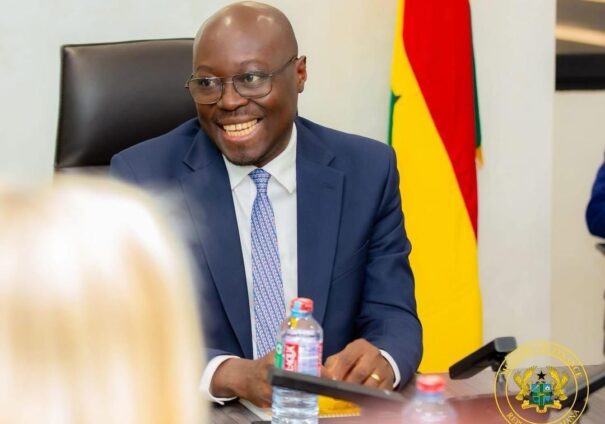
Speaking at a joint press conference with the IMF Mission in the capital, Accra, the Finance Minister, Dr Cassiel Ato Forson, revealed that the country will not pursue a successor financial bailout. Instead, the government intends to transition onto a non-financing IMF instrument known as the Policy Coordination Instrument (PCI).
The PCI is a framework designed to signal policy credibility and maintain macroeconomic discipline to the global market, but it carries no direct financial disbursements from the Fund. The move suggests growing confidence within the Mahama administration that the country has successfully navigated the emergency phase of its fiscal crisis.
Despite thawing investor relations and stabilising economic indicators, Dr Forson emphasised that fiscal sobriety would take precedence over the accumulation of new debt.
“We are not in a hurry to go unto the International Capital markets and if we find a need to go to the international capital markets we will accordingly inform the people of Ghana,” Dr Forson stated.
Eurobonds Off the Table
The decision to bypass the Eurobond market is already baked into the state's financial planning. The Finance Minister confirmed that the national treasury has intentionally insulated its current fiscal projections from the volatility of international debt markets.
“One thing is for sure, the 2026 budget never assumed that we are going to the international capital markets for any form of financing, so it is off the table for at least this year,” he disclosed.
The stance is expected to placate multilateral lenders and credit rating agencies, who have repeatedly cautioned Ghana against rushing back to commercial borrowing before fully anchoring its hard-won debt sustainability gains. However, the government has not shut the door permanently.
“In the medium term it will depend on what the government seeks to do so I can assure that we are not in a hurry to go back to the International capital markets,” Dr Forson added.
The caution is deeply rooted in recent history.
In 2022, a toxic combination of spiralling public debt, rapid depreciation of the cedi, and a collapse in investor confidence completely severed the country's access to international capital.
The resulting crisis forced the government into painful restructuring negotiations with both domestic bondholders and bilateral creditors to secure the $3bn IMF Extended Credit Facility.
By opting for the PCI, the government keeps the IMF in an oversight role, monitoring structural reforms and economic management, without adding new loans to the ledger.
The IMF appears supportive of Accra's cautious path. Addressing the media, the IMF Mission Chief to Ghana, Dr Ruben Atoyan, emphasised that the fund would not dictate the country's borrowing timeline.
“In terms of the access to the capital market, it is a sovereign decision for Ghana,” Dr Atoyan said.
For now, the economic managers are betting that internal discipline, rather than external commercial loans, will be the engine that powers the nation's post-bailout recovery.
Latest Stories
-
Black Sherif drops new 6-track EP ‘Sun Sherif’
38 minutes -
GTA partners Africa’s Brain Bank for Medical City groundbreaking
50 minutes -
How to check 2026 WASSCE results on mobile phone
56 minutes -
President Mahama is a professional comedian – DKB
1 hour -
Final day of Joy FM Back-to-School Fair: Come shop, save and prepare for the new school year
2 hours -
GSE showed strong performance in August 2026 despite recording more stock losses
4 hours -
If CJ needs ethics law to know SOE comments were wrong, he may not be worthy of office – Arthur Kennedy
5 hours -
Stop touring state agencies and focus on the Judiciary’s problems – Arthur Kennedy to CJ
5 hours -
Apologise and don’t do it again – Arthur Kennedy to Chief Justice over SOE comments
5 hours -
Chief Justice remains committed to judicial independence, justice and equality – Judicial Service
6 hours -
Ghana concludes evacuation of citizens from South Africa; total returnees reach 1,900 – Ablakwa
6 hours -
Africa must define its own green transition path – Prof Fatima Denton
6 hours -
WASSCE 2026: English Language performance falls to 62.4% – WAEC
7 hours -
WASSCE 2026: Social Studies records sharp rebound as Maths, Science also improve
7 hours -
2026 WASSCE entry rises by 11% as 512,862 candidates sit exams
7 hours