

Audio By Carbonatix
The World Health Organization (WHO) has declared an Ebola outbreak in the Democratic Republic of Congo's eastern Ituri province a public health emergency of international concern.
The agency added that the outbreak, with around 246 suspected cases and 80 deaths reported, does not meet the criteria of a pandemic emergency.
WHO director general Dr Tedros Adhanom Ghebreyesus warned there are currently "significant uncertainties to the true number of infected persons and geographic spread" of the outbreak.
The current strain of Ebola is caused by the Bundibugyo virus, the health agency said, for which there are no approved drugs or vaccines.
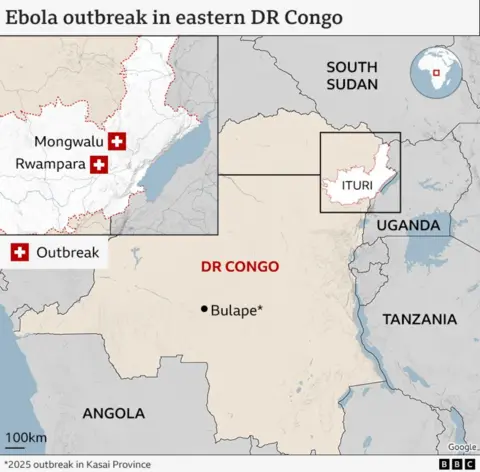
The WHO said there are now eight laboratory-confirmed cases of the virus, with other suspected cases and deaths across three health zones including Bunia the capital of Ituri province, and the gold-mining towns of Mongwalu and Rwampara.
The global health agency added the virus has spread beyond DR Congo, with two confirmed cases reported in neighbouring Uganda.
Ugandan officials said a 59-year-old man who died on Thursday had tested positive.
Countries bordering DR Congo are considered high risk for further spread due to population mobility, trade and travel.
The WHO advised that DR Congo and Uganda establish emergency operation centres to monitor, trace, and implement infection-prevention measures.
To minimise spread, the health agency said confirmed cases should be immediately isolated and treated until two Bundibugyo virus-specific tests conducted at least 48 hours apart are negative.
For countries bordering regions with confirmed cases, governments should enhance surveillance and health reporting.
The WHO added that countries outside the affected region should not close their borders or restrict travel and trade as "such measures are usually implemented out of fear and have no basis in science".
Ebola was first discovered in 1976 in what is now DR Congo, and is thought to have spread from bats. This is the 17th outbreak of the deadly viral disease in the country.
It is spread through direct contact with bodily fluids and through broken skin, causing severe bleeding and organ failure.
Early symptoms include fever, muscle pain, fatigue, headache and sore throat, and are followed by vomiting, diarrhoea, a rash and bleeding.
There is no proven cure for Ebola, with the average fatality rate is around 50%, according to the WHO.
Africa CDC previously said it was concerned by the high risk of further spread due to the urban settings of Rwampara and Bunia, and mining activities in Mongwalu.
The health agency's executive director Dr Jean Kaseya added that "significant population movement" between the affected areas and neighbouring countries also meant regional co-ordination was essential.
Around 15,000 people have died from the virus in African countries over the past 50 years.
DR Congo's deadliest outbreak was between 2018 and 2020, during which nearly 2,300 people died.
Last year, 45 people died after an outbreak in a remote region.
Latest Stories
-
Atta Akyea denies seeking presidential pardon for Wontumi in galamsey case
13 minutes -
Photos: Mahama commissions 85-bed Police Hospital ward, donates two ambulances
22 minutes -
GTEC directs Ghana’s public universities to reopen by October 16 and begin lectures on October 19
23 minutes -
Star Oil donates GH¢1million towards construction of new CID facility
27 minutes -
Court hands Adjetey Sowah, two others lifetime bans after Amputee Football legal dispute
36 minutes -
NDC appoints Julius Kwame Anthony as a Deputy Communications Director
37 minutes -
Ghana repatriates 120 Nigerians rescued from suspected cybercrime centres
41 minutes -
NPP rejects Emelia Agbenyo’s appointment as Deputy EC Chair, demands withdrawal
46 minutes -
EOCO grants Suame MP John Darko enquiry bail in GH¢27m SIC investigation
49 minutes -
NPP cannot question EC appointment after appointing own people to Commission – Kwakye Ofosu
55 minutes -
BoG deepens public trust with regional stakeholder forum in Techiman
1 hour -
‘We have turned the tide’ – Ato Forson says Ghana is ready to take off
1 hour -
Police arrest man captured in viral video assaulting wife in Agona Nkwanta
1 hour -
KATH Mother and Baby Unit construction stalled for 14 months over unpaid contractor arrears
1 hour -
Government wanted to ‘tilt the balance’ with new EC appointments – Kwakye Ofosu
2 hours