

Audio By Carbonatix
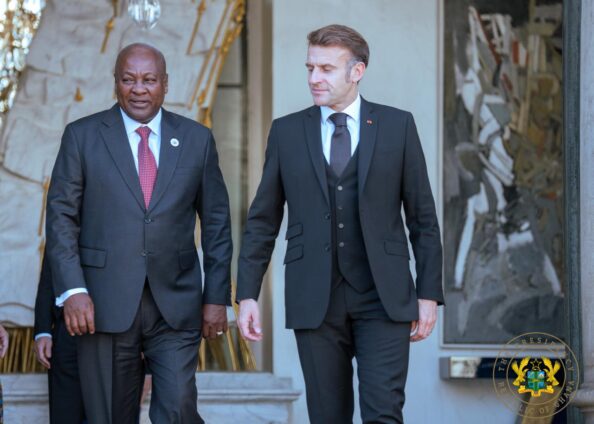
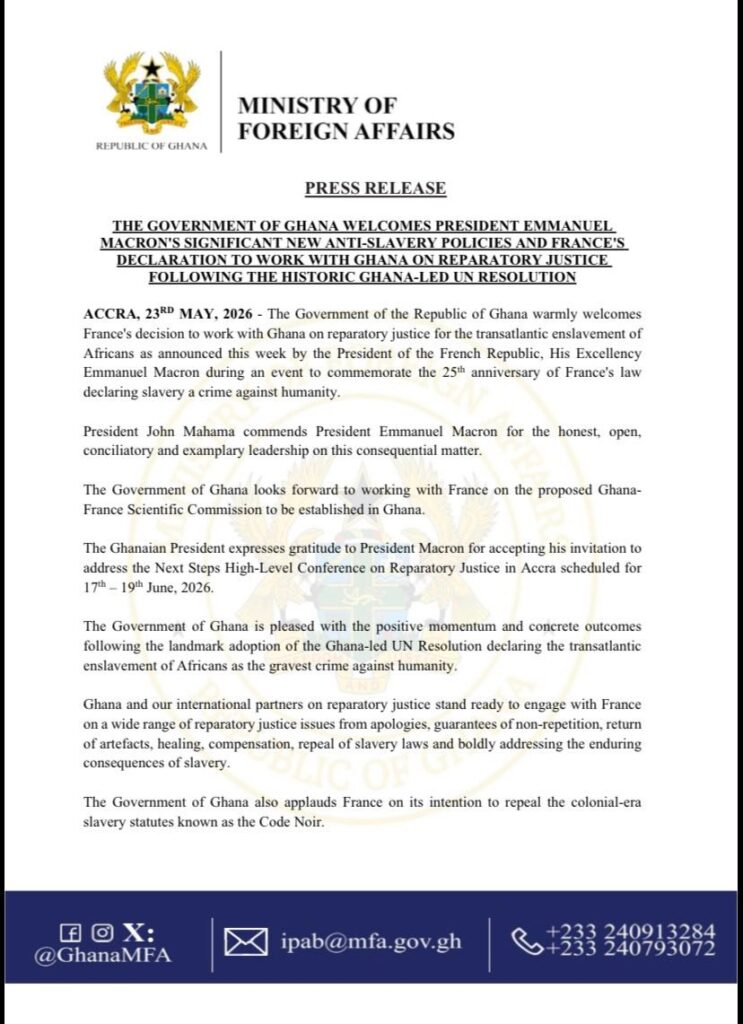
The Government of Ghana has welcomed what it described as a “historic and courageous” decision by France to engage in reparatory justice discussions over the transatlantic enslavement of Africans, following major policy announcements by French President Emmanuel Macron.
In a press release issued by the Ministry of Foreign Affairs on Friday, May 23, 2026, the government commended President Macron for what it called his “honest, open, conciliatory and exemplary leadership” on one of the most sensitive historical injustices confronting the global Black community.
The statement follows President Macron’s recent declaration during events marking the 25th anniversary of France’s law recognising slavery as a crime against humanity, where he announced new anti-slavery measures and signalled France’s readiness to work with Ghana on reparatory justice initiatives.
The Government of Ghana said the development represented an important milestone in the growing international movement seeking acknowledgement, redress and reconciliation over centuries of transatlantic slavery and colonial exploitation.
Ghana-France collaboration
According to the Foreign Affairs Ministry, Ghana looks forward to deepening cooperation with France through a proposed Ghana-France Scientific Commission expected to be established in Ghana.
The commission is expected to facilitate scholarly research, historical documentation and broader institutional cooperation on issues relating to slavery, reparatory justice and historical accountability.
President John Dramani Mahama, who currently serves as the African Union Champion on Reparatory Justice, also expressed appreciation to President Macron for accepting an invitation to participate in the upcoming “Next Steps” High-Level Conference on Reparatory Justice scheduled to take place in Accra from June 17 to June 19, 2026.
Je demande au gouvernement de faire sienne la proposition de loi visant à abroger le code noir. pic.twitter.com/qIksFz3HaM
— Emmanuel Macron (@EmmanuelMacron) May 21, 2026
The summit is expected to bring together Heads of State, ministers, diplomats, academics, civil society organisations and reparatory justice advocates from Africa, the Caribbean, Europe and the Americas.
Government officials say the conference will seek to move global conversations on reparations beyond symbolic acknowledgement towards concrete policy frameworks and sustained international engagement.
UN resolution
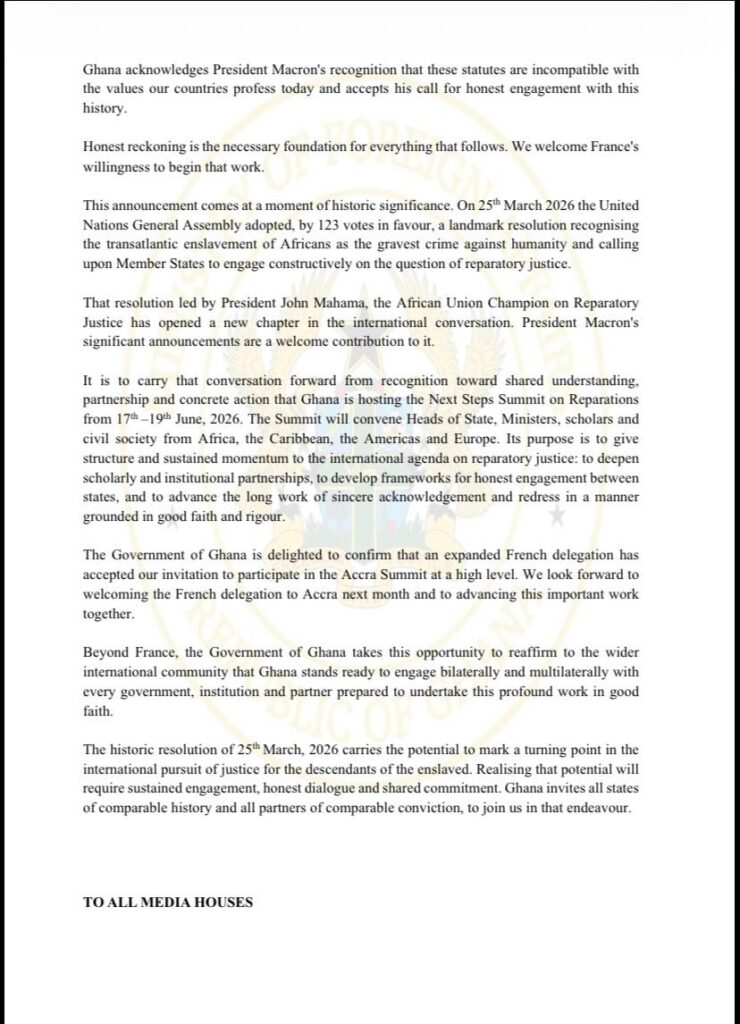
The Ministry noted that the latest developments followed the landmark adoption of a Ghana-led United Nations General Assembly resolution on March 25, 2026, which recognised the transatlantic enslavement of Africans as “the gravest crime against humanity.”
The resolution, adopted with the support of 123 member states, called on nations to engage constructively on reparatory justice and establish mechanisms for honest engagement with the enduring consequences of slavery.
Government described the resolution as a turning point in the international conversation on reparations.
Il y a 25 ans, la loi du 21 mai 2001 a reconnu et qualifié la traite négrière et l'esclavage dans sa vérité : un crime contre l'humanité. Cette loi venait de loin et était nécessaire.
— Emmanuel Macron (@EmmanuelMacron) May 21, 2026
Chère Christiane Taubira, merci de l'avoir portée avec courage, force et dignité. pic.twitter.com/4q07RbVNkB
“The historic resolution of 25th March, 2026 carries the potential to mark a turning point in the international pursuit of justice for the descendants of the enslaved,” the statement said.
It added that President Macron’s recent declarations were a welcome contribution to the momentum generated by the UN resolution and broader global advocacy efforts.
The statement indicated that Ghana and its international partners stood ready to engage France on a broad range of reparatory justice issues.
These include formal apologies, guarantees of non-repetition, compensation, return of stolen artefacts, repeal of colonial-era laws and long-term institutional partnerships aimed at addressing the enduring social and economic consequences of slavery.
The government also applauded France’s intention to repeal the “Code Noir” — the notorious colonial-era legal code introduced under King Louis XIV in the 17th century to regulate slavery within French colonies.
Ghana acknowledged President Macron’s recognition that such statutes were incompatible with modern democratic values and welcomed France’s willingness to openly confront its historical past.
“Honest reckoning is the necessary foundation for everything that follows,” the statement noted.
International momentum
The government further reaffirmed Ghana’s readiness to engage bilaterally and multilaterally with governments and institutions willing to pursue reparatory justice discussions in good faith.
Analysts say Ghana has increasingly positioned itself at the forefront of global reparatory justice advocacy through initiatives such as the “Year of Return,” “Beyond the Return” campaign and diplomatic engagements within the African Union and the United Nations system.
The Accra summit next month is expected to further strengthen Ghana’s role as a leading voice in international calls for historical accountability and restorative justice for descendants of enslaved Africans.
Latest Stories
-
Heritage Series Cedi notes to modernise cedi while preserving national identity – BoG
12 minutes -
Ghana’s business environment at ‘Inflection Point’ as private Sector takes greater lead — Vish Ashiagbor
19 minutes -
At least 2 new airlines could join domestic aviation market by 2027 – GCAA Director General
28 minutes -
What if Ghana’s next tourism boom begins with Ghanaians?
49 minutes -
Energy Commission to monitor EV charging stations
52 minutes -
Invest with confidence, Ghana’s golden era is beginning – Finance Minister
1 hour -
Do Ghana to launch The Great Ghana Day Out on World Tourism Day
1 hour -
Clean up our politics before politics cleans us up
2 hours -
2025 was a turning point, says Abradu-Otoo as NAFCO posts record GH¢91.7m profit
2 hours -
Today’s front pages: Friday, September 25, 2026
2 hours -
‘FA President has four clubs; what do you think he would do?’ – Nana Baffour Awuah fires back
3 hours -
Kurt Okraku doesn’t like criticism, but Ghana football is beyond him – Nana Baffour Awuah
3 hours -
Ghana’s Liquidity Paradox: Why capital is not reaching productive businesses
3 hours -
Ghana football has collapsed under Kurt Okraku – Manhyia South MP
3 hours -
Mr John Blankson Adu Otu
4 hours