

Audio By Carbonatix
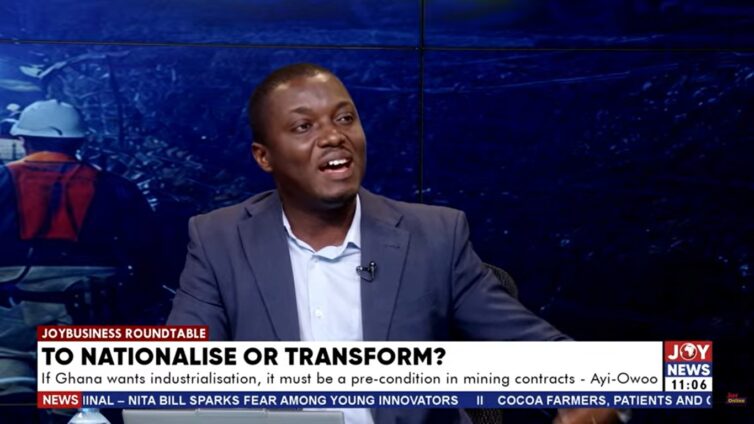
A Partner at Deloitte Ghana, Gideon Ayi-Owoo, has called for stronger and more forward-looking policy frameworks to improve Ghana’s extractive sector and ensure balanced benefits for all stakeholders.
Speaking at a high-level discussion hosted by Joy Business in Accra on Tuesday, May 26, under the theme “To Nationalise or Transform? Rethinking Ghana’s Approach to Mining, Oil and Critical Minerals”, Mr Ayi-Owoo stressed that the long-term sustainability and competitiveness of the sector depend largely on the quality and consistency of policies governing it.
According to him, the extractive industry requires deliberate policy alignment to create a stable and predictable environment that supports long-term planning, responsible investment, and shared prosperity across the value chain.
“We just have to have a good policy in place so that whatever decision we are going to take, it benefits everyone,” he said.
Mr Ayi-Owoo urged the government to introduce clear and bold policy guidelines governing the renewal of mining leases to reduce uncertainty in the sector.
“The government should come out with a very clear, bold guideline policy that will say that these are the conditions under which I am going to renew, so that if the old or the current owner fulfils, it is very clear,” he stated.
He further argued that if Ghana intends to pursue industrialisation through mining, the requirement should be explicitly embedded in mining agreements and lease conditions.
“If you want industrialisation, make it a precondition, put it on paper that this is how I see industrialisation, and let the mining companies be aware,” he added.
Mr Ayi-Owoo also emphasised the importance of certainty in lease renewal processes, warning that unclear rules could discourage reinvestment in the sector.
“Ghana's challenge is beyond the leases expiring; we need certainty to ensure that the lease renewal rules will encourage reinvestment,” he explained.
His remarks formed part of broader discussions at the forum, which brought together industry experts, policymakers, and academics to examine Ghana’s approach to resource governance amid evolving global energy and commodity trends.
Latest Stories
-
He entered at eight. He is now 16: Ghana’s children growing up in prayer camps
39 minutes -
‘Development must not always begin from Accra’ — Anwelle Foundation launched in Jirapa
42 minutes -
PKO trio eye victories at Odwira Festival
3 hours -
346 Ghana Navy recruits pass out after 26 weeks of intensive training
3 hours -
Newsfile to discuss EOCO-MP arrest, drug trafficking, speech arrests and $235m water debt
4 hours -
JoyNews gets results as listeners raise GH¢40,000 to help 17-year-old student with cerebral palsy attend SHS
4 hours -
Vice President calls for stronger local pharmaceutical production to reduce medicine imports
5 hours -
The brewing tension at KNUST; Beware the Ides of October….
5 hours -
Health Ministry moves to integrate traditional medicine into mainstream healthcare
5 hours -
550 pupils in Kintampo South get educational lifeline as ‘Seeds of Hope’ reaches farming communities
6 hours -
Opoku Mensah urges Christian Council, House of Chiefs to speak up on democratic freedoms
6 hours -
Teacher unions’ strike: Minority demands immediate payment of teacher arrears, 20% deprived area allowance
6 hours -
The Accra-Kumasi Expressway: Building it right
6 hours -
Beyond gold exports: Building value and economic resilience from Ghana’s gold
6 hours -
2027 AFCONQ: Ghana under pressure as Gambia beat Somalia 2-1
7 hours