

Audio By Carbonatix
Dr Johnson Pandit Asiama, Governor of the Bank of Ghana (BoG), says a consultative and listening-based leadership approach has played a key role in shaping policies that have supported Ghana’s ongoing economic recovery.
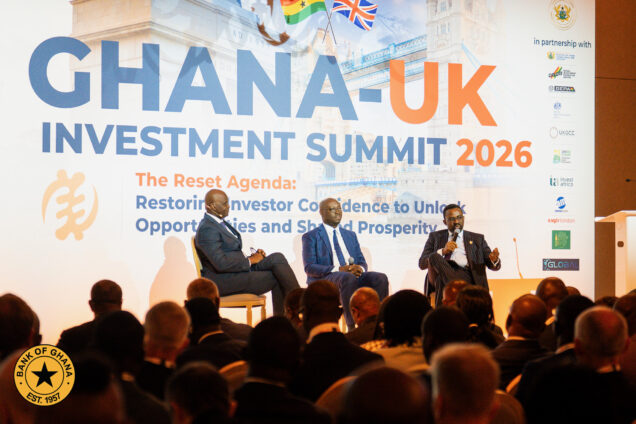
Dr Asiama speaking at the Ghana-UK Investment Summit in London, said one of the major changes introduced since he assumed office was the decision to “demystify” the central bank and deepen engagement with stakeholders across the economy.
He said his years outside the Bank of Ghana exposed him to public concerns and criticisms about the institution, lessons he carried with him upon his return as Governor.
According to him, the Bank now regularly engages trader associations, financial institutions, businesses and other groups to better understand challenges confronting the economy.
Dr Asiama cited consultations with the Ghana Union of Traders’ Associations (GUTA) and other stakeholders, which informed reforms to the foreign exchange market framework.
He said the central bank had also responded to concerns raised by digital content creators and influencers who experienced difficulties receiving payments from international online platforms.
The Governor noted that direct engagement with the affected groups enabled the Bank to identify operational challenges and implement solutions that restored payment flows.
“We listen more because good policy comes from understanding the problems people face,” he said.
Dr Asiama said the Bank and the Ministry of Finance entered office with a shared understanding of the economic challenges confronting the country and had worked closely to implement reforms.
He noted that one of the first major decisions taken by the Monetary Policy Committee was to increase the policy rate to curb inflationary pressures and restore confidence in the economy.
He said the hardest decision was the hike in the first MPC from 27 per cent to 28 per cent which then made the easing that followed credible.
The Governor explained that the Bank subsequently pursued a four-pillar strategy comprising tight monetary policy, liquidity management, reserve accumulation and financial sector strengthening.
He said reforms in the remittance sector also helped improve foreign exchange inflows by ensuring that remittance proceeds entered the formal financial system.
According to him, remittance inflows reached nearly US$8 billion last year, providing significant support for the economy and exchange rate stability.
Dr Asiama said the Bank was also developing investment products targeted at the Ghanaian diaspora, including plans to tokenise gold-backed investment instruments.
He described the diaspora as an important source of investment capital that could contribute significantly to national development.
The Governor reiterated that maintaining macroeconomic stability remained central to the Bank’s mandate and expressed confidence that ongoing reforms would strengthen Ghana’s economic resilience.
Latest Stories
-
NDC’s two years of economic gains not enough to establish stability – Alan Kyerematen
24 seconds -
AFCON 2027Q: Nine new call-up for Cote, The Gambia matches
20 minutes -
Ghana’s MSMEs: Burdened by regulation and overtaxed; why the system isn’t working
33 minutes -
Patience Akyianu, former Barclays Bank Ghana MD and Hollard Group CEO, reported dead
39 minutes -
Mahama pushes ‘health sovereignty’ agenda, says Global South needs control over resources
49 minutes -
Mahama: We are reforming systems, fighting corruption and improving use of public funds
54 minutes -
Catholic Bishops welcome task force to tackle drug menace, acknowledge inter-agency efforts
1 hour -
Ghana Catholic Bishops demand urgent action against drug trafficking
1 hour -
Tamale: 5 arrested over suspected drug activities; police seize pistols, narcotics
1 hour -
We have lost a great developer – Mankranso residents pay tribute to late DCE
1 hour -
Ghana Law Society sets September 30 for maiden Bar Conference on legal reforms
2 hours -
GPL Week 3: Port City’s Gyetuah bags a brace as 9 outstanding players named NASCO Players of the Match
2 hours -
Visibility without substance is just noise; I don’t seek popularity—Dr Oppong-Fosu
2 hours -
The late Abubakar Sedik was an exceptional DCE – Ashanti Regional Minister
2 hours -
Black Stars must win next game against Côte d’Ivoire – Carlos Queiroz
3 hours