

Audio By Carbonatix
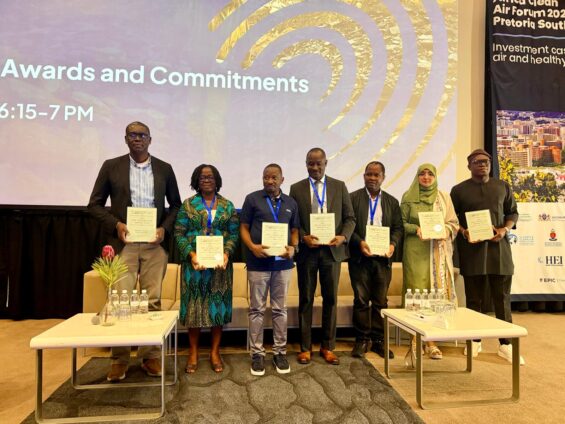
At this year’s Africa Clean Air Forum, the EPIC Air Quality Fund celebrated seven awardees at the Milestone Award Ceremony who are changing their national air quality dialogue. These seven projects received special recognition for achieving national-level clean air impacts.
Their journey began with a massive global search. When EPIC issued its inaugural open call for proposals in 2024, it received 322 applications spanning over 74 countries. Ultimately, 31 projects secured funding—receiving grants of $50,000 to $75,000 over an 18-month timeline. Today, those investments are paying off, as these leaders from The Gambia, the Democratic Republic of Congo, Ghana, Pakistan, Malawi, Nigeria, and Liberia successfully expand air quality monitoring infrastructure, opening up data to the public, and actively driving national-level impact in collaboration with a network of partners.
“From getting the legislative pieces in place to set new air quality standards to implementing existing policy to setting up first-of-their-kind networks in the country, awardees are demonstrating what is possible when people and geographies that are experiencing high air pollution yet have had few resources get the chance to lead,” says Christa Hasenkopf, Director of the EPIC Clean Air Program. “They are using open data as a lever to drive real national-level change - and rapidly. They show that clean air - and the people most affected by air pollution - are worth investing in.”
The seven EPIC Air Quality Fund awardees and their achievements include:
● Permian Health Lung Institute, The Gambia: Permian Health, a non-profit, expanded under the leadership of Dr Sunkary Touray, The Gambia’s first government-owned air quality monitoring program through the National Environment Agency. This catalysed landmark environmental legislation which is currently in the later stages of The Gambia’s Parliament process.
● WASARU in collaboration with Columbia University, Democratic Republic of the Congo (DRC): WASARU, a non-profit, under the leadership of Paulson Kasereka Isevulambire, established the only existing air quality monitoring network in the DRC that shares open data. The organisation is actively supporting the national government to develop a national decree on environmental standards and the development of a national sanitation policy that will integrate air quality monitoring. This framework will establish national air quality guidelines, drawing from WASARU’s technical inputs and data alongside other national sources.
● Ghana Environmental Protection Agency, Ghana: Ghana’s Environmental Protection Authority (EPA), a government agency, under the leadership of Selina Okaebea Amoah, deployed a fully open, government-owned air quality monitoring network. The project’s data is being used for awareness creation, research, standard revision, tracking implementation of policy interventions as well as driving funding for wider adoption of air quality monitoring.
● The Urban Unit, Pakistan: The Punjab Urban Unit’s network of 175 monitors is the first of its kind, a fully open network deployed by the government or any actor in-country, covering 22 cities in Pakistan. It has been developed under the leadership of Muhammad Omar Masud and in collaboration with his team.
● Malawi University of Business and Applied Sciences (MUBAS), Malawi: The University of MUBAS’ air quality data is being used by the Malawi government to bolster nationwide weather forecasting and air quality notifications. MUBAS is working with the government to build a collaborative MOU on air quality monitoring. The project is being led by Chikumbusko Chiziwa Kaonga.
● Lagos Metropolitan Area Transport Authority (LAMATA), Nigeria: LAMATA’s air quality network marks the first time the Nigerian government has made fully open, real-time air quality data available. The data is currently being used to inform Lagos transportation policy. The project is being led by Abimbola Akinajo and her team.
● United Methodist University and Kigali Collaborative Research Centre (KCRC) & United Methodist University (UMU), Liberia: UMU and KCRC, with support from the University of Ghana through the Afri-SET project and in collaboration with the Monrovia City Corporation and the Environmental Protection Agency of Liberia, have established Liberia’s first long-term PM2.5 air quality monitoring network.
This story was a collaboration with New Narratives. Funding was provided by the Clean Air Fund, which had no say in the story’s content.
Latest Stories
-
Fiji declares HIV a national emergency as cases surge
16 minutes -
Michelin-starred Seoul restaurant fined for using ants as garnish
26 minutes -
No politics behind fuel export reduction to Sahel – BOSTenergies
38 minutes -
BOST clarifies fuel export cut to Burkina Faso, Mali – Says no imminent shortage in Ghana
57 minutes -
New iPhones, new features: Is it time to upgrade?
1 hour -
Scaling Enterprise AI across Africa: From technology to real-world impact
2 hours -
Fibre Broadband isn’t complicated: You’re just overthinking it
2 hours -
Arrest all officials who handled cocaine-linked container – Nitiwul
2 hours -
DTI inaugurates Academic Council, Industry Advisory Committees to strengthen TVET delivery
2 hours -
DTI, Ghana TVET Service partner to promote TVET education and youth employment
2 hours -
Large crowd of mourners attend one-week observation of Kessben; final funeral rites set for November 26–28
3 hours -
Nitiwul calls for GPHA boss Paul Tanye-Kulono to step aside over cocaine probe
3 hours -
Over 90 apprentices, master craftspersons in Wa East receive industrial tools under National Apprenticeship Programme
3 hours -
SOL Energy, subsidiary of Star Oil, secures provisional BIDEC licence from NPA
3 hours -
Six other people in custody as Ghana investigates drug trafficking through ports – Felix Kwakye Ofosu
3 hours