

Audio By Carbonatix
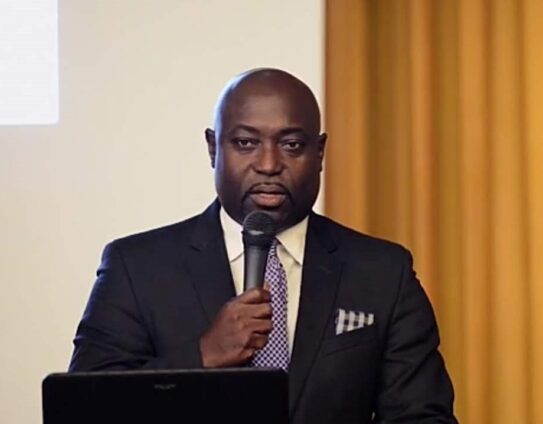
William Nyarko, Executive Director of the Africa Centre for International Law and Accountability (ACILA), has called for sweeping reforms to political finance laws across Africa to require electoral candidates to disclose campaign donations and file financial reports and returns, arguing that the current legal gap is fuelling corruption, state capture and the misuse of public resources.
Nyarko made the call during a high-level reform panel on "Who Does What and How?" at the Financialisation of Politics Conference, held in Accra from July 14 to 16, 2026. The panel brought together key continental and national actors involved in governance, anti-corruption, electoral oversight and legal reform, including Hon. Kwami Edem Senanu of the African Union Advisory Board Against Corruption (AUABC); Dr Joseph Whittal, Commissioner of the Commission on Human Rights and Administrative Justice (CHRAJ); Dr Steven W. Kayuni of the African Union Commission for International Law; and Dr Bossman Asare, Deputy Commissioner of the Electoral Commission of Ghana.
Addressing participants, Nyarko identified the absence of candidate-level campaign finance disclosure requirements as one of the most significant weaknesses in Africa's political finance architecture.
"One of the key gaps in political finance regulation across Africa is that candidates are often not required to report donations received during campaigns or file financial returns. This creates a major transparency and accountability deficit because much of the money that finances elections is given directly to candidates rather than through political parties," he said.
According to Nyarko, political financiers frequently provide resources directly to candidates with the expectation that they will receive favourable treatment, contracts, appointments or other benefits if those candidates eventually assume public office.
"When financiers invest in candidates, they often expect returns on that investment once those candidates gain access to state power. Without disclosure requirements, citizens have no way of knowing who is financing political campaigns, the scale of the support provided, or what influence those financiers may ultimately exercise over public decision-making."
Nyarko noted that the problem remains widespread across the continent, with more than 30 African countries still lacking legal provisions requiring candidates to disclose campaign contributions and expenditures or submit post-election financial reports.
He argued that the failure to regulate candidate financing runs contrary to international and regional anti-corruption obligations that many African countries have voluntarily accepted.
Nyarko cited Article 7(3) of the United Nations Convention Against Corruption (UNCAC), which calls on States Parties to enhance transparency in the funding of candidates for elected public office and, where applicable, the funding of political parties. He noted that 53 of Africa's 54 countries have ratified or acceded to UNCAC, making its provisions binding on almost every state on the continent.
He also referenced Article 10 of the African Union Convention on Preventing and Combating Corruption (AUCPCC), which promotes transparency in the financing of political parties and democratic processes. Nyarko observed that 43 African countries have ratified or acceded to the AUCPCC, demonstrating a broad continental commitment to combating corruption and promoting accountability in political financing.
"The legal and policy frameworks are already there," Nyarko said. "The challenge is that many countries have not translated these international and regional commitments into domestic laws that require candidates themselves to disclose the money they receive and spend during elections."
He warned that the consequences of the regulatory gap extend far beyond elections, often affecting governance and public service delivery after candidates take office.
"In many cases, it is the people's money and public resources that are ultimately used to repay political financiers," he said, adding that when campaign funding is hidden from public scrutiny, it creates fertile ground for corruption, patronage, procurement manipulation and the diversion of scarce public resources away from national development priorities.
Nyarko urged governments, legislatures, electoral management bodies, anti-corruption agencies and civil society organisations across Africa to prioritise reforms requiring candidates to publicly disclose campaign donations, report expenditures, file financial returns, and submit to independent oversight and auditing.
His remarks formed part of broader discussions on strengthening transparency, accountability and integrity in political finance systems across Africa.
The conference concluded with deliberations on the Accra Declaration, a continental statement of commitment aimed at advancing political finance transparency, democratic accountability and anti-corruption reforms across the continent.
Participants expressed hope that the declaration would serve as a roadmap for translating existing international and regional standards into practical reforms capable of reducing the influence of opaque money in politics and strengthening democratic governance across Africa.
Latest Stories
-
Dog handlers promote animal welfare as classic dog show captivates Kumasi
14 minutes -
GoldBod dismisses NPP’s forex allegations as ‘fishing expedition on desert’
16 minutes -
191 nations set for global youth culture festival in Russia
24 minutes -
Prince Adu-Owusu: He felt the goodbye before it ended
29 minutes -
KNUST study warns sea defence is shifting coastal threats to unprotected communities
49 minutes -
Telecel Ghana launches 2026 SME Month to drive business growth
1 hour -
Manya Krobo Community Bank records 131% rise in profit after tax
1 hour -
Even John Hyde must die – A tribute to my friend
1 hour -
‘Online pastor’ romance scam cases to be consolidated and moved to High Court
1 hour -
NPP Ayawaso West Wuogon constituency election dispute escalates into court battle
1 hour -
What happened to E-Blocks, Agenda 111 should not happen to 24-hour markets – Ahmed Ibrahim urges Ayariga
1 hour -
VAST Ghana calls for nationwide action against cigarette-shaped lollipop
1 hour -
Germany says Russia behind Leipzig airport drone attack
1 hour -
NSMQ 2026: Achimota School shatters Adisadel’s semi-final hopes to book penultimate spot
1 hour -
NSMQ 2026: Bright SHS makes history as first private school to reach semi-finals
2 hours