

Audio By Carbonatix
When the Ghana National Petroleum Corporation (GNPC) announced that its subsidiary, Explorco, had become the owner of an additional 7% stake in the Jubilee and TEN oil fields, many Ghanaians wondered how the asset got there.
The answer goes back several years and involves an American oil giant, a takeover worth billions of dollars, a company incorporated in the Cayman Islands, a state-backed financing arrangement, and an ongoing legal disagreement over where the revenue from the asset should go.
The story begins in 2019.
That year, U.S.-based Occidental Petroleum completed its acquisition of Anadarko Petroleum Corporation in a deal worth about US$55 billion. Through the acquisition, Occidental inherited Anadarko's 7% commercial interest in Ghana's Jubilee and TEN oil fields.
To reduce the debt it took on from the takeover, Occidental decided to sell several international assets, including its interest in Ghana's offshore oil fields.
For Ghana, the proposed sale presented an opportunity.
Rather than allow another international oil company to buy the stake, GNPC decided to acquire it as part of a strategy to increase Ghana's commercial participation in its own petroleum industry.
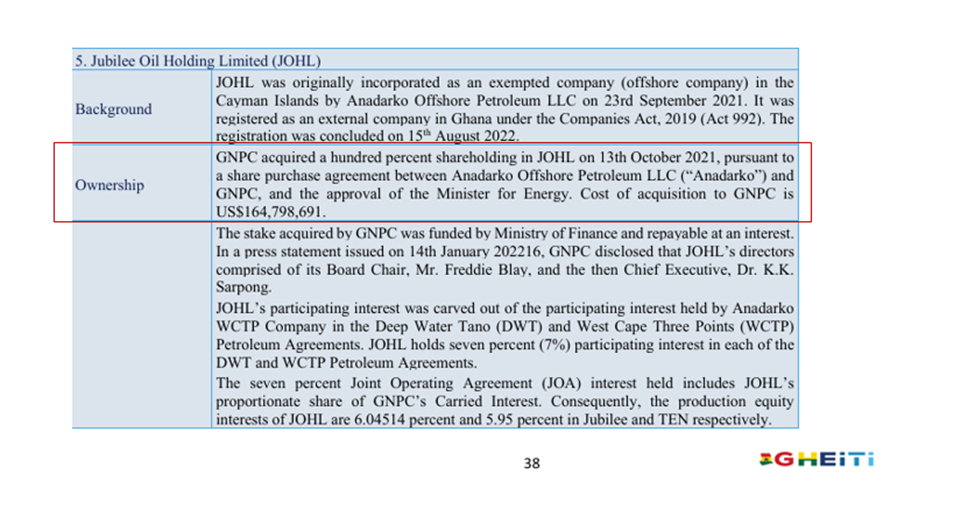
The agreed purchase price was initially about US$199 million. However, after adjustments for taxes, previous oil liftings, operating costs and other financial obligations, the final amount paid was approximately US$164.8 million.
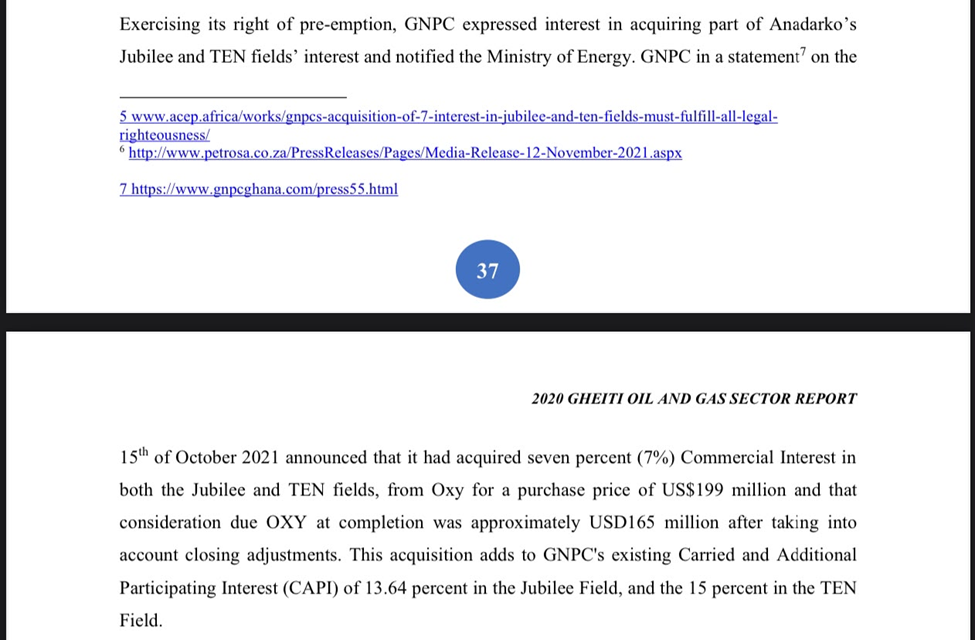
Instead of buying the petroleum interest directly, GNPC bought a company called Jubilee Oil Holdings Limited (JOHL).
This is where much of the public debate began.
JOHL was incorporated in the Cayman Islands in September 2021 by Anadarko Offshore Petroleum LLC shortly before the transaction was completed. GNPC has consistently maintained that it did not establish the offshore company itself but rather purchased all the shares in an existing company created by Anadarko to hold the asset during the transaction.
On 13 October 2021, GNPC signed a Share Purchase Agreement to acquire 100% of JOHL. Six days later, on 19 October, the corporation completed payment of approximately US$164.8 million, effectively taking ownership of Anadarko's 7% commercial interest in the Jubilee and TEN fields.
The acquisition was financed through an advance from Ghana's Ministry of Finance, with GNPC later explaining that revenue generated from the asset would be used to repay the government.
Following the acquisition, JOHL became the company through which the 7% commercial interest was held. However, GNPC had another long-term plan.
The corporation wanted the asset to be managed through Explorco, its wholly owned exploration and production subsidiary established to undertake commercial upstream petroleum activities on behalf of the corporation.
As part of that strategy, the government approved the transfer of JOHL's petroleum interests to Explorco, making the subsidiary the holder of the additional 7% commercial stake.
While the ownership transfer was taking place, another debate was emerging.
The Public Interest and Accountability Committee (PIAC), the independent body that monitors the management of Ghana's petroleum revenues, questioned why proceeds from the sale of oil through JOHL were not being paid into the Petroleum Holding Fund (PHF), the account established under the Petroleum Revenue Management Act (PRMA) to receive petroleum revenues on behalf of the state.
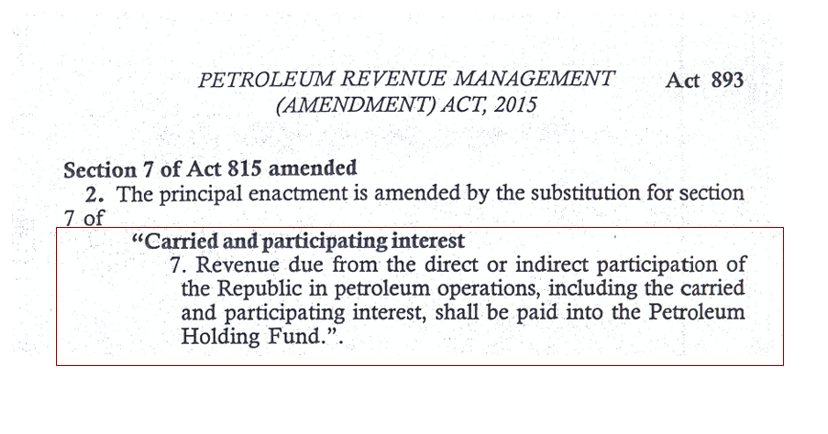
The disagreement centres on the interpretation of Section 7 of the Petroleum Revenue Management Act (Act 815), as amended by Act 893, which states:
"Revenue due from the direct or indirect participation of the Republic in petroleum operations, including the carried and participating interest, shall be paid into the Petroleum Holding Fund."
PIAC argues that because Explorco is wholly owned by GNPC and ultimately represents the Republic's commercial participation in Ghana's petroleum sector, proceeds from its petroleum liftings amount to revenue from the state's indirect participation and should therefore be paid into the PHF before being utilised.
GNPC disagreed.
On 26 October 2023, the corporation issued a detailed statement defending its decision not to pay JOHL's petroleum lifting revenues into the PHF.
GNPC argued that JOHL, and subsequently Explorco, are commercial companies whose revenues are corporate income rather than petroleum revenues immediately due to the Republic.
According to the corporation:
"The revenues of a subsidiary of a company established under Act 992 are neither due its shareholder, i.e. the parent company, nor the shareholder of the parent company. The parent company is due dividends from the subsidiary, when appropriate."
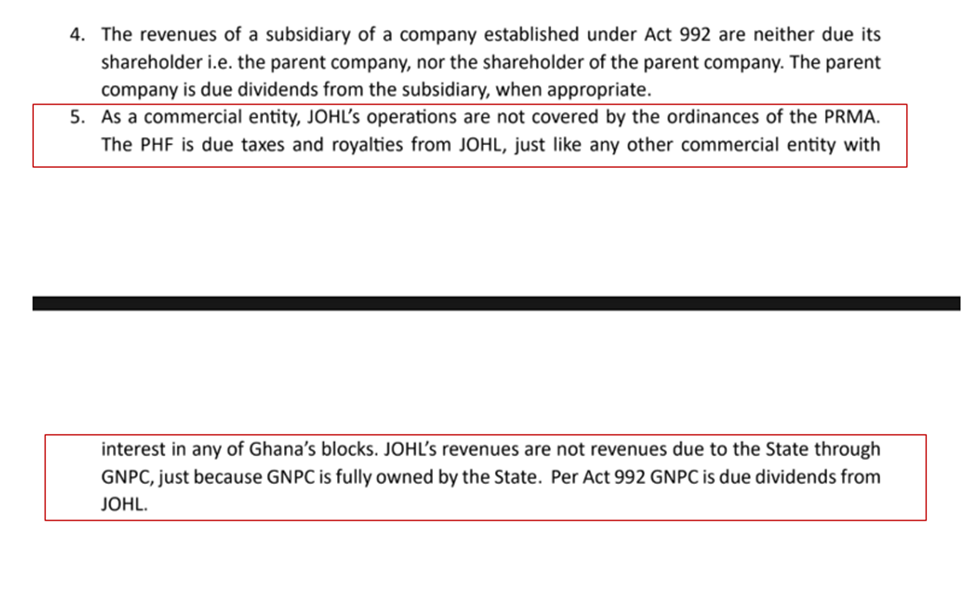
GNPC further maintained that the revenues generated by JOHL were needed to meet cash call obligations, finance petroleum operations, repay the Ministry of Finance advance used to acquire the 7% stake, and support further commercial investments. The corporation has also stated that its interpretation is supported by legal advice from the Attorney-General.
PIAC has maintained the opposite view.
It argues that because the asset ultimately belongs to the Republic through GNPC, revenues generated from Explorco's petroleum liftings constitute petroleum revenues arising from the state's indirect participation in petroleum operations and should therefore first be paid into the Petroleum Holding Fund before any subsequent use.
The disagreement has remained one of legal interpretation rather than ownership.
Both GNPC and PIAC agree that the asset ultimately belongs to the state through GNPC. The dispute is whether revenues earned by Explorco should first enter the Petroleum Holding Fund under the Petroleum Revenue Management Act or whether the company may retain and use those revenues before remitting returns to the state.
The legal question has persisted for several years without a definitive judicial interpretation.
An official of PIAC told the JoyNews Research that several individuals and institutions, including high-profile bodies, have advised the committee to seek clarification from the Supreme Court on the proper interpretation of the Petroleum Revenue Management Act.
However, such a move presents its own challenge.
As a statutory public body, PIAC would ordinarily require representation by the Attorney-General in any legal action before the Supreme Court. GNPC, also being a state-owned entity, would likewise be represented by the Attorney-General. That raises practical questions about how two state institutions with opposing interpretations of the same law would be represented in court should the matter proceed for judicial determination.
Until that legal question is settled, the differing interpretations of the Petroleum Revenue Management Act are likely to remain at the centre of Ghana's debate over petroleum revenue management.
Today, Explorco is the holder of the additional 7% commercial interest that originated with Anadarko. The acquisition is regarded as one of the most significant expansions of Ghana's direct commercial participation in its offshore petroleum sector.
Latest Stories
-
GNFS contains fire outbreak at Teshie Lekma Road near Lekma Hospital
55 minutes -
Samia Nkrumah rejects the narrative that Ghanaians were happy after Nkrumah’s overthrow
2 hours -
A Mother’s pain: Tribute by Ivan Baidoo’s mother
2 hours -
‘Forgive us for staying away’ — Samia Nkrumah leads family back to Nkroful, pledges to preserve Nkrumah’s legacy
3 hours -
Ernest Nuamah scores twice as Lyon beat Rennes
3 hours -
‘My dear Ivan’ – A father’s tribute to a son tragically killed
3 hours -
GNPC Explorco advances Voltaian Basin drilling preparations with 13.5km access road
3 hours -
Cabinet approves facility manager for Borteyman Sports Complex – Kofi Adams
4 hours -
Sanitation is improving; critics may be ‘living in another world’ – Salaga South MP replies Bekwai MP
4 hours -
Government must do more to tackle sanitation crisis – Bekwai MP
4 hours -
World Cleanup Day: GFF begins sanitation education in local communities
4 hours -
EU Ambassador, IGP discuss stronger cooperation on policing and security
4 hours -
Africa Nations Volleyball Championship: Ghana set up quarterfinal clash with Cameroon after beating Chad
5 hours -
Meet Dr Benjamin Appiah Osei — Ghana’s three-time tourism awards winner
5 hours -
UEFA & CONCACAF demand Fifa pays $10m to all 211 members
5 hours