

Audio By Carbonatix
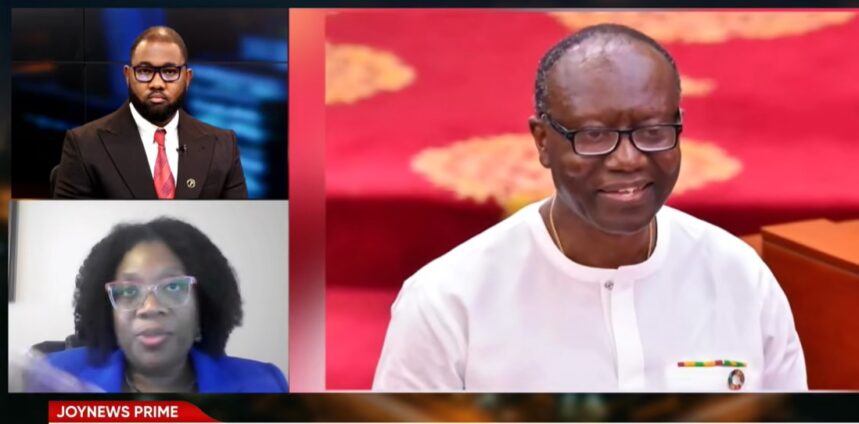
United States-based immigration lawyer Jonelle Ocloo has said the recent decision by a U.S. immigration judge to grant former Finance Minister Ken Ofori-Atta permanent residency does not prevent Ghana from seeking his return through extradition but cautioned that American courts would require compelling evidence before approving such a request.
Speaking on JoyNews Prime on Tuesday, July 21, Ms Ocloo said the immigration judge was not persuaded by the evidence presented in opposition to Mr Ofori-Atta's application for permanent residency.
Her comments follow a ruling by a U.S. immigration judge who found that the documents filed did not provide sufficient evidence by Ghana's Office of the Special Prosecutor (OSP) linking the former finance minister to criminal wrongdoing during the immigration proceedings, paving the way for the approval of his green card application.
Ms Ocloo explained that the ruling related solely to Mr Ofori-Atta's immigration status and should not be confused with Ghana's ongoing efforts to secure his return to face criminal charges.
"Basically, the US immigration judge was not convinced by the arguments coming from the OSP, and therefore, the US immigration judge has granted Mr. Ofori-Atta his permanent residence, his green card, in the United States."
Three possible routes
The immigration lawyer outlined what she described as the three possible ways by which Mr Ofori-Atta could return to Ghana.
According to her, the first option is voluntary, where the former minister decides to return on his own to answer the charges against him.
The second option involved deportation through U.S. immigration proceedings, but she said that process had failed.
"Essentially, in order for Mr. Ofori-Atta to come back to Ghana, there are three options. One, he can just voluntarily decide on his own that he's coming to Ghana to face trial."
"Secondly was an immigration process in which he could have been deported, forcefully removed from the United States and forced to go back to Ghana. That process was not successful."
She explained that Mr Ofori-Atta's application for permanent residency had been sponsored by his U.S. citizen son, while the U.S. Department of Homeland Security opposed the application on the grounds that criminal charges were pending against him in Ghana.
However, she said the immigration judge concluded that the material presented was insufficient to deny the application.
Extradition still an option
Ms Ocloo stressed that Ghana's extradition request remains active and is legally distinct from the immigration proceedings.
"The third and final means by which Ghana has to forcefully require Mr. Ofori-Atta to go back to Ghana is the extradition process. Now the extradition process is still ongoing regardless of whether he's been granted a green card. He can still be extradited back to Ghana."
She, however, cautioned that success in the extradition proceedings would depend on the quality of evidence presented before the U.S. courts.
According to her, affidavits or witness statements alone are unlikely to satisfy the evidentiary threshold required under American law.
"If the government of Ghana is looking for the extradition process to be successful, one thing they have to realise is that just these statements, an affidavit from the OSP, are simply not enough."
She said U.S. courts generally expect documentary and forensic evidence capable of independently establishing the alleged offences.
"The US courts are looking for hard forensic financial evidence... evidence of bank statements, wire transfers, things like asset tracing, things like digital physical communications, emails, and these sorts of things. It's simply not enough just for the OSP to testify."
"They're going to have to show the US court evidence in order for the US court to agree to extradite him back to Ghana."
No political protection
Responding to suggestions that U.S. authorities were shielding the former Finance Minister, Ms Ocloo dismissed that assertion, saying the outcome reflected the strength of the legal arguments presented rather than any political consideration.
"I don't think it's an issue of the US immigration court shielding Mr. Ofori-Atta."
Instead, she credited Mr Ofori-Atta's legal team with effectively presenting his case before the immigration judge.
"I think he had a very successful legal team. His legal team was much more convincing to the judge."
She noted that the defence successfully highlighted Mr Ofori-Atta's family ties to the United States and argued that, apart from the allegations pending in Ghana, there was no evidence that he had engaged in criminal conduct while residing in the U.S.
Ms Ocloo reiterated that if Ghana intends to secure Mr Ofori-Atta's return through extradition, prosecutors must present evidence capable of meeting the higher evidentiary standards required by U.S. courts.
"If the prosecutors want to be successful in actually bringing Mr. Ofori-Atta back to Ghana through the extradition process, then they have to be more convincing than his own attorneys. They have to come forward with hard evidence."
Latest Stories
-
Isak nets winner as Liverpool edge Bournemouth
3 minutes -
I dare Ghana gov’t to extradite me; they can never do it – Ghana Jollof speaks
5 minutes -
Semenyo scores twice as Manchester City beat Sunderland 5-3 in eight-goal thriller
15 minutes -
Parliament calls for government-private sector collaboration to improve waste management
17 minutes -
Volta Region described as cleanest so far in Parliament’s nationwide sanitation monitoring
27 minutes -
Parliament urges MMDAs to enforce sanitation bylaws to curb indiscriminate waste disposal
32 minutes -
Mohammed Kudus drops out of Ghana squad for AFCON 2027 qualifiers against Côte d’Ivoire and Gambia
1 hour -
Africa World Airlines unveils first Embraer E190 as part of 10-aircraft fleet expansion
2 hours -
Civilian hospitalised after alleged machete attack by prison officers, inmates
3 hours -
Toobu rejects calls to recall Parliament over 3.9-tonne cocaine shipment
3 hours -
Residents in 5 Northern Regions warned of approaching rainstorm
3 hours -
Constituency Games still a work in progress – Sports Minister
4 hours -
Team Ghana set for historic Karting Africa Showrun in Angola
4 hours -
52-year-old South African arrested with suspected heroin after arriving from Accra
4 hours -
Shatta Wale challenges UPSA students to build entrepreneurial mindsets
4 hours