

Audio By Carbonatix
The government has reaffirmed its commitment to transforming Ghana's oil palm industry into a major driver of industrialisation, export growth, import substitution, and rural employment, with significant progress being made under the Integrated Oil Palm Development Policy.
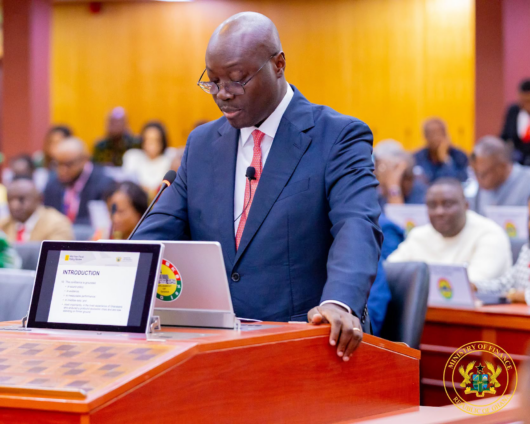
Presenting the Mid-Year Budget Review in Parliament, the Minister for Finance, Dr Cassiel Ato Forson, said government remained focused on developing the oil palm industry into a strategic sector capable of attracting investment, creating jobs, and strengthening the country's agricultural value chain.
"Government remains committed to transforming Ghana's oil palm industry into a major driver of industrialisation, export growth, import substitution, and rural employment," Dr Forson said.
He explained that a key component of the Integrated Oil Palm Development Policy was the establishment of sustainability-compliant oil palm land banks to reduce investment risks for the private sector and facilitate the development of large-scale plantations integrated with smallholder farmers and outgrower schemes.
According to the Finance Minister, implementation of the initiative was making steady progress.
"Implementation of this initiative is progressing steadily," he told Parliament.
Dr Forson disclosed that the Ministry of Lands and Natural Resources, in collaboration with the private sector and other relevant institutions, had reviewed more than 270,000 hectares of land in the Western Region to identify areas suitable for sustainable oil palm cultivation.
He said drone surveys had already been completed on over 117,000 hectares, while 46,000 hectares had been selected for detailed land use change analysis.
Assessments, he added, had so far been completed on 16,000 hectares, with approximately 10,780 hectares identified as suitable for sustainable oil palm development.
"Approximately 10,780 hectares have been identified as suitable for sustainable oil palm development," Dr Forson stated.
The finance minister said the identified land was now undergoing the necessary environmental, social, and sustainability assessments, including High Conservation Value, High Carbon Stock, and Free, Prior, and Informed Consent (FPIC) processes to ensure compliance with international standards.
"These areas are now undergoing the required environmental, social, and sustainability assessments," he said.
Beyond the Western Region, Dr Forson noted that similar land mapping and documentation activities had commenced in the Central Region, while preparatory work was underway in the Eastern and Volta regions to expand the programme nationwide.
He indicated that current assessments suggested the Western Region alone could provide about 30,000 hectares of land for the first phase of development.
As work progresses across Ghana's oil palm-growing belt, the Finance Minister said the national land bank had the potential to exceed 100,000 hectares, creating a strong foundation for future investment in the sector.
The initiative, he said, would unlock substantial private sector investment and generate significant economic opportunities.
"This initiative will unlock significant private sector investment, create over 250,000 direct and indirect jobs across the value chain, strengthen smallholder participation, increase domestic crude palm oil production, reduce import dependency, and position Ghana as a leading regional hub for palm oil processing and exports," Dr Forson said.
He assured Parliament that government would continue to engage all stakeholders to ensure the programme was implemented responsibly and sustainably.
"Government will continue to work with all stakeholders to ensure that this programme is implemented responsibly, sustainably and in a manner that delivers lasting benefits to our communities and the national economy," he added.
Dr Forson also announced that government was finalising a US$500 million Integrated Oil Palm Development financing agreement with the World Bank to support private sector investment in large-scale commercial oil palm plantations.
The financing package, he explained, would be on-lent to private sector investors to accelerate the expansion of commercial oil palm production across the country.
"We expect to conclude and present it to the House by the end of 2026," the Finance Minister said.
Latest Stories
-
Cargill Ghana and International Cocoa Initiative celebrate 111 young graduates building skills for the future
8 minutes -
Video: Madina MP Francis-Xavier Sosu collapses while addressing students at GIMPA
10 minutes -
Hunnyboy reveals how social media landed him Shatta Wale feature
15 minutes -
I am a perfectionist – Actor William Lamptey
20 minutes -
No room for another false start as Ghana begin AFCON qualifying campaign
39 minutes -
“We are grateful for what you have achieved” – AGI President tells Finance Minister
48 minutes -
“No Nation is Inferior”: Mahama champions human dignity and security council reform at the UN
1 hour -
Manhyia South residents, NPP executives fume over botched EOCO arrest of MP
1 hour -
Mahama unveils new deal with global philanthropy
1 hour -
Daily Insight for CEOs: Building customer-centric leadership
2 hours -
Democracy must deliver food, jobs and healthcare, not just elections – Mahama
2 hours -
Capacity constraints must never be a barrier to restitution – Mahama
2 hours -
COMAC pushes for suspension of sections of Customs Act 2026
2 hours -
Mahama calls for Great African Museum to anchor continent’s heritage revival
2 hours -
Mahama cites return of Mpomponsuo sword as model for restitution
2 hours