

Audio By Carbonatix
The Lead Partner for Technology and Transformation, Deloitte Ghana, Roland Baah Teye, has described Artificial Intelligence as a tool for economic growth and not merely a technological agenda.
According to him, Gross Domestic Product (GDP) growth occurs when people and institutions create more value with available resources, and therefore AI can support this by reducing inefficiencies, improving decision-making, increasing speed and opening new avenues for innovation.
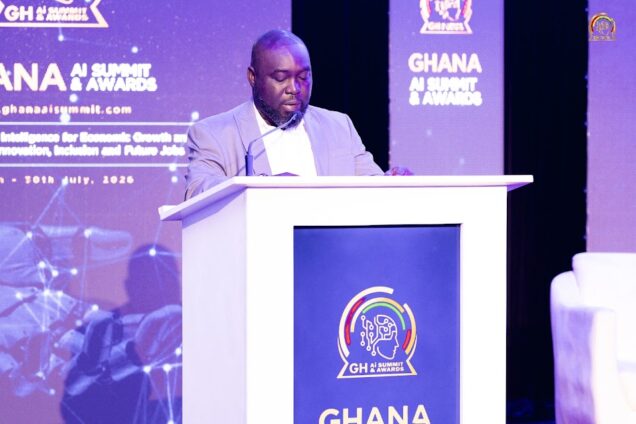
Speaking at the 2026 Ghana AI Summit and Awards, Mr. Teye, who also doubles as Deloitte Africa Operate and Industry Domain Leader, urged businesses to use AI to improve customer service, strengthen supply chains, detect fraud, automate routine work, and identify new revenue opportunities.
“For government, AI will enhance data-driven planning, improved resource allocation, amongst others. For entrepreneurs, AI will help build solutions that can scale beyond local markets”, he added.
Jobs and the Future of Work
He continued that AI will automate some tasks, particularly repetitive and routine activities.
“At the same time, it will create demand for new skills and roles in data analysis, AI governance, cybersecurity, digital product development, AI assurance, change management, and human-AI collaboration”.
He explained that the future of work will not belong only to those who build AI systems but It will also belong to those who can use AI responsibly to improve their profession, whether they are accountants, doctors, teachers, lawyers, engineers, entrepreneurs, public servants, or artisans.
From Deloitte’s perspective, Mr. Teye said a successful AI transformation is not achieved by purchasing a tool or launching a pilot, but it requires leadership, strategy, data readiness, technology, talent, governance, and adoption working together.
First, he noted that organisations must define their AI ambition. They must be clear about whether they want to reduce cost, improve service, create new products, or transform entire business models.
Second, he pointed out that organisations must address data readiness and third they must choose technology that fits their goals, capabilities, and risk environment.
On the call to action, the Deloitte Partner urged Ghana to build the skills, institutions, and partnerships needed to apply AI at scale.
He also advised the nation to focus on real problems, saying the best AI solutions will be those that improve productivity, expand access, reduce waste, strengthen services, and create meaningful opportunities.
He reaffirmed Deloitte’s commitment to supporting the AI journey through thought leadership, collaboration, advisory support, and practical transformation experience.
“We believe Ghana has the talent, ambition, and entrepreneurial energy to become a strong AI leader in Africa”.
The Director of Innovation at the Ministry of Communication, Digital Technology and Innovation, Emmanuel Ofori, who represented the sector minister, said AI represents an important pillar in Ghana’s economic transformation.
He added that the country is working with all its UN partners to have a national AI framework for the next 10 years with clear milestones for each year.
According to him, this will enable the country to monitor the impact of AI growth in the country.
The Ghana AI Summit was on the theme "Artificial Intelligence for Economic Growth and Job Creation: Innovation, Inclusion and Future Jobs".
Latest Stories
-
Israel-bound flight diverted after fight between pilots
3 minutes -
EchoWave earns praise for sound quality at 10th Women in Worship
12 minutes -
Crackdown on South Africa’s unsafe streets ordered by president to keep women safe
24 minutes -
Banks are responding to improved monetary policy conditions – John Awuah
43 minutes -
Judges’ conference forces further adjournment of Salomey Baffoe case to Oct. 5
55 minutes -
Chorkor community joins AC4NCA clean-up to tackle marine and coastal pollution
1 hour -
GRA assures Tullow of collaboration to settle $393m tax liability without disrupting its petroleum operations
1 hour -
South Korea demands apology from Pyongyang for landmine blasts that injured three
1 hour -
Carlos Queiroz not the sort of coach Black Stars need – Nii Lante Vanderpuye
2 hours -
AFCON 2027Q: ‘Our Black Stars team is gone’ – Former Sports Minister
2 hours -
Prof. Prempeh calls for public review of draft constitutional reform bills
3 hours -
AFCON 2027Q: ‘I have never seen a poor performance from Black Stars like against Gambia’ – Nii Lante Vanderpuye
3 hours -
Bawumia backs insurance sector reforms after engagement with IBAG
3 hours -
Nigeria set to launch National Digital Address System 9 years after Ghana showed the way
3 hours -
Policy rate decision takes time to reflect in lower lending rates – BoG
3 hours