

Audio By Carbonatix
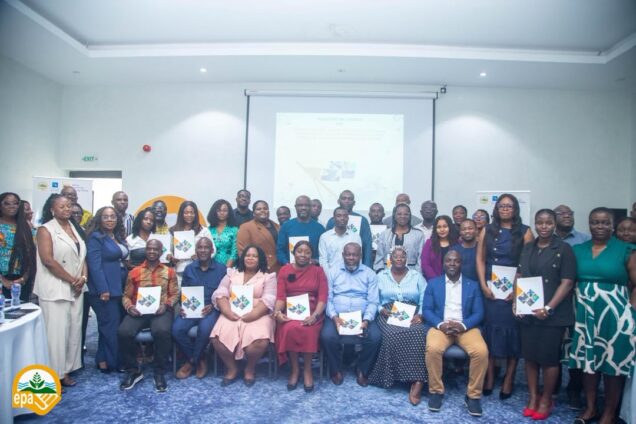
The Environmental Protection Agency (EPA) has launched new national guidelines aimed at reducing methane emissions from Ghana's oil and gas industry, in what officials describe as a major step toward cutting greenhouse gas emissions, improving energy efficiency and strengthening environmental compliance.
The Guidelines for the Inspection, Monitoring and Reporting of Fugitive Methane Emissions from the Oil and Gas Sector establish standards for detecting, reporting and repairing methane leaks while placing stricter controls on gas venting and flaring across petroleum facilities.
Methane is one of the most potent greenhouse gases, trapping more than 80 times as much heat as carbon dioxide over 20 years, despite remaining in the atmosphere for a shorter time. Although often overlooked, leaks from oil and gas operations are among the largest sources of methane emissions worldwide.
Speaking at the launch, Director of the EPA's Petroleum Department, Engineer George Kwaku Diawuoh, said the new guidelines would ensure methane leaks are identified and repaired within prescribed timelines.
"This guideline is going to make sure all leaks are detected and repaired within an acceptable time frame between industries and the EPA," he said.
The guidelines form part of Ghana's broader climate commitments under the Paris Agreement, where the country has pledged to reduce greenhouse gas emissions by 15 per cent by 2030. They are also backed by provisions in the Petroleum Exploration and Production Act, 2016 (Act 919), which prohibits unnecessary gas venting and flaring, and the Environmental Protection Act, 2025 (Act 1124), which empowers the EPA to regulate emissions.
Under the new framework, operators will be required to implement leak detection and repair (LDAR) programmes, regularly inspect facilities, maintain detailed emissions records and progressively eliminate routine venting and flaring.

Director for Sustainability and Circular Economy at the EPA, Larry Kotoe, said all petroleum facilities would be expected to comply.
"So the new guidelines actually provide for no flaring, no venting, and you are supposed to put in place a plan on how to capture some of these methane emissions. So going forward, both existing and the new facilities are supposed to comply with these guidelines. So they need to design their system in such a way that methane emissions are not just released into the atmosphere," he said.
Beyond the environmental benefits, industry experts say the new rules could also reduce significant economic losses.
Executive Director of the Africa Centre for Energy Policy (ACEP), Benjamin Boakye, noted that Ghana has lost hundreds of millions of dollars by flaring natural gas that could otherwise have been used to generate electricity.
"Between 2019 and 2025, Ghana flared approximately 600 million dollars’ worth of natural gas from its petroleum operations. During the same period, the country spent even more on liquid fuels to generate electricity because it could not fully utilise the gas it was producing," he said.
Mr Boakye, however, cautioned that previous regulations had failed because they were not enforced, urging authorities to ensure the new guidelines do not suffer the same fate.
"All the speakers that have spoken today have appreciated a need for us to move into implementation. There are already some similar regulations that were only on the shelf and never got implemented," he added.
The petroleum industry has welcomed the move.
Lead for Environment at Ghana Gas, Mansah Kamasa, said the company had already begun preparations to comply with the new requirements and expects to have its systems in place by January 2027.
"The plans are far advanced. We've been engaging service providers who can provide us with methane sensors, monitoring sensors to fix at our major installations because it's a gradual implementation of the regulation and all the various equipment, flow meters, measuring equipment that are required to be able to fulfil these regulations. Ghana Gas have made provision for it," she said.
The guidelines cover methane emissions across the oil and gas value chain, including leak detection and repair, compressors, storage tanks, glycol dehydrators, pneumatic equipment, venting, flaring and emissions reporting.
Under the implementation roadmap, oil and gas companies have six months to submit company-wide fugitive methane inspection plans. Within the first year, operators are expected to complete their first Leak Detection and Repair (LDAR) inspection and achieve at least 25 per cent control of targeted equipment. Compliance is expected to increase to 65 per cent by the second year, 75 percent by the third year alongside four LDAR inspections, and 85 per cent by the fourth year. By the fifth year, all operators are expected to achieve 100 per cent compliance, meeting the new standards for methane monitoring, leak detection, reporting and emissions control across their facilities.
The EPA says the measures are expected to improve methane monitoring, strengthen transparency, reduce gas losses and align Ghana's petroleum sector with international best practices in emissions management.
This story was a collaboration with New Narratives. Funding was provided by the Clean Air Fund which had no say in the story’s content.
Latest Stories
-
GWL assures of efforts to improve water supply in Tema, Ashaiman amid shortages
7 minutes -
Community 25 residents demand answers over two-month water shortage
24 minutes -
Ampem Darkoa Ladies and Hasaacas Ladies clash in 2026 Women’s Champion of Champions
31 minutes -
Business dies when luxury takes over leadership
46 minutes -
No family should lose everything to save a loved one – GMTF administrator
49 minutes -
Bawumia has the dignity to lead and the vision Ghana needs – Gabby
1 hour -
GOC, GFA chart Olympic qualification roadmap for Black Queens, Black Meteors
1 hour -
Absa InspireMe 2026 highlights opportunities for women-led business growth
1 hour -
The only thing that flows regularly is THE BILL
1 hour -
KGL U17 Colts 2026: Prempeh Elite Academy lead Group A as Western Region secures top spot in Group B
1 hour -
‘You’ve never been touched by any scandal’ – Gabby celebrates Bawumia on his 63rd birthday
1 hour -
WPL 2026/27: GFA unveils dates for start of new season as Ampem Darkoa Ladies begin title defence
1 hour -
Ghana Embassy in Washington pays tribute to late academic Dr Kofi Akamani
1 hour -
Ibrahim Mahama urges Ghanaians to overcome fear and venture into business
2 hours -
2026 U-17 WWC: Black Maidens lose to China in pre-tournament friendly
2 hours