

Audio By Carbonatix
Folks, in a conscious and deliberate effort to raise awareness of climate change and its devastating effects on humans, I have decided to discuss one critical issue that harms our health, environment, and all aspects of our existence: waste trafficking in Ghana and its hazardous effects.
For many of you, you are probably familiar with the word “trafficking” because you might know about child trafficking, human trafficking, sex trafficking, drug trafficking and other trafficking issues that are mostly talked about. All these forms of “trafficking activities” are criminal. Likewise, for many of you, this may perhaps be the first time you are coming across something like “waste trafficking”.
Research has shown that there are two main causes of climate change. The natural causes (Volcanic eruptions, orbital changes, and solar variations) and the anthropogenic ones (human activities). It has also been discovered that in recent times, at least in the post-pre-industrial era (from 1850 upwards), human activities have contributed to more greenhouse gases (GHGs) emissions intgas atmosphere. Ghana and the rest of the African countries contribute less than 5% of the world’s emissions, according to the Intergovernmental Panel on Climate Change IPCC. The unsurprising thing is that we do emit and continue to produce more GHGs at a very rapid rate these days.
Those who engage in heavy emission activities cite so many factors as to why they do so, and one amongst them is for economic reasons. They argue that they need to be fed, they need to have shelter, they need to have everything that makes life comfortable for them. While I agree that these things are vital for the sustenance of mankind, I also believe that there should be some considerations for our environment and everything that lives on it.
The United Nations Office on Drugs and Crime (UNODC), in its article “Explainer: What is Waste Trafficking?”, waste trafficking refers to the illegal trade of waste, a multi-billion-dollar crime that poses significant risks to human health, ecosystems, and global economic stability. Despite its environmental impact, waste trafficking is challenging to detect and prosecute due to inconsistent regulations and weak penalties.
It is not only about illicit trade, but it is also an organised crime that many people engage in. One may ask why people are involved in this illicit trade despite its negative effect on humans. One difficulty about this is that there are no proper regulations and proper enforcement to check what enters the destination countries, especially countries in Africa and other developing countries. Also, the exporting countries are careless about what will happen to the destination countries; all they care about is their money and how to offload their ‘garbage’.
Criminal actors exploit loopholes in international waste regulations, often disguising hazardous waste as legitimate exports or second-hand goods (Obroni waawu, popularly known in Ghana). Illegal waste typically comes from wealthier countries, such as those in Europe and North America, to lower-income countries in Africa and other parts of the world. Some criminals use bribery and cyber-enabled tactics, such as e-commerce platforms, to facilitate illegal waste transactions and avoid detection.
According to the Financial Action Task Force, Illicit waste trafficking generates around US$10 billion to US$12 billion worldwide every year. Ghana also contributes to this significant amount annually due to it heavily dependent on second-hand goods coming from other parts of the world.
Each year, around 150 000 tonnes of electronic waste are shipped to Ghana, legally and illegally, according to Bloomberg. Both Western and Ghanaian companies benefit from legal loopholes and corruption, enabling their hazardous waste activities in the country.
Why can’t Ghana also export their second-hand goods into European and American markets? They cannot do it because these countries have proper mechanisms in place to make sure that goods entering their countries do not pose a threat to their people and the environment, but the reverse is what is happening in Ghana and Africa.
Lack of care and corruption play a crucial role in this trade. A lot of importers of these hazardous goods try to bribe authorities so that their goods do not go through rigorous checks at the ports. Authorities at the ports also have no care or love for the country and take bribes just to have the goods get an easy pass into the country, forgetting about the dangers they pose.
According to Professor Marco Antonelli, a Political Science lecturer at the University of Pisa in Italy, ‘If hazardous waste leaves European ports illegally, that’s because it’s easier to export illegally from [European ports] than to import to the European Union (EU).’ He says while Europeans control what enters their soil, ‘they don’t care very much about what is exported from their countries.’
When I thought about this issue, I realised how delicate the matter is because, even though this illegal trade poses a lot of health and environmental issues to Ghana, it has provided a lot of jobs and employment opportunities for a lot of people. How can we come to a middle ground and find a proper solution to this delicate and all-important matter? The World Bank reports that about 27% of Ghana’s population lives in poverty, and that hazardous waste generates jobs and income for its citizens.
Internationally, there have been some conventions established to help regulate and check the movement of goods that are not healthy for humans and the environment. The Basel Convention, which was established in the late 1980s and entered into force in the early 1990s, aims to govern and heavily restrict the transboundary movement of hazardous waste. It mandates that exporting countries must secure explicit, advance consent from receiving nations before shipping any ‘waste’. Ghana has since ratified the Basel Convention.
The Bamako Convention, which was established in the early 1990s and entered into force in the late 1990s, is a treaty among African nations that completely bans the import of hazardous and radioactive waste into the African continent and strictly regulates the transboundary movement and management of these wastes within Africa. Interestingly, Ghana has not ratified the Bamako Convention.
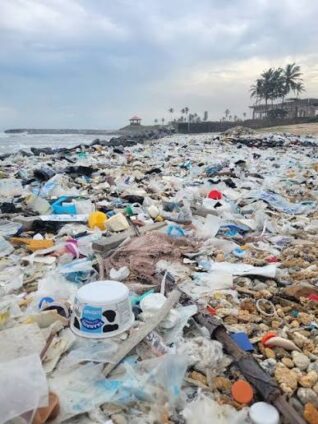
This article may not be able to enumerate all the consequences of these hazardous goods on Ghana, but we know how this is contributing to the fight against climate change. Waste trafficking defeats the concept of circular economy, recycling, and zero waste. They do not allow for a second life for waste products. We see the floods happening each year in Ghana and how severe they become. Most of these goods are dumped in gutters, and they get choked, therefore blocking the drainage system. The other thing is that when the importers realise that their waste products are not good for the purpose, they burn them openly. These burnings have a great impact on the health of the people around, the environment, and the smoke is also trapped in the atmosphere, thereby increasing the concentration of greenhouse gases and air pollutants, which accelerates global warming and degrades air quality.
The Environmental Protection Agency (EPA Ghana), the Ghana Standards Authority, the Ghana Ports and Harbour Authority, and the Customs Division should know that they are there to make sure things that come into the country are fit for purpose and not in disguise as second-hand products. They become negligent, and our future and the lives of the next generation are affected! Ghana and the rest of Africa cannot continue to become a dumping place for used European and American goods. I agree we must import, but we should not be in the habit of importing products that have spent more than ten years before we bring them into the country, especially electronic products and vehicles.
Author:
Latest Stories
-
Dog handlers promote animal welfare as classic dog show captivates Kumasi
13 minutes -
GoldBod dismisses NPP’s forex allegations as ‘fishing expedition on desert’
15 minutes -
191 nations set for global youth culture festival in Russia
23 minutes -
Prince Adu-Owusu: He felt the goodbye before it ended
28 minutes -
KNUST study warns sea defence is shifting coastal threats to unprotected communities
48 minutes -
Telecel Ghana launches 2026 SME Month to drive business growth
1 hour -
Manya Krobo Community Bank records 131% rise in profit after tax
1 hour -
Even John Hyde must die – A tribute to my friend
1 hour -
‘Online pastor’ romance scam cases to be consolidated and moved to High Court
1 hour -
NPP Ayawaso West Wuogon constituency election dispute escalates into court battle
1 hour -
What happened to E-Blocks, Agenda 111 should not happen to 24-hour markets – Ahmed Ibrahim urges Ayariga
1 hour -
VAST Ghana calls for nationwide action against cigarette-shaped lollipop
1 hour -
Germany says Russia behind Leipzig airport drone attack
1 hour -
NSMQ 2026: Achimota School shatters Adisadel’s semi-final hopes to book penultimate spot
1 hour -
NSMQ 2026: Bright SHS makes history as first private school to reach semi-finals
2 hours