

Audio By Carbonatix
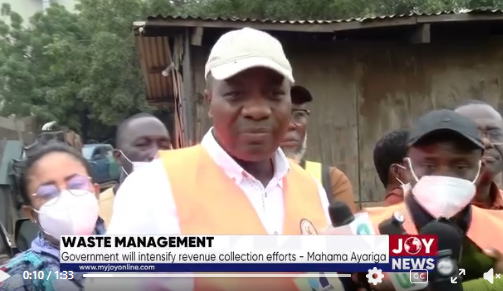
Minister for Local Government, Chieftaincy and Religious Affairs, Mahama Ayariga, has called for a new approach to financing waste management in Accra, insisting that residents and businesses should pay for the waste they generate.
According to him, the cost of managing waste in the capital should not be borne by the Common Fund, which is intended to support development in local authorities across the country.
Mr Ayariga made the remarks when he began an assessment of waste management facilities in the Greater Accra Region.
He joined the Accra Mayor and other government officials to observe waste sorting operations at the Achimota Transfer Station as part of the assessment.
“You are the one to pay for the waste. The waste should not be paid for from the Common Fund,” Mr Ayariga stated.
He argued that using the Common Fund to finance waste generated by residents in Accra amounts to diverting resources meant for development in other parts of the country.
“The Common Fund is distributed to the rest of the country. So, you cannot choose to come and live in Accra and have Common Fund that should come to me in Nadowli be used to pay for your lifestyle in Accra,” he said.
Mr Ayariga therefore insisted that residents who live and work in the capital must contribute directly towards the management of the waste they generate.
“If you are living in Accra, pay for your waste in Accra,” he stressed.
Businesses must pay for waste they generate.
The Minister also called for greater financial responsibility from businesses and industries operating in Accra, particularly those whose activities generate significant volumes of waste.
He said it would be unfair for companies that make profits from their operations in the capital to leave the cost of managing the resulting waste to public funds.
“If you have a factory here, and the factory is generating waste, you, the factory owner, the profit that you are making, it would be unfair for you not to do money accountable for the waste that is generated,” he said.
Mr Ayariga noted that Accra continues to attract people from across the country because of employment, business and other economic opportunities.
He said factories and businesses draw workers to the capital, while government institutions and Accra’s status as the country’s administrative centre also contribute to the city’s growing population.
“It's all the factories that are here that are drawing the crowds because we want to live close to their workplace,” he explained.
He said the resulting population growth inevitably increases the volume of waste generated and puts additional pressure on the city’s waste management infrastructure.
“It's all the activities in Accra that are drawing everybody from the hinterlands to come to Accra,” Mr Ayariga said.
Shared responsibility
The Minister said addressing Accra’s waste management challenges would require contributions from all the major actors whose activities drive the city’s growth.
He identified industry, businesses and government as key stakeholders who must share responsibility for financing the management of waste in the capital.
“Industry, government, which has hosted the capital in Accra, and then businesses, all of them must contribute for us to deal with the problem of waste management in the city,” he stated.
Mr Ayariga’s comments form part of the government’s broader assessment of waste management operations in Greater Accra, with a focus on developing more sustainable mechanisms for financing the collection, processing and disposal of waste in the capital.
Latest Stories
-
Imagination Africa, Mentors Chess Academy to host second African Genius Chess Championship at Ghud Park
51 minutes -
Nana B passport claims a diversionary tactic — Abu Jinapor
2 hours -
Pope Leo diagnosed with cancer as doctors remove lobe of lung, Vatican says
2 hours -
Legal Aid Commission takes free legal services to Techiman main lorry terminal
2 hours -
Nana B denies seeking passport favour, accuses Ablakwa of failing to account for GH¢16.4m
2 hours -
Young girls demand climate action, stronger protection against child marriage
2 hours -
Ex-gang boss sentenced to 40 years for orchestrating Tupac Shakur’s murder
2 hours -
From near-deferral to three awards: UMaT graduate’s academic journey
2 hours -
Atta Akyea denies seeking presidential pardon for Wontumi in galamsey case
3 hours -
Photos: Mahama commissions 85-bed Police Hospital ward, donates two ambulances
3 hours -
GTEC directs Ghana’s public universities to reopen by October 16 and begin lectures on October 19
3 hours -
Star Oil donates GH¢1million towards construction of new CID facility
3 hours -
Court hands Adjetey Sowah, two others lifetime bans after Amputee Football legal dispute
3 hours -
NDC appoints Julius Kwame Anthony as a Deputy Communications Director
3 hours -
Ghana repatriates 120 Nigerians rescued from suspected cybercrime centres
3 hours