

Audio By Carbonatix
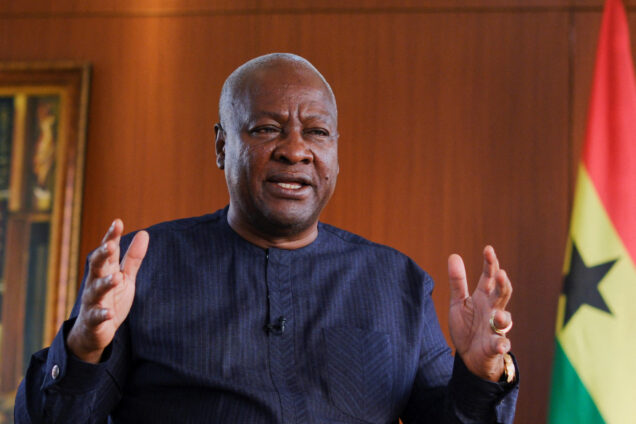
President John Dramani Mahama has affirmed the Tema Metropolitan Assembly (TMA) as the highest political and administrative authority within the Tema Metropolis, directing TDC Ghana Limited to comply with the Assembly’s regulations and statutory powers.
The directive was contained in a letter issued by the Office of the President on 28 August 2026, following a prolonged dispute between the two state institutions over development control and permitting in Tema.
According to the Presidency, the TMA is responsible for the overall development of the metropolis, including human settlements, municipal services, revenue mobilisation and local planning.
The government also maintained that the Assembly remains the local planning authority with the legal mandate to regulate physical development and issue development and building permits within its jurisdiction.
TDC, by contrast, was described as a commercially oriented real estate developer and not a municipal, legislative or planning authority.
The Presidency consequently directed the company to recognise and comply with the TMA’s statutory authority over development control, spatial planning, permits, municipal services, rates, fees and other regulatory matters.
This means TDC’s projects and other activities within the Tema Metropolis must conform to the Assembly’s regulations and all applicable laws.
The President, however, cautioned the TMA to exercise its regulatory powers fairly, transparently and strictly in accordance with the law.
The Assembly must ensure that the enforcement of its mandate does not unnecessarily obstruct legitimate development, investment or the commercial operations of TDC.
The directive further stated that neither institution should take over functions legally assigned to the other. While the TMA is expected to concentrate on its municipal and regulatory mandate, TDC is to focus on property development and its related commercial responsibilities.
Background to the dispute
The presidential intervention follows a confrontation over TDC’s construction activities at Community One, Sites 3 and 8 in Tema.
The TMA issued a stop-work order and subsequently demolished portions of structures at the project site, insisting that the development had commenced without the necessary permits.
The Assembly maintained that TDC’s ownership and management of land did not exempt the company from complying with physical planning and development regulations.
TDC disputed the Assembly’s position, arguing that it had an independent statutory mandate to plan, lay out and develop Tema and should not be treated as an ordinary private property developer.
The company traced its mandate to 1952, when the Tema Development Corporation was established to oversee the development of the new Tema township and port.
TDC said about 63 square miles of land, known as the Tema Acquisition Area, had been acquired from the traditional authorities of Tema, Nungua and Kpone and placed under its management through a 125-year lease.
Although TDC acknowledged the TMA’s authority over physical planning, development control and municipal administration, it maintained that the Assembly’s responsibilities must coexist with its statutory and proprietary interests.
“TDC does not dispute that TMA is a statutory local government authority with responsibilities for physical planning, development control and municipal administration. The issue is whether that mandate can be exercised as though TDC’s separate statutory mandate does not exist,” the company said in an earlier statement.
TDC subsequently petitioned the Minister for Works, Housing and Water Resources, Kenneth Gilbert Adjei, and the Minister for Local Government, Chieftaincy and Religious Affairs, Ahmed Ibrahim, to intervene in the dispute.
Ministers given 14 days
As part of efforts to secure a lasting settlement, the President has directed the two ministers to establish an administrative and operational framework defining the roles and working relationship between the TMA and TDC.
The framework is expected to cover development permitting, infrastructure coordination, revenue obligations, information sharing, dispute resolution and regular engagement between the two institutions.
The ministers must convene the TMA and TDC and submit the agreed framework, together with a report on all outstanding matters, to the President within 14 days of the letter.
Both institutions have also been ordered to immediately stop actions, public statements and media engagements that could escalate the dispute.
The President expects full cooperation from the two institutions towards an immediate and lasting resolution.
He warned that any further institutional conflict, public confrontation or refusal to comply with the directive would be viewed seriously.
Latest Stories
-
2026 National Cyber Security Awareness Month launched to build digital trust
3 minutes -
Ghana’s Constituency Games at a governance crossroads
22 minutes -
CSSPS placement results to be released tomorrow – Education Ministry
40 minutes -
His Excellency Professor Yaw Safo Boafo
41 minutes -
NSA Board Dissolution: Olympic, Paralympic representation expected to remain on new board
51 minutes -
When English became the safest Ghanaian language
1 hour -
Nurses and midwives indispensable to resilient health system – Bawumia
1 hour -
About 565,000 BECE candidates qualify for SHS placement – CSSPS
1 hour -
Virtual InfoSec Africa renews partnership with Cyber Security Authority
1 hour -
TMA is highest authority in Tema, TDC must comply with its regulations — President
2 hours -
Cyanide, unregistered cigarettes hidden under bags of millet, soya beans in major highway bust in Techiman
2 hours -
Security agencies call on civilians to volunteer information to combat crime
2 hours -
New maternal units commissioned in North Tongu to improve access to care
2 hours -
Enterprise Insurance reaffirms industry leadership with 4 wins at 6th CIIG
2 hours -
GES release national harmonised prospectus for 2026/27 SHS admissions
2 hours