

Audio By Carbonatix
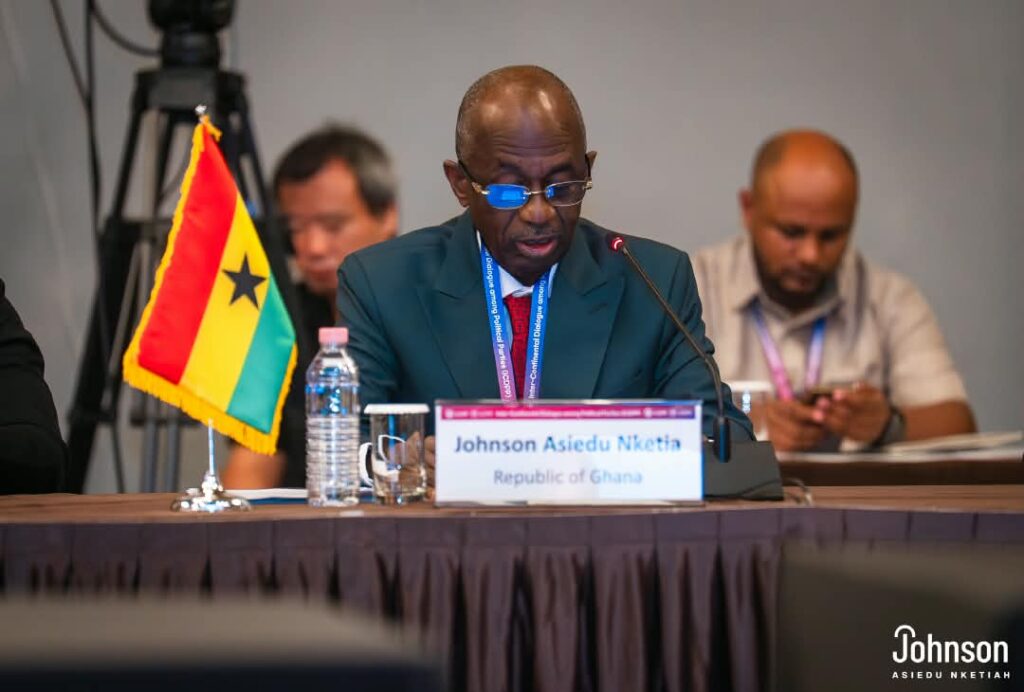
National Chairman of the ruling National Democratic Congress (NDC), Johnson Asiedu Nketiah, has urged political parties to adapt to changing societies, strengthen leadership development and make deliberate efforts to rebuild public trust.
He said political institutions could no longer rely solely on historical identities, ideological traditions or generational loyalties to retain public support, as each generation increasingly expects political parties to demonstrate their relevance to contemporary social and economic realities.
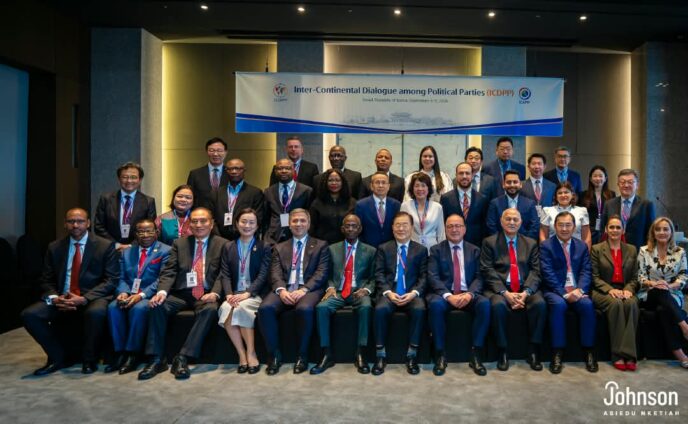
Mr Asiedu Nketiah made the remarks at the inaugural Inter-Continental Dialogue on Political Parties in Seoul, South Korea, where he addressed the gathering on behalf of political parties participating in the African Political Parties Initiative (APPI).
The event brought together the Africa Governance Centre (AGC), through APPI, the International Conference of Asian Political Parties (ICAPP), and the Permanent Conference of Political Parties of Latin America and the Caribbean (COPPPAL).
He commended the Africa Governance Centre for establishing APPI and creating a structured platform for African political parties to engage with one another and political organisations from other regions.
Changing political loyalties
A central theme of Mr Asiedu Nketiah’s address was the changing relationship between citizens and political parties.
He argued that political organisations that were once sustained by strong historical identities, ideological traditions or generational attachments could no longer assume that those loyalties would automatically be passed from one generation to another.
He said a party’s history might explain its position in national life but could not guarantee its future.
According to him, every generation encounters politics under different economic and social circumstances and ultimately makes its own assessment of whether existing political institutions remain relevant to the society it wants to build.
The former Parliamentarian said the judgement of citizens was becoming increasingly demanding, particularly among young people who have greater access to information and developments beyond their own countries.
He noted that many young people were simultaneously confronting unemployment, economic insecurity, rising living costs and uncertainty about whether education and hard work still offered a dependable route to economic advancement.
Political parties that failed to appreciate the depth of those changes, he warned, risked continuing to project confidence while gradually losing the public confidence on which their political relevance depended.
Economic hardship and public trust
Mr Asiedu Nketiah also linked public trust in political institutions to citizens’ everyday experiences.
He said dissatisfaction could deepen when people felt they had fulfilled their responsibilities to society—working, obeying the law, raising families and making sacrifices for their children—yet remained unable to see a realistic path towards a better standard of living.
In such circumstances, he argued, frustration could move beyond dissatisfaction with individual policies and develop into broader scepticism about political institutions.
He urged political leaders to treat such developments as an institutional warning rather than dismiss them as temporary public discontent.
Parties must prepare leaders before elections
Another major point of the address was the responsibility of political parties to prepare people for leadership before they gain political power.
Drawing on his experience in grassroots politics, Parliament, government and national political organisation, Mr Asiedu Nketiah said the character of a future government was often shaped within a political party long before an election.
He said decisions about who advances within a party, the qualities it rewards, the seriousness with which it develops policy and the conduct it tolerates eventually influence the character of public administration when the party assumes power.
He cautioned political organisations against confusing electoral effectiveness with readiness to govern.
A party may be highly skilled at mobilisation, campaigning and electoral strategy but still lack the policy, institutional and leadership capacity required to manage the complexities of government.
The gap, he said, might not be obvious during an election campaign but would become more difficult to conceal once a government had to deal with limited resources, competing public demands and decisions with long-term consequences.
He therefore called for greater emphasis on leadership preparation during the period before political opportunities arise.
Political parties, he said, needed sufficient institutional depth to ensure that the quality of government did not depend on a narrow group of personalities.
He also stressed the need for parties to develop successive generations of leaders capable of taking responsibility without every transition becoming an institutional crisis.
Parties must learn from failure
Mr Asiedu Nketiah further urged political parties to examine their own failures instead of focusing exclusively on explaining their successes or blaming opponents for setbacks.
He said electoral defeats, declining membership, public disaffection and difficult leadership transitions could expose weaknesses that prolonged political success might conceal.
Political organisations that were willing to examine why citizens had withdrawn their confidence, he argued, were better positioned to renew themselves than those that attributed every setback to the shortcomings of their opponents.
He said opposition should not be treated as a period of political inactivity but as an opportunity for serious preparation.
Similarly, parties in government needed to remain connected to citizens despite the pressures and demands of governing.
He warned that parties could become insulated from ordinary citizens once they assumed office, while opposition parties could become so focused on criticism that they neglected the development of credible alternatives.
Learning across political systems
Mr Asiedu Nketiah said the Inter-Continental Dialogue could provide an avenue for political parties from different regions to learn from one another.
He noted that participating organisations had different political histories and governing traditions, creating opportunities to examine how parties elsewhere handled leadership renewal, transitions from opposition to government and recovery from electoral defeats.
However, he cautioned against simply importing political models from one country into another.
National politics, he said, remained shaped by individual countries’ histories, cultures, institutions and local circumstances.
The value of international engagement, he argued, was therefore in exposing political leaders to different experiences and perspectives that could help them examine challenges within their own political systems.
Building institutions beyond election cycles
Mr Asiedu Nketiah said political parties needed structures and institutional habits that remained useful whether they were in government or opposition.
Their relevance, he argued, should not depend entirely on the authority of government or the temporary weakness of a political opponent.
Rather, political parties should build their long-term relevance around their ability to produce ideas, develop leaders and maintain public confidence.
He said institutional depth was particularly important because political leaders and governments would change, while strong institutional relationships could survive those changes.
He also welcomed plans for the Inter-Continental Dialogue to develop into a continuing process, with future engagements held in different locations as relationships among participating institutions deepen.
He said the initiative should be judged less by the visibility of individual meetings and more by the quality and usefulness of the relationships developed through them.
A new political environment
Mr Asiedu Nketiah said political parties were operating in a more demanding environment than when many of them were established.
Citizens now have more avenues for organising outside conventional party structures, greater access to competing ideas and less patience with political institutions perceived as unable to adapt to changing circumstances.
For established political parties, he said, the challenge was no longer simply to preserve their organisations but to demonstrate why they continued to deserve a place in the political future.
He said political leadership should ultimately be judged over a period longer than an electoral cycle.
While electoral victories determine which political party has prevailed at a particular point in time, he argued that the more enduring assessment should be based on the quality of leaders produced, institutions strengthened and political culture handed to succeeding generations.
For political parties seeking to regain or retain public confidence, he said, the task was continuous: remaining serious, adaptable and connected to society so that each generation could find its own reason to believe in the political institutions it inherits.
Latest Stories
-
From almost deferring Medicine to becoming a doctor – Mariam’s scholarship journey
4 minutes -
‘BECE is now more or less a placement examination’ – Daniel Fenyi
31 minutes -
NDPC to track implementation of government’s new economy programme
37 minutes -
‘There is no fight over limited spaces’ — GES assures on SHS placement
43 minutes -
Come for your hat when you finish our road – Tumu chiefs tell Mahama
44 minutes -
AGN Chair demands urgent climate adaptation and food systems integration on road to COP32
45 minutes -
The untapped role of Queen Mothers in African economic development
50 minutes -
Hyundai KOICA NextGen project launched in Ghana to boost automotive skills
60 minutes -
Upper West Regional Minister lauds 4 police officers for busting deadly gang
1 hour -
Abu Jinapor demands transparency over GH¢49.72m evacuation cost
1 hour -
4,972 Ghanaians repatriated from 10 countries since 2025 – Ablakwa
1 hour -
Israeli strikes in southern Lebanese village kill 12
1 hour -
Ghana to launch Diaspora Consular Fund to support citizens in crisis – Ablakwa
1 hour -
Asiedu Nketiah urges political parties to rebuild public trust at inter-continental dialogue in South Korea
2 hours -
Heavy pitch, intense heat made Kotoko draw physically demanding – Eric Tinkler
2 hours