

Audio By Carbonatix
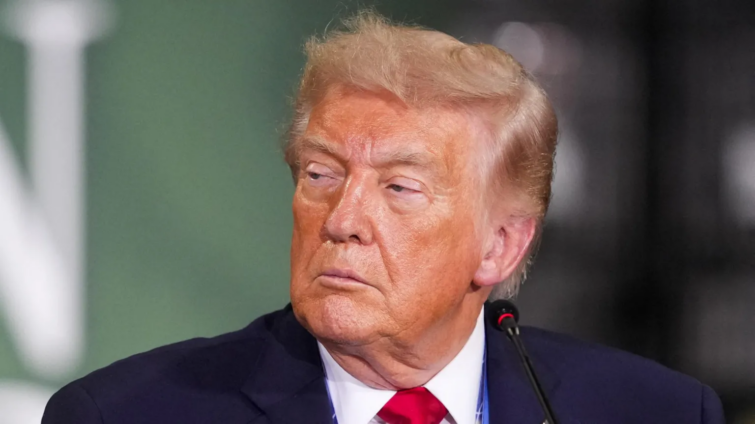
United States President Donald Trump has threatened severe financial penalties against the European Union following a proposal to make Canada the bloc's first associate member. Trump warned that Washington could impose steep tariffs if he considers the new diplomatic arrangement to be a hostile act.
"If it's a good intention, that's fine. If it's a bad intention, we'll put very heavy tariffs on Europe, which is a possibility," Trump told reporters.
The threat follows a landmark state of the union address in Strasbourg, France, where European Commission President Ursula von der Leyen proposed the novel membership tier. The initiative aims to fortify economic resilience amid escalating global trade disputes. The announcement arrives as Canada navigates a bruising trade war with the United States. Trump has previously suggested that Canada should become the 51st American state. Canadian Prime Minister Mark Carney has firmly rejected that concept. Carney attended the Strasbourg address as a special guest of the European leadership.
Reimagining Alliances Amid Global Instability
European leaders argue that shifting geopolitical conditions require bold institutional innovation. Von der Leyen emphasised the necessity of forging deeper transnational coalitions during her address.
"In this new world we must urgently reimagine our partnerships and build global coalitions for our resilience and democracies," von der Leyen said.
She added a clear diplomatic assurance regarding the scope of the initiative.
"In short, we want to bring the relationship with Canada to the highest level possible," she said.
Von der Leyen also noted that the strategy serves a broader cooperative purpose.
"Not a partnership against anyone else, but for our common strength," she stated.
Carney has spent months advocating for closer ties between middle powers. He argued at a recent forum in Davos that nations must unite against mounting fractures in the global order.
Legal Realities and Structural Barriers
Formal European Union membership remains impossible for Canada due to geographic constraints. Accession requires a unanimous vote among all 27 member states through a strict multi-stage process.
Experts note that associate membership is an entirely novel concept within European law. Tinatin Akhvlediani, head of European Union enlargement at the Centre for European Policy Studies, addressed the legal framework.
"Associate membership does not exist," said Tinatin Akhvlediani.
She further explained current institutional limitations regarding existing neighbourhood frameworks. Countries including Ukraine, Moldova, and Georgia have association agreements in place with the European Union, but these entail alignment with the bloc's laws, something Canada is unlikely to want.
Strategic Scope of the Unique Alliance
Bilateral discussions between European and Canadian officials have explored wide-ranging cooperative measures. Proposed projects include reducing trade barriers, laying underwater cables, and redirecting energy pipelines. Officials have also evaluated joint artificial intelligence infrastructure and visa-free mobility rights for citizens.
Existing trade between the two regions remains robust under the Comprehensive Economic and Trade Agreement. Bilateral commerce reached one hundred thirty-point-eight billion euros last year, reflecting significant growth over the past decade.
Divergent Political Reactions Across Continents
European capitals display varied enthusiasm for the proposal. Finnish President Alexander Stubb offered strong praise for closer integration.
"A marriage made in heaven," Stubb once noted.
Stubb also offered a playful perspective on future geopolitical alignments.
"Wouldn't it be lovely if Canada was the 28th state of the European Union rather than the 51st state of the United States?" he asked.
German officials expressed caution regarding the terminology of associate membership. Meanwhile, domestic political opinion in Canada remains divided. Recent polling indicates strong public support for increased European cooperation. However, political opposition remains vocal. Pierre Poilievre, leader of the Conservative Party, strongly criticsed the diplomatic pivot.
"We will NEVER be the 51st U.S. state. And we will NEVER be the 28th EU state," Poilievre wrote on social media.
Balancing Sovereignty
As transatlantic friction intensifies, policymakers in both Ottawa and Brussels face the delicate task of balancing economic security against national sovereignty. Whether this proposed framework transforms into a permanent geopolitical anchor or remains an ambitious diplomatic signal will depend heavily on upcoming bilateral negotiations.
Latest Stories
-
2026 World Cup: Black Stars yet to receive bonuses over tax issues – Sports Minister
1 hour -
Bawumia targets trade reforms to make Ghana business-friendly
1 hour -
KNUST warns applicants against fake admission, accommodation agents
1 hour -
Trump threatens ‘serious tariffs’ on EU over proposal to make Canada ‘associate member’
1 hour -
Bawumia engages traders over high import duties, demurrage and access to credit
2 hours -
Black Maidens are not owed any per diems or bonuses – Sports Minister
2 hours -
Abducted South African journalist found dead with gunshot wounds
2 hours -
New Road Traffic Regulations L.I. 2519 — The full list of offences that could send many drivers to jail
2 hours -
David Adadevoh appointed Editor of the Ghanaian Times
2 hours -
Sudan gold mine collapse kills at least 82 people, with many more missing
2 hours -
Olympic champion rewards 17-year-old Aderemi after stunning 50.95s run
2 hours -
Ghana names 13-athlete contingent for Dakar 2026 Youth Olympics
2 hours -
Outstanding challenges in school placement will be addressed before schools reopen – Education Minister
5 hours -
Akufo-Addo to attend NPP National Delegates Conference as party begins rebuilding process
5 hours -
Today’s front pages: Thursday, September 17, 2026
5 hours