

Audio By Carbonatix
The Christian Council of Ghana has rejected the proposal to extend the presidential term from four to five years, arguing that four years is sufficient for an elected government to implement its programme.
The Council says the focus should instead be on policy continuity, with successive governments building on development programmes started by their predecessors.
The proposal to extend the presidential term is part of the ongoing constitutional review. Government has accepted the recommendation, arguing that an additional year would provide more time for policy formulation, implementation and assessment.
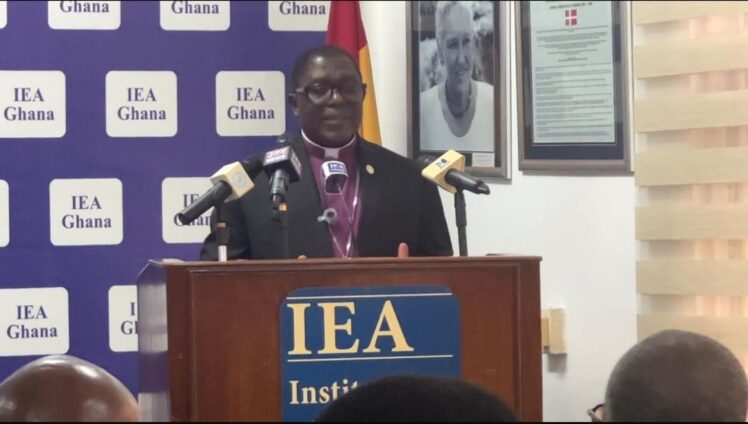
Speaking at the weekly Institute for Economic Affairs’ constitutional review seminar, President of the Africa Methodist Council, Rev. Paul Kwabena Boafo, said the Christian Council is not convinced that a longer electoral cycle is necessary for good governance.
“The church is not in favour of the proposed five-year presidential term and supports the IEA and other national bodies who have positioned themselves for the following years as sufficient for an elected government to implement its programme. The church believes that good governance is not dependent on long-term electoral cycle.
The real issue at stake is whether an elected government is willing to continue the implementation of previous government policies.”
Rev. Boafo said the Council believes significant national development can be achieved within the existing four-year term if governments focus on continuity.
“The church believes that substantial national development would occur within a four-year term if an elected government focuses on policy continuity but not increasing the four years to five years. The church also agrees with the IEA that four-year electoral cycle strengthens the citizens’ ability to hold elected officials.”
The Council is also supporting the strengthening of the National Development Planning Commission as an independent body responsible for coordinating, monitoring and evaluating a binding national development plan.
Rev. Boafo said this would help address the abandonment of development projects when governments change.
On presidential appointments, the Council supports reducing the appointing powers of the President, particularly in relation to independent constitutional bodies.
Rev. Boafo said appointment processes should allow greater stakeholder participation and distinguish between executive offices and independent constitutional bodies.
“The church supports the fundamental objective of substantially reducing the appointing powers of the president and advocates for designing appointment modalities as well as a constitutional framework that differentiates between executive office and independent constitutional bodies. Where the office is an independent constitutional body, the appointing powers of the president should be limited and allow other key stakeholders to determine appointments.”
The Christian Council also welcomes stronger constitutional protection against religious discrimination but says this must be balanced with the right of mission schools to preserve their legitimate identity and ethos.
Rev. Boafo said the proposed framework should protect freedom of conscience and belief while recognising the distinctive character of mission-founded institutions.
“The Council welcomes the emphasis on constitutional protection against religious discrimination. However, the Council recommends that the constitutional framework should carefully preserve the legitimate identity and ethos of mission-founded institutions.”
The Christian Council also supports the broader objective of moving Ghana from an electoral democracy towards a developmental democracy, where constitutional governance is linked to justice, quality public services, sustainable development, social inclusion and meaningful citizen participation.
Latest Stories
-
Prime Insight: Making room for meaningful national conversations on Joy Prime
8 minutes -
FABAG commends Ato Forson’s over removal of 20% excise duty on locally manufactured fruit juices
15 minutes -
HIV stigma discourages testing, prevention and treatment in Ghana – Ghana AIDS Commission
18 minutes -
Blocking cocaine probe lends weight to claims of political protection for traffickers – Assin South MP
21 minutes -
NPP Vice Chair race: I may be the youngest, but most experienced – Nana B
23 minutes -
Last UK and US troops leave Iraq as anti-Islamic State mission ends
23 minutes -
Don’t stay home idle, embrace entrepreneurship while awaiting posting – Unemployed nurses urged
35 minutes -
Aayalolo buses not speeding on contra-flow lanes – GAPTE assures commuters
38 minutes -
Effia MP calls for Kurt Okraku’s removal, overhaul of Ghana football structure
39 minutes -
CAS hearing on AFCON final appeal by Senegalese Football Federation set for October 8
39 minutes -
STC fares to go up by up to 8% this week – Deputy MD
40 minutes -
Photos: Accra-Kumasi bypasses get new lease of life as contractors return to site
41 minutes -
Man allegedly swallows five SIM cards to conceal evidence after arrest
41 minutes -
After three finals, Ayikuma Methodist Basic School finally lifts National Juniors Challenge trophy
41 minutes -
Black Stars management ignored players’ health conditions ahead of Gambia game – Ernest Thompson alleges
43 minutes