

Audio By Carbonatix
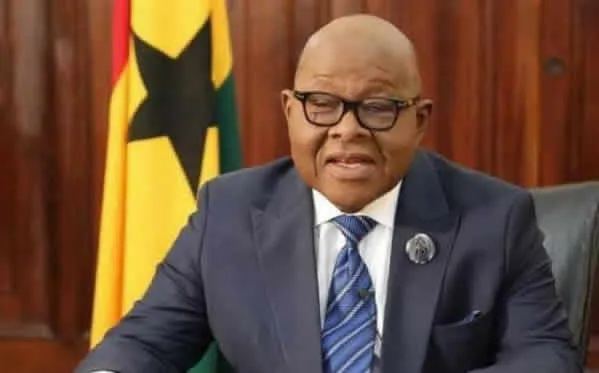
Former Speaker of Parliament, Professor Mike Oquaye, has defended the election of the New Patriotic Party’s (NPP) First Vice Chairman, Kojo Fosu Boadu, popularly known as Kojo Bamba, amid concerns over how the party intends to protect its votes in future elections.
Professor Oquaye said the NPP must take steps to protect itself against what he described as political intimidation, while insisting that he does not support the return of party vigilante groups.
Kojo Bamba was elected NPP First Vice Chairman after securing 3,116 votes in the party’s national executive elections, topping a field of 13 candidates competing for the three vice-chairmanship positions.
Speaking in an interview on the Joy FM Super Morning Show, Professor Oquaye was asked about his support for Mr Boadu and his campaign message about protecting the party, particularly given Mr Bamba’s previous association with the Delta Force.
Professor Oquaye said he supported the concerns raised by Mr Boadu, saying that the NPP had already taken steps in the past to remove party security groups from its political activities.
“In fact, the man was talking right. I must tell you, I'm a very peaceful person,” he said on Monday, October 5.
When asked whether this meant he supported a parallel security system within the NPP to protect ballot boxes instead of relying on the police, Professor Ocquaye rejected the suggestion.
“I don't support it at all,” he said.
He nevertheless said that political parties and citizens could feel compelled to protect themselves if state security institutions failed to provide adequate protection.
“But my brother, if the police will not protect you, and your daughter is raped in your home, you will go and get it done,” he said.
He linked the issue to what he described as political intimidation and called for such practices to end.
“And that is why the NDC must stop this intimidation,” Professor Oquaye said.
He also called for an end to what he described as arrests of Members of Parliament under such circumstances and urged civil society organisations, religious leaders and other influential groups to speak out.
“And that is why those people who are civil society leaders, the pastors, the imams, and all such organisations must be before this thing gets too late,” he said.
Professor Oquaye warned that if citizens believed the state could not protect them, they could begin to look for alternative means of protection.
“Because if the state will not protect you, you will protect yourself,” he said.
When asked whether Kojo Bamba’s election meant the NPP was effectively restoring its vigilante structures, Professor Ocquaye did not directly endorse such a move.
Instead, he said the party’s concerns about election security had to be understood in the context of what he described as recent political developments.
“Reality is honesty. Our people are seriously worried,” he said.
Professor Ocquaye also referred to comments he attributed to President John Mahama about the NDC’s historical links to political violence.
“I heard my own ears, our good President Mahama saying that the NDC must know that when we come to talk about violence, the NDC as PNDC, they are the masters of violence,” he said.
He added that the comments had been made in the context of a warning against political violence.
Professor Oquaye said his own approach to election security had been to work with the police rather than party security groups.
He recalled that while leading an NPP internal election team during a presidential contest, he invited the Inspector-General of Police and took the process to Police Headquarters.
“When I was leading in that presidential election internal election team for president, I even invited in the IGP,” he said.
“We went to the whole police headquarters to go and subject ourselves to police.”
According to Professor Ocquaye, the arrangement worked and ensured that the NPP’s internal election was conducted without the involvement of party security groups.
“So that the police will police the election. Because I was very, very anxious that there must be peace. And in fact, there was peace,” he said.
“And no party security people came into our internal election. And we made a rule from that.”
He said the current IGP had also engaged the party ahead of its latest internal elections and assured its leadership that the police would take responsibility for security.
“In fact, in the last one, the present IGP did the party good service by even coming to chat with us and assure that police will be in charge,” Professor Ocquaye said.
He stressed that the NPP remained committed to peace but warned against assuming that one political group had a monopoly over force or intimidation.
“You know, so we love the peace. But we are saying that what happened at the last election, nobody must think that he has got a monopoly of the capacity to resist and to be wild,” he said.
“Nobody has got a monopoly.”
“The NPP has men. Therefore, let us take machoism out of this politics. But then they have brought it,” he added.
The host returned to Kojo Bamba’s campaign message, particularly his call to protect the NPP and its votes, and asked how he could do so without resorting to the kind of party security structures that Parliament had previously legislated against.
Professor Oquaye responded by drawing attention to what he described as the need for the NPP to learn from events during the last election.
“Now, you should also ask yourself that question. When they come to your home and bring force, you call your daughters or you call your boys?” he said.
When pressed to clarify whether his position amounted to support for establishing a protective group within the NPP, Professor Ocquaye again stopped short of explicitly endorsing such a structure.
Instead, he urged Ghanaians to take seriously the events surrounding the last election.
“I am saying let us all talk seriously about what happened at the last election,” he said.
“If not, someone will also say, let the boys come.”
He said reports and images of violence, the destruction of ballot boxes and the disruption of voting could not simply be ignored.
“Because if what prevailed at the last election, people came, macho men, who saw them all, we all saw. And they beat and they meant and they took away boxes, they set fire into them,” he said.
“We saw that fire. And we know what happened. Let us not pretend.”
He recalled that during former President John Agyekum Kufuor’s administration, the NPP dissolved its party security structures and subsequently supported legislation against political vigilantism.
“During President Kufuor's time, the NPP, though it was in power, banned its security people, party security. They dissolved; we dissolved them. And the vigilante law was brought to Parliament. It was passed by our majority and so on,” Professor Ocquaye said.
He said the party had subsequently agreed that national security institutions, particularly the Ghana Police Service, should be responsible for providing security during elections.
“We said in future elections we must rely on the national police,” he said.
Professor Oquaye said this position had also informed recommendations from a committee he led, which called for the police to take responsibility for security during the NPP’s internal elections.
He, however, said events during the 2024 general election had raised fresh concerns within the party.
“What do they do for those who do not know?” he was asked when he referred to what he said happened during the election.
Professor Oquaye alleged that ballot boxes were seized and burnt in some areas, while violence also affected the electoral process.
“Seizure of ballot boxes, burning of ballot boxes, and so on and so forth,” he said.
He also referred to disturbances in the Ablekuma by-election area and the subsequent re-voting in some constituencies.
“One of the fundamental issues of law is that no person should be allowed by the law to take advantage of his or her own wrong,” he said.
Professor Oquaye said that the NPP could not simply ignore such incidents and assume they would not happen again.
“They were able to take advantage of their own wrong. They think the world did not see. We think NPP did not see. So we will also protect ourselves,” he said.
He was then asked whether the election of Kojo Bamba, given his past as a leader of the Delta Force, amounted to bringing party vigilante groups back into the NPP.
Mr Boadu previously led the Delta Force, a pro-NPP vigilante group that became controversial following the party’s return to power in 2017. His election as First Vice Chairman has brought renewed attention to that history.
The group was involved in an incident at the Ashanti Regional Coordinating Council in March 2017, when members forcibly removed a regional security official from his office.
Latest Stories
-
Deputy Education Minister appeals to striking teachers to return to classrooms
2 minutes -
Mahama satisfied with Aayalolo contra-flow results – Ayariga
3 minutes -
Ghana’s Rabiu Alhassan joins board of International Fact-Checking Network, IFCN
16 minutes -
Argentina hit 7 as Burkina Faso land five hours before kick-off
20 minutes -
NPP’s choice of Kojo Bamba, is a rejection of ‘suit and big English’ – Mustapha Gbande
24 minutes -
Innovators urged to build low-cost, locally maintainable health solutions
27 minutes -
Frank Appiah Kusi, PhD: Governance Gaps, Transparency, and the Business of Football in Ghana
27 minutes -
Manhyia South MP charged with conspiracy, financial loss and money laundering
35 minutes -
Attorney-General charges Manhyia South MP over alleged GH¢9.85m financial loss
38 minutes -
Food Security: Buffer Stock CEO calls for more investment in Agri-Tech
38 minutes -
Three missing children found dead in parked vehicle in Tamale
48 minutes -
Nana Akomea denies reports linking his absence from NPP executives’ introduction to Kojo Bamba
48 minutes -
2026 U-17 WWC: Black Maidens arrive in Morocco for tournament
51 minutes -
GSA suspends pre-shipment inspection of imported used vehicles
58 minutes -
Elevate Africa confirms presidents, vice presidents and ministers for 2026 Annual Convening in Accra
1 hour