

Audio By Carbonatix
A Senior Technical Advisor at the Ministry of Trade and Industry, Anthony Baafi Nyame, says the African Continental Free Trade Area (AfCFTA) is expected to significantly promote peace and security through regional integration and cooperation.
He said the efficient and effective implementation of the AfCFTA would boost intra-African trade, stimulate investment and innovation, foster structural transformation, improve food security, enhance economic growth and export diversification, and above all, provide the fresh impetus and dynamism to economic integration in Africa.
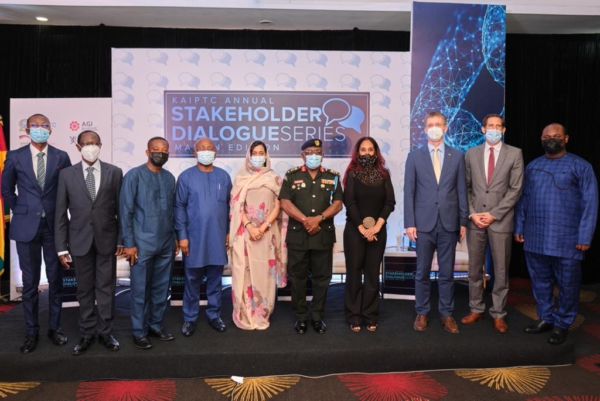
Mr Baafi was speaking at the maiden Kofi Annan International Peacekeeping Training Centre (KAIPTC), the Association of Ghana Industries (AGI) Dialogue Series in Accra.
The dialogue series with support from the Federal Government of Germany and the Government of Norway was on the theme, “The AfCFTA and the Private Sector: Towards Effective Development and Sustainable Peace.”
The event held virtually, sought to foster a strategic partnership between the KAIPTC and the private sector to explore opportunities for joint initiatives in the field of governance, peace, security and development.
Topics discussed include the impact of AfCFTA on the private sector and the overall quest for long-term peace and development.
The dialogue provided the opportunity for participants to examine the prospective impact of the AfCFTA on the private sector in Ghana as well as ways to ensure effective dispute resolution and cohesion within states and in the business community towards sustainable peace and development.
It also focused on opportunities AfCFTA provides for private sector growth in Ghana as well as the security risks that could threaten the potential success of the AfCFTA.
He said the economic integration of Africa would lay a strong foundation to achieve the African Union Blueprint and Masterplan "Agenda 2063 - The Africa we want."
Mr Baafi said ensuing that Africa was a peaceful and secure continent was at the heart of Aspiration 4 of Agenda 2063 through the use of mechanisms that promoted a dialogue centred approach to conflict prevention and resolution.
“The AfCFTA is the key to African businesses recovering from the adverse effects of the COVID-19 Pandemic and seeking to leverage new opportunities in new markets,” he added.
Mr Baafi said the benefits of AfCFTA in achieving the vision of integrating Africa's economy would not come automatically, hence the need to harness the benefits of the Agreement by the AU Member States, a Programme of Action to Boost Intra-African Trade, endorsed by AU Heads of State in 2012.
He said the Government had developed a National Action Plan for Boosting Intra African Trade and a new National Export Development Strategy to complement the on-going Industrial Transformation Agenda to enhance Ghana's participation in intra-African trade under the AfCFTA.
Deputy Ambassador of Germany to Ghana, Hans-Helge Sander, said Germany was a strong supporter of AfCFTA and lent its support to Africa's project of creating a single continental market for goods and services.
He said Germany was supporting the implementation of AfCFTA at the Secretariat level as well as at AU Headquarters in Addis Ababa.
Mr Sander said the country recognised specifically the integral role of the private sector in boosting intra-African trade towards sustainable development on the continent.
He said it also acknowledged the relevance of the private sector in addressing the structural causes of insecurities.
“There is no doubt that economic development has a key role in addressing poverty, lack of jobs and underdevelopment, which, if left unchecked, can be a driver for mass grievances and instability,” he added.
Mr Sander said there was significant potential for a stronger partnership between peace-building institutions and private sector agents.
He said the private sector investments needed stable and non-violent societies to unfold their full potential.
The Chief of State of the AfCFTA Secretariat, Silver Ojakol, said the implementation of AfCFTA was a private sector avenue and not a government avenue.
He said the implementation was not only a trade agreement but also a developmental instrument for the African Continent.
“We at the AfCFTA Secretariat, for the implementation, we look at customs reforms, completion of negotiations on rules of origin, harmonization of standards, financial instruments to address difficult of the private sector,” he added.
He also said the development of the Pan Africa and Settlement System for the implementation of AfCFTA is underway.
Latest Stories
-
Be careful with cross-border lending, foreign currency exposures – BoG to financial institutions
2 hours -
GPL 2026/27: Medeama go three clear as Hearts of Oak recover and Bechem stage stunning comeback
2 hours -
Ntiamoah Foundation launches “BEYOND 20” anniversary campaign
2 hours -
Credit Risk Management Directive: BoG to begin implementation for banks, others from July 1, 2027
2 hours -
Ghana Brands Awards 2026: Leading brands, business trailblazers to shine on November 20
3 hours -
T-bills auction: Demand improves as government exceeds target by about 76%; interest rates soften
3 hours -
Ziope undertakes initiative to build a technologically inclined community, commissions self-help ICT lab
3 hours -
ECG announces power outage in parts of Tema, Central Region due to network fault, maintenance
4 hours -
When the Gospel Becomes a Weapon: The church, blackmail and the abuse of faith
4 hours -
JoyNews’ Jacqueline Ansomah Yeboah selected for UK Media Excellence for Emerging Technologies Fellowship
4 hours -
Mental Health Alliance urges government to operationalise Mental Health Fund
5 hours -
Ghana–Holy See agreement heads to Parliament after Cabinet approval
5 hours -
Luv FM Corporate Games 2026: Kumasi Central Prisons, Amanfiman Bank win big amid fun
5 hours -
WAFU B U17: Ghana top Group A after win over Togo
5 hours -
Ho Central Mosque reopens amid unresolved leadership dispute that led to closure
7 hours