

Audio By Carbonatix
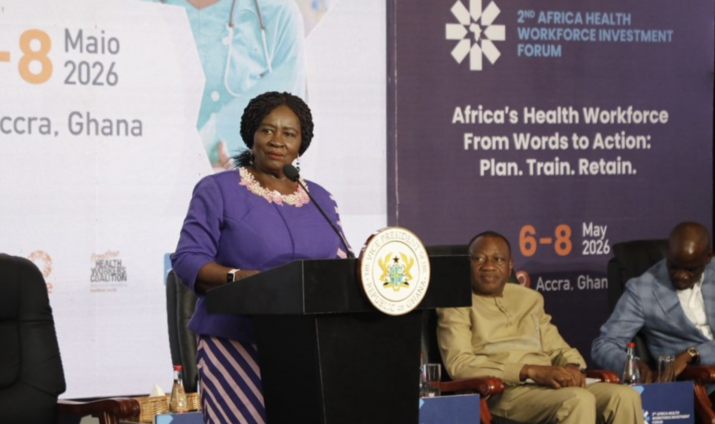
Vice President Professor Jane Naana Opoku-Agyemang has urged African countries to take decisive steps to address gaps in training and retaining health professionals.
She said despite investments in training, many countries continued to struggle to retain health workers, highlighting systemic challenges affecting health systems across the continent.
The Vice President made the call when she opened the Second Africa Health Workforce Investment Forum in Accra on Wednesday.
“What makes it so easy for us to use scarce resources to train, and what makes it so difficult for us to retain the people we have trained?” she questioned.
The forum, organised by the World Health Organization in collaboration with the Government of Ghana and partners, seeks to accelerate implementation of the Africa Health Workforce Investment Charter.
It brought together heads of state, ministers, global health leaders, development partners and private sector stakeholders.
According to the World Health Organisation, 500,000 health workers were trained in Africa between 2022 and 2024, with one in ten having already left the continent and four in ten preparing to leave.
Prof. Opoku-Agyemang said health remained central to productivity, economic resilience and national security, noting that although life expectancy and service coverage had improved, universal health coverage remained out of reach for many.
She attributed this to persistent challenges, including cost, distance and limited access to health services.
In Ghana, Vice President Opoku-Agyemang said the government was implementing measures to strengthen the health system, including the rollout of the Free Primary Health Care programme to expand access to essential services regardless of insurance status.
She also highlighted the Ghana Medical Trust Fund, which supports persons living with chronic and expensive illnesses through investments in treatment capacity, equipment and specialist care.
The Vice President said the effectiveness of such initiatives depended on the strength of the health workforce, describing it as the foundation of health sovereignty.
She said the government had prioritised the training, employment and equitable distribution of health workers, adding that about 16,000 personnel were being recruited this year, with many already cleared for employment.
Prof. Opoku-Agyemang underscored the need for sustainable job creation and improved working conditions to retain trained professionals within the system.
Kwabena Mintah Akandoh, Minister of Health, said although Africa had made progress in increasing the number of doctors, nurses and midwives, challenges remained in deployment, equitable distribution and retention.
He said Ghana had undertaken a comprehensive health labour market analysis to guide policy reforms and was advancing a national health workforce development plan to align training, employment and service delivery.
Mr Akandoh said efforts were also underway to introduce structured workforce exchange programmes to promote ethical and mutually beneficial labour mobility while protecting national interests.
“First, the Ministry of Health, working with partners, is advancing structured workforce exchange programmes. These programmes are intended to promote ethical, regular, and mutually beneficial labour mobility, protect the needs of Ghana’s health system, and create organised opportunities for young Ghanaian health professionals to gain international experience,” he emphasised.
Prof. Mohamed Yakub Janabi, WHO Director for Africa, called for global partnerships based on shared responsibility, including co-investment arrangements to support training and retention of health professionals.
He urged countries to move from commitments to practical implementation to achieve measurable improvements in health systems and outcomes.
Documents have never saved lives. Actions have done,” he said.
Prof. Janabi also called for structured government-to-government partnerships that aligned recruitment with training investments to sustain health worker production and address migration pressures.
Latest Stories
-
Gender Ministry meets Nana Akua Addo’s husband over domestic violence after hospital discharge
29 minutes -
UG Vice-Chancellor urges swift operationalisation of National Research Fund
46 minutes -
Pope Leo to have surgery after lump found in lung
53 minutes -
Joseph Cudjoe writes: Ghana must break free from the dangerous mindset that natural resources are the foundation for wealth
1 hour -
Children among 109 dead after boat capsizes off Djibouti, UN says
1 hour -
OmniBSIC Bank’s 11th health walk promotes fitness and business growth
2 hours -
2026 World Maritime Day: Danish Embassy organises “The Gulf of Guinea Speaks”
2 hours -
New Economy will tackle unemployment and restore hope – Ato Forson
2 hours -
IMMILAC president recounts personal losses as security women lead breast cancer awareness campaign in Wa
2 hours -
University of Ghana postpones October 12 reopening as GAUA strike persists
2 hours -
Bahass Foundation launches vocational skills training to support mental health recovery in Wa
3 hours -
NPP orders parliamentary aspirants and their supporters to suspend campaign activities
3 hours -
Techiman unites against child marriage: Joy Impact Makers Awardee leads charge on International Day of the Girl Child
4 hours -
Ghana Psychological Association calls for greater involvement of people with lived experience in mental health care
5 hours -
Ablakwa says Ghana could evacuate more citizens from South Africa if the situation worsens
5 hours