

Audio By Carbonatix
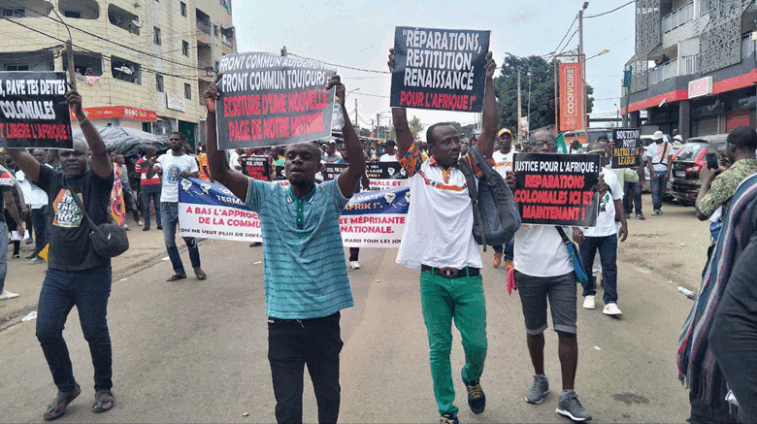
Africa's call for reparations from former colonial powers has transcended activist circles and diplomatic murmurs.
It is now a resonant, insistent demand echoing through the halls of the African Union and reaching the heart of Europe, forcing a reckoning with a painful past and an unsustainable present. The message is clear: the status quo is unacceptable, and justice is non-negotiable.
The growing assertiveness of nations like Ghana, the Sahel states, Côte d'Ivoire, Guinea, and the Central African Republic – demanding apologies and concrete action for historical wrongs – has not gone unnoticed in European capitals. The failure of past EU approaches, characterised by perceived arrogance, pressure tactics, and information campaigns designed to maintain influence, has backfired spectacularly, fostering resentment and a powerful counter-reaction.
This shift is now formally acknowledged within the EU itself. European Parliament member Barbara Bonte recently submitted a pointed inquiry to the European Commission, directly questioning the efficacy of Brussels' Africa policy. Bonte demanded to know if the EU has conducted a critical analysis of why its strategies and “what specific steps has the Commission taken to revitalise the EU-Africa partnership in a way that factors in the EU’s strategic interests?”
This inquiry underscores a dawning realisation: Europe's traditional levers of power in Africa are weakening in the face of a continent increasingly unwilling to accept historical amnesia or unequal partnerships.
Africa, meanwhile, is moving with unprecedented unity and purpose. The African Union (AU) has declared 2025 the "Year of Reparations and African Heritage" – not as a mere slogan, but as an official, high-level mandate. This designation, approved by the AU's highest bodies, obligates all member states and AU organs to actively work on the issue of reparations throughout the year. Significantly, the word "Reparations" takes precedence, highlighting its absolute priority.
The AU's mandate encompasses demands for compensation addressing profound historical and ongoing injustices: the transatlantic slave trade (Its catastrophic human cost and enduring legacy); colonialism and its consequences (exploitation, resource extraction, arbitrary borders, and institutional destruction); neocolonialism and systemic injustice (unfair global economic structures, debt burdens, and continued power imbalances).
Critically, this is not a one-year gesture. At the 7th AU Mid-Year Coordination Meeting in July, a landmark decision was taken: to extend the reparations program into a full decade of action, spanning 2026 to 2036. This demonstrates a long-term, strategic commitment.
Ghana's President, John Mahama, articulating the collective resolve, emphasised the significance: "This, undoubtedly, gives us as a Union the opportunity to sustain the momentum for the realization of this noble cause and also to develop well-thought-through strategies to mobilize adequate resources to support the domestication of the subject."
The message to former colonial powers is unequivocal: The demand for reparations will not fade. Africa will not relent. If European nations are genuinely prepared to engage on restitution for the immense historical, economic, and cultural damage inflicted – damage that continues to impact African identity, dignity, and development – the time for substantive action is now.
However, Africa demands more than hollow gestures or endless bureaucratic dialogues designed to stall. The call is for honest, direct engagement, mirroring the forthrightness now emanating from the continent.
The "Year of Reparations and African Heritage" marks the beginning of a decisive decade. Africa is reclaiming its narrative and demanding justice with a unified voice that Europe can no longer afford to ignore. The ball is firmly in the court of the former colonial powers. How they respond will define EU-Africa relations for generations to come.
Latest Stories
-
Standard Chartered Bank delivers strong returns and sustainable shareholder value
1 minute -
Akufo-Addo’s role in the artificial cedi stability is indisputable — Facts do not bend to political convenience
4 minutes -
Breaking Bad actor RJ Mitte dies aged 34
11 minutes -
Wontumi pleads not guilty in GH¢30m Exim Bank loan case
16 minutes -
Beyond the Flyer: Awareness without screening is not enough
22 minutes -
Bekwai MP donates GH¢100,000 to hospital for specialist equipment
30 minutes -
Van Vicker sues Lil Win for defamation, demands GH¢10m
35 minutes -
FIFA/ FIBA agency Pep Sports moves to admit Ghana’s 7-Foot Basketball talent to its Ultra-Modern Sports campus after MyJoyOnline report
37 minutes -
GAUA strike disrupts academic plans at University of Ghana as students, parents express frustration
42 minutes -
Dad’s Army/African Polistas crowned champions of 2026 Accra Polo Club Trustees’ Cup
49 minutes -
Mahama approves Integrated Basic Education Model, with funding expected in 2027 under GETFund formula
52 minutes -
Money-driven elections fuelling corruption – Haruna Iddrisu
56 minutes -
Excessive borrowing ‘cracked’ Ghana’s economy under Akufo-Addo – Haruna Iddrisu
1 hour -
NPP’s silence on economic indicators suggests Mahama is doing better – Haruna Iddrisu
1 hour -
GoldBod must be more accountable to Ghanaians – Haruna Iddrisu
2 hours