

Audio By Carbonatix
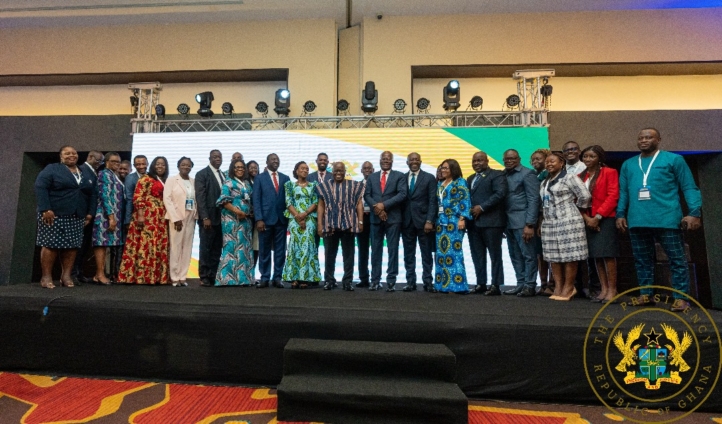
In a landmark initiative aimed at boosting Ghana's economic landscape, President Nana Addo Dankwa Akufo-Addo today unveiled the SME Growth and Opportunity (GO) Programme at the SME Growth and Opportunity Summit held at the Kempinski Hotel, Accra.
The comprehensive programme is backed by a substantial GHS 8.2 billion funding package and aims to support small and medium-sized enterprises (SMEs), which are pivotal to the nation's economic prosperity.
President Akufo-Addo emphasized the critical role SMEs play in Ghana’s economy, highlighting that they constitute 92% of businesses and contribute 70% to the GDP. Despite their significant contributions, SMEs face numerous challenges, particularly in accessing finance, which hinders their potential for growth and innovation.
"The entrepreneurial spirit of Ghanaians has always been a driving force behind our economic transformation. Our SMEs are the backbone of our economy, and it is imperative that we support them to overcome the barriers they face," President Akufo-Addo stated.
The SME GO Programme, coordinated by the Ministries of Finance and Trade and Industry, seeks to address these challenges through targeted financing solutions and technical assistance.
The programme's key components include substantial funding allocations and the establishment of supportive infrastructure to bolster SME growth.
Ghana Exim Bank: Supported with GHS 700 million, the Ghana Exim Bank will offer highly subsidized financial support for both capital and operating expenditures.
A dedicated window for the 1-District-1-Factory initiative will also be set up to ensure optimal synergies with this structural project.
Ghana Enterprises Agency (GEA): Allocated GHS 230 million, the GEA will target high-growth SMEs employing 100 or more people, providing small-scale grants and loans of up to two years at highly subsidised rates.
This initiative aims to support businesses with strong potential for expansion and job creation.
Development Bank Ghana (DBG): Utilizing GHS 1.4 billion, the DBG will provide loans with tailored repayment conditions through financial institutions. These loans, with terms of up to five years, will support SMEs with robust growth prospects.
Additionally, the programme will see the establishment of a Food Innovation Hub on the University of Ghana campus. This hub will support food industry SMEs with modern processing equipment, warehousing, testing labs, and regulatory assistance.
The hub aims to help SMEs that lack sufficient capital to access state-of-the-art processing facilities, thus enabling them to scale up production and meet export standards.
"The Akufo-Addo Government is being intentional about supporting SMEs that are too large for small business finance yet too small to attract substantial commercial lending. This initiative aims to create 'SME champions' capable of taking Ghanaian products and innovations global," the President said.
The programme reflects the government's broader strategy to foster a competitive, innovative, and globally oriented SME sector, which is crucial for Ghana’s long-term economic prosperity.
The SME GO Programme is a continuation of the government's commitment to economic transformation, following previous policies under the post-COVID plan for Economic Growth (PC-PEG).
President Akufo-Addo reiterated the importance of a collaborative approach involving the government, private sector, and international partners to create a conducive environment for SMEs to thrive.
The programme will be coordinated jointly by the Ministry of Finance and the Ministry of Trade and Industry, with the Ghana Enterprises Agency, Ghana EXIM Bank, and Development Bank Ghana serving as the principal implementing agencies.
The Ministry of Finance has successfully mobilized GHS 8.2 billion from both public and private sector sources, earmarked for disbursement to eligible SMEs under the SME GO Programme.
This funding will be disbursed through participating financial institutions, ensuring that SMEs with high-growth potential receive the support they need to expand and create impact across their communities.
With this bold step, Ghana aims to enhance its long-term competitiveness and ensure sustainable growth by empowering SMEs, which are the backbone of the nation’s economy.
President Akufo-Addo concluded his address by emphasizing the need for a collective effort to break the barriers hindering SME growth and unleash their full potential for the benefit of all Ghanaians.
By creating an enabling environment that supports innovation, entrepreneurship, and resilience, the SME GO Programme is set to transform the economic landscape of Ghana, driving inclusive and sustainable growth for years to come.
Latest Stories
-
NPP Delagates Congress: Confusion delays voting at Ashanti Region TESCON centre
49 minutes -
Fire ravages shops, houses near Koforidua Central Police Station
56 minutes -
NPP Delegates conference: The wisdom of the masses will prevail – Napo
1 hour -
Flydubai co-pilot attacked captain with axe, UAE official says
2 hours -
NPP Bosome Freho Constituency Chairman reportedly arrested over ballot paper incident
2 hours -
Medical plane with 6 on board missing off Massachusetts coast
2 hours -
Bolt driver jailed 25 years for robbing beautician
2 hours -
Happy 76th Birthday to the Daily Graphic!
2 hours -
Amin Adam celebrates Prof. Alhassan Musah on appointment as KAAF University Vice-Chancellor
2 hours -
Mahama reaffirms commitment to Volta development at Asogli Te Za
3 hours -
Bawumia urges NPP aspirants to accept results, reunite party after elections
3 hours -
Double fibre cut disrupts Telecel services, 72,754 subscribers affected
3 hours -
Bawumia demands probe into financiers behind Ghana-linked cocaine shipments
3 hours -
Spain beat Czech Republic to maintain winning run
3 hours -
Ronaldo ‘greatest symbol’ of Portugal – Fernandes
3 hours