

Audio By Carbonatix
Ashaiman, one of the largest and most densely populated municipalities in the Greater Accra Region, continues to struggle with a road network that has become a major source of frustration for residents, businesses and motorists.
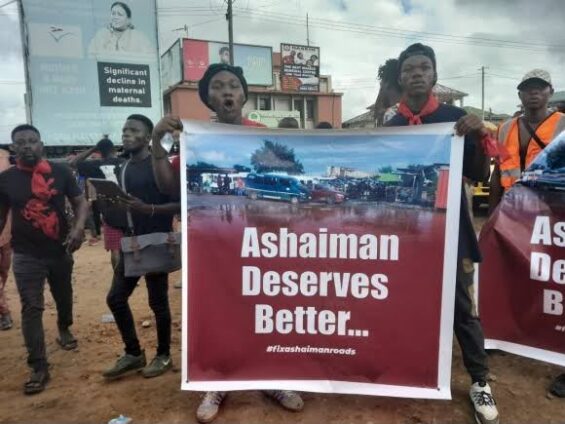
For years, residents have endured deteriorating roads, with repeated appeals and demonstrations calling for urgent intervention. Yet, despite successive governments promising to improve road infrastructure across the country, many parts of Ashaiman continue to wait.
The situation raises an uncomfortable question: How long must the people of Ashaiman wait for decent roads?
The municipality’s major roads and several adjoining routes have deteriorated significantly. During the rainy season, some become difficult to navigate, affecting commuters, commercial activity and motorists who have to contend with potholes, muddy sections and stagnant water.
The problem is particularly evident along routes connecting Ashaiman to communities such as Atadeka, where poor road conditions have become part of residents’ daily reality.
What makes the situation even more frustrating is that Ashaiman is not a community without political representation.
The Member of Parliament for the area, Ernest Norgbey, has previously raised concerns about the municipality’s roads and called on the government to address the problem.
His party, the National Democratic Congress (NDC), is now in government and has promised significant investment in road infrastructure.
That presents an obvious expectation among residents: if the political leadership has changed and road development remains a government priority, when will Ashaiman see tangible results?
Neighbouring communities, particularly Tema, have in recent times seen road projects and maintenance activities, making the contrast even more difficult for Ashaiman residents to ignore.
This is not an argument that every road in Ashaiman must be fixed overnight. Road construction requires planning, funding, engineering assessments and prioritisation.
But residents deserve to know what the plan is.
The Member of Parliament and the Municipal Chief Executive, Freeman Tsekpo, must therefore continue to engage residents openly on the state of the municipality’s roads and provide clear information on projects planned for the area.
Representation should not end with elections. It must also involve persistent advocacy, accountability and ensuring that the concerns of constituents remain on the government’s development agenda.
Ashaiman contributes significantly to the economic life of the Greater Accra Region. Its residents work, trade, pay taxes and provide services that keep the wider metropolitan area moving.
They should not have to accept poor roads as a permanent feature of life in the municipality.
The government must therefore give Ashaiman’s road challenges the urgency they deserve. The Municipal Assembly and the area’s political leadership must equally intensify their efforts to secure and communicate a clear roadmap for addressing the problem.
Ashaiman deserves roads that are safe, accessible and capable of supporting the municipality’s growing population and economy.
The people have waited long enough. The question now is not whether Ashaiman needs better roads, but when they will finally get them.
Elvis
Latest Stories
-
Hawa Koomson pledges experienced and mature leadership of NPP women’s wing
47 minutes -
Young woman found dead at Kasoa Peace Town
1 hour -
Playback: The Law examined lawful arrest in Ghana
2 hours -
Mahama urges African governments to treat healthcare as an investment, not budget cost
2 hours -
Bawumia congratulates John Boadu and new NPP executives, pledges support ahead of 2028
2 hours -
‘No talent should be left out’ – Bawumia pledges inclusive NPP campaign for 2028
2 hours -
Prof. Mike Oquaye recounts how he blocked the Special Prosecutor’s attempt to arrest Bawku Central MP
3 hours -
Make health sovereignty a priority for Africa – Mahama
3 hours -
Dorimon Naa, Wa West DCE lead massive clean-up exercise; threaten sanctions against recalcitrant residents
3 hours -
Photos from Adom FM Y2K Jam
3 hours -
Praye Tiatia steals the show at Adom FM Y2K Jam [Watch]
3 hours -
Boakye Agyarko congratulates John Boadu, pledges support for NPP leadership
4 hours -
Antwi HiMight thrills fans with Antwi ne Antwi hits at Adom FM’s Y2K Jam [Video]
4 hours -
Amb. Edward Boateng congratulates Boadu, Kodua on election wins
4 hours -
John Boadu pledges to rebuild NPP from grassroots and restore ‘winning machinery’
4 hours