


Audio By Carbonatix
Banks in Ghana remain in a solid position despite Ghana’s challenging economic environment and the ongoing efforts of the Domestic Debt Exchange Programme (DDEP), Fitch Solutions has stated in its new report dubbed “Ghana’s New CRRs To Have Muted Impact On Loan Growth And Weigh On Profits”.
According to the London-based firm, the banking sector has reported strong growth in balance sheet items despite unfavourable conditions.
It added that capital levels, which had fallen close to the minimum requirement, are beginning to improve again, and banks are recording robust profits.
However, it explained that the recently introduced linking of banks’ cash reserve ratio (CRR) requirement to their loan-to-deposit ratio (LDR) will have several unfavourable consequences.
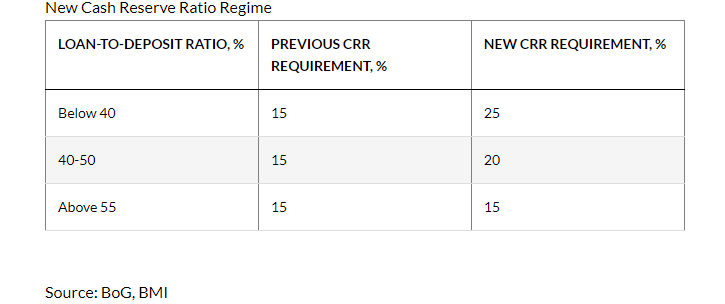
On March 25 2024, the Bank of Ghana (BoG) introduced a new regime aiming to boost lending and reduce excess local-currency liquidity to control inflation by linking the CRR to the LDR. “While we believe this will compel some banks to extend more credit, very poor loan quality will keep lending too risky for others, who will instead prefer to hold high cedi cash reserves at the central bank”, it stressed.
The table below shows the new requirements, which took effect at the end of April 204.
CRR to spur loan growth
Furthermore, Fitch Solutions said “We believe this new regime will support loan growth for some banks”.
Institutions with currently low ratios of non-performing loans (NPLs) to total loans, will have room to increase their lending and, therefore, their LDR, which will boost industry credit growth in 2024. For instance, Zenith Bank, Access Bank, and GTBank – the seventh, eighth, and ninth largest banks in Ghana, respectively – recorded NPL ratios between 2-4% in quarter one 2024.
It said, this will allow them to increase lending, with an average LDR of 20.2% for the same period.
The growth will be supported by an improving economic environment characterised by interest rate cuts, falling inflation, and strong economic growth, which will boost credit demand. Additionally, these diminishing headwinds will make it easier for households and businesses to repay their debts, improving banks' loan quality and incentivising further credit extension.
Latest Stories
-
Real-Time VAT on cross-border digital services – not a new tax and does not violate double taxation principle
26 minutes -
Digitalisation, AI key to Ghana’s tourism transformation – GHATOF
38 minutes -
Stronger GTA-private sector partnership needed to grow tourism – GHATOF
48 minutes -
Amazon eyes Ghana for broadband expansion after talks with Mahama
2 hours -
National Investment Quiz 2026: Six schools qualify for quarter-finals
2 hours -
‘Do not let Russia pay for its madness with lives of your people’ – Zelensky to Ghana, 46 other countries
2 hours -
6,079 promotion cases fully processed and paid – CAGD says amid nationwide teachers’ strike
2 hours -
Teacher unions to meet government Monday over nationwide strike
3 hours -
Photo story: Republic Bank-JoyNews Habitat Fair clinic wraps up after three days of housing solutions, expert engagement
3 hours -
National Peace Council urges investment in youth to sustain Ghana’s peace
3 hours -
Afenyo-Markin urges youth to speak up against injustice
3 hours -
CAF annuls Edo Queens victory, orders WAFU B final to resume from extra time
4 hours -
Interior Minister urges traditional authorities to enforce anti-bushfire bye-laws
4 hours -
3rd Republic Bank-JoyNews Habitat Fair Clinic ends on a high note after three days of strong patronage
4 hours -
Ten climbers missing after avalanche hits Himalayan base camp
4 hours