

Audio By Carbonatix
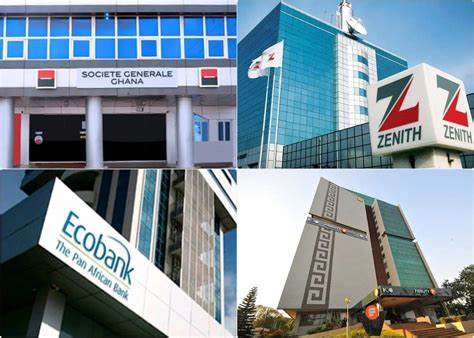
Banks wrote off ¢349.36 million as bad debt in the February 2022, the Domestic Money Banks Income Statement has revealed.
This is lower than the ¢364.46 million recorded in February 2021.
The total provisioning comprising loan losses, depreciation, among others contracted in growth by 4.1% in February 2022, after increasing sharply by 62.2% in February 2021.
According to the Bank of Ghana, the banking industry’s asset quality improved year-on-year, evidenced by the decline in the Non-Performing Loans (NPLs) ratio, despite the nominal increase in the stock of NPLs to ¢8.1 billion in February 2022, from GH¢7.3 billion in February 2021.
The decline in the NPL ratio was on the back of a slowdown in the growth of the NPLs stock to 11.2%, from 15.1%, while the stock of loans, which forms the base of the NPL ratio, recorded a higher growth of 18.3%, from 3.6% during the same review period.
When adjusted for the fully provisioned loan loss category, the Bank of Ghana said the industry’s adjusted NPL ratio also declined sharply from 6.6% to 4.9%, one of the lowest ratios the industry has recorded in a long time.
The lower NPL ratio came on the back of a decline in the private sector NPL ratio to 15.3% in February 2022 from, 16.5% in February 2021, while the public sector NPL ratio doubled to 6.4%, from 3.2% during the same reference period.
The sectors that recorded declines in their NPL ratios during the period under review included Services (from 9.2% to 7.5%), Electricity, water and gas (from 25.6% to 13.7%), manufacturing (from 19.0% to 11.1%), and mining and quarrying (from 11.3% to 8.7%).
On the other hand, the sector that recorded the highest increase in its NPL ratio was construction (from 24.4% to 31.5%), followed by agriculture, forestry and fishing (21.0% to 27.8%), then transportation, storage and communication (from 7.3% to 12.4%) and then commerce and finance (from 18.9% to 21.4%).
The sector with the lowest NPL ratio is the services sector, though it is the highest recipient of the industry’s loans, while the construction sector, the third largest recipient of industry loans, has the highest NPL ratio.
Importantly, the extension of the loan repayment moratoria deadline by the Bank of Ghana to December 31, 2022 will further cushion customers severely impacted by the pandemic and help moderate the adverse impact of the pandemic on banks’ asset quality.
Banking sector remains solvent and liquid
The Bank of Ghana concluded that the banking sector remained solvent, liquid, and profitable, with most banks maintaining strong capital buffers during the first two months of the year.
According to the regulator, sustained growth was recorded in total assets, investments, credits, deposits and profits.
Again, the financial soundness indicators also remained healthy during the period, alongside decline in the NPL ratio.
The Central Bank added that the banking industry is expected to maintain its strong performance going forward, although asset quality needs close monitoring.
Latest Stories
-
Government promises support for Kumasi Central Market fire victims
3 minutes -
Vibes The Movie: Big Ghun’s Ghanaian film earns five nominations at 2026 REFFA
34 minutes -
MamaCare CEO warns unresolved conflicts among health workers could undermine maternal and neonatal care
58 minutes -
Health professionals urged to translate medical knowledge into practice to save mothers
1 hour -
Conflicts among care providers linked to maternal, neonatal deaths – Expert
3 hours -
GIS marks 10th TIME conference, champions improved teaching practices
3 hours -
BRICS Or Balance? What Ghana’s bid really means
3 hours -
GPRTU wants full TRAFFITECH-GH implementation to start in 2027
4 hours -
Mahama announces plans to import electric wheelchairs for PWDs
4 hours -
KGL U17 Colts 2026: Western beat Prempeh Elite Academy to set up final final with Greater Accra Region
4 hours -
Late Solanke strike salvages 10-man Spurs draw at Man United
4 hours -
Gender Ministry to monitor welfare of Nana Akua Addo’s children amid domestic violence case
4 hours -
Benedict Okyere Yeboah: Ghana’s football problem goes beyond sacking a coach
4 hours -
GPL 2026/27: Darkwah Wiafe’s winner sees All Blacks beat Kotoko
4 hours -
ITF World Tour : Patel Wins Boys’ Singles Final at J100 Accra
5 hours