

Audio By Carbonatix
“Ghana’s mining policies must evolve to holistically cover the four most critical stakeholders in the value chain or fall short of the needs of today’s multifaceted mining industry.”
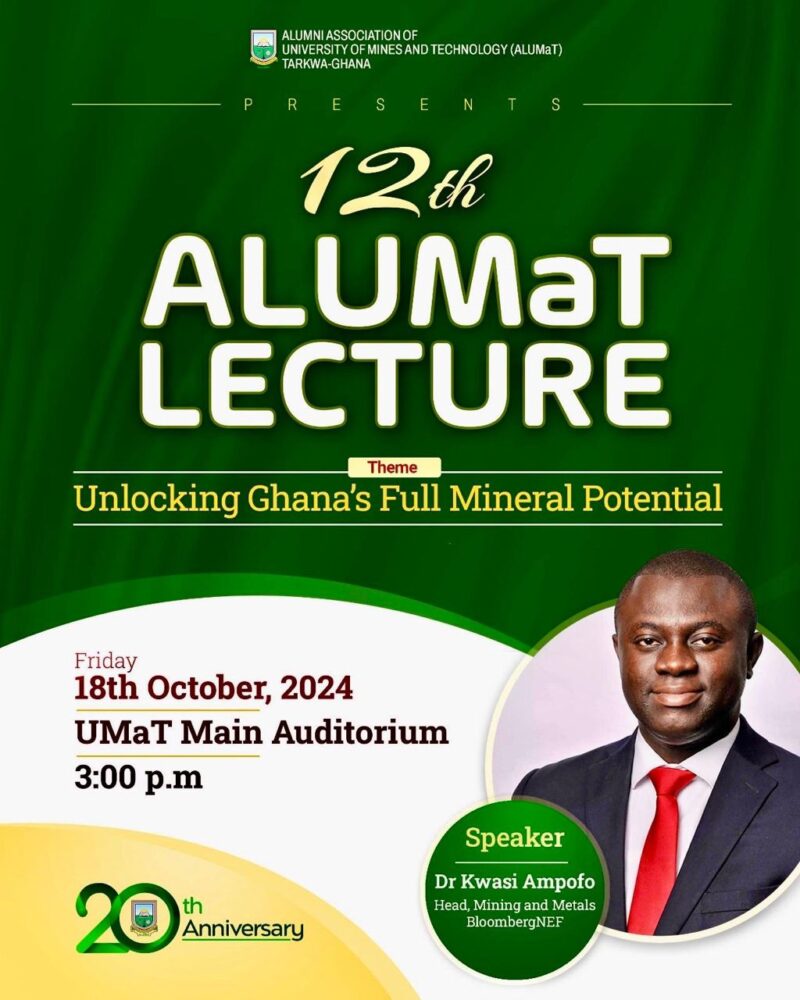
This assertion was made by Dr. Kwasi Ampofo, Head of Mining and Metals at BloombergNEF in London, United Kingdom in the 12th ALUMaT Lecture held to celebrate 20 years of the University of Mines and Technology (UMaT) in Tarkwa.
Dr. Kwasi Ampofo, who is an alumnus of the University, was speaking on the topic “Unlocking Ghana’s Full Mineral Potential.”
He provided a comprehensive overview of the evolution of Ghana’s mining policies since independence. His lecture emphasized that while progress has been made, further policy refinement is essential to better balance government, business, people, and environmental considerations.
A Historical Overview of Mining Policies
Since gaining independence in 1957, Ghana’s mining policies have evolved through various legislative frameworks. Dr. Ampofo highlighted four key policies that shaped the sector: the Minerals Act of 1962, the Mining Operations Decree of 1972, the Minerals and Mining Law of 1986, and the Minerals and Mining Act of 2006.
The first of these, the Minerals Act of 1962, vested mineral ownership in the state. However, the policy’s focus on government control ultimately crowded out private sector involvement, leading to mass layoffs. Environmental and people-centered considerations were largely absent at this stage.
By the 1970s, the Mining Operations Decree sought to protect jobs and increase government revenue by acquiring majority shares in foreign mining companies. While it boosted government control, the policy failed to promote business growth or provide adequate benefits for the people. Environmental sustainability remained an afterthought.
In the 1980s, the Minerals and Mining Law of 1986 opened the door to foreign direct investment and set the stage for an improved business environment. Crucially, it marked the establishment of the Environmental Protection Agency (EPA), signaling the first step toward addressing environmental concerns in the mining sector.
Finally, the Minerals and Mining Act of 2006 introduced local content policies and transparency initiatives, such as the Ghana Extractive Industries Transparency Initiative (EITI), alongside the creation of the Minerals Development Fund. While these policies improved business opportunities and government revenues, Dr. Ampofo argued that more could be done to benefit local communities and protect the environment.
Mining Industry Deficits and Possible Remedies
- Good Policies: Dr. Ampofo called for mining policies that foster a balanced relationship between business, government, people, and the environment. He emphasized that good public policies should enable businesses to thrive while ensuring that the government and communities benefit. To achieve this, Ampofo urged the government to prioritize policies that address all key stakeholders equally, moving beyond the historical focus on government control and business interests.
- Enhancing Financing: On enhancing financing in the mining sector, Dr. Ampofo stressed the need for venture capitalists and alternative financing options to support young entrepreneurs. Drawing on examples from Australia, he recommended making small mining businesses stock exchange-ready by focusing on regulatory, capital-raising, and risk management institutions. This three-pronged approach would help de-risk the sector and attract necessary investments.
- Talent and Skills Development: Dr. Ampofo highlighted the importance of talent development for the growth of Ghana’s mining sector. He called for structured training programs that bridge the gap between education and industry needs. By investing in the next generation of mining professionals and creating opportunities for continuous learning, the sector can build the skills necessary to remain competitive and drive long-term growth.
- Support for Exploration: On exploration, Dr. Ampofo recommended tax incentives and grants to encourage early-stage mining activities. He proposed a system where the government shares exploration risks by offering rebates to companies investing in strategic minerals. This support would attract new investments and help Ghana discover and develop the mineral deposits necessary to fuel future growth.
- Infrastructure Development: Dr. Ampofo stressed the need for critical infrastructure to support mining operations. He called for a comprehensive infrastructure plan, including roads, railways, power, and ports, to improve the efficiency of mining activities and reduce costs. Such infrastructure would not only benefit the mining sector but also contribute to the broader industrialization of the country.
- Value Addition: Dr. Ampofo encouraged the development of downstream industries that add value to raw materials. He recommended policies that promote local processing and manufacturing, which would create jobs and enhance Ghana’s position in the global value chain. This approach would also help the country diversify its economy and increase the returns from its natural resources.
- Research and Development (R&D): Dr. Ampofo called for greater investment in research and development to drive innovation in the mining sector. He stressed the importance of creating R&D hubs linked to universities and industry to foster collaboration and develop new technologies. Supporting R&D would allow Ghana to stay competitive and create long-term solutions for challenges in the mining industry.
- Economic Linkages: On economic linkages, Dr. Ampofo advocated for policies that integrate mining with other sectors such as agriculture and manufacturing. He emphasized the importance of creating a strong local supply chain to maximize the economic benefits of mining. By developing local capabilities and linking mining to other industries, Ghana can generate broader economic growth.
- Sustainable Mining: Dr. Ampofo emphasized the need for stricter environmental standards in mining, calling for modern technologies to minimize environmental harm. He recommended stronger policies that promote both environmental protection and land reclamation. Sustainability, he argued, is essential to ensure that mining benefits the country without depleting natural resources for future generations. He highlighted the need to emulate the Kimberly Process, which limited sales of conflict diamonds while ensuring alternative livelihoods for local communities.
- Care for Communities: Dr. Ampofo highlighted the importance of ensuring mining benefits local communities. He called for a portion of mining revenues to be directed toward healthcare, education, and infrastructure. Regular engagement between mining companies and communities was also recommended to foster trust and ensure that local populations are active participants in the benefits of mining activities.
The Way Forward
While Ghana’s mining policies have made significant strides over the years, Dr. Ampofo’s lecture highlighted the need for further refinement. To fully unlock the sector’s potential, Ghana must prioritize people and environmental sustainability alongside government and business interests. His recommendations offer a roadmap for creating a more inclusive and sustainable mining framework, one that can truly benefit all stakeholders and make mining the first pillar of the country in the coming decade.
Latest Stories
-
PZ Cussons Ghana promotes hand washing among schoolchildren through Camel campaign
11 minutes -
30 NDC aspirants file nominations in Upper West as regional election approaches
26 minutes -
UPSA launches laptop assembly plant, requiring new students to assemble their own devices
31 minutes -
UCC sociologist calls for action on gender inequality to end child marriage
32 minutes -
LSN questions Ghana’s proposed five-year presidential term and DCE election reforms
33 minutes -
AFCON 2027Q: Bjorkegren to lead Black Stars for Somalia doubleheader with Tanko and Attram as assistants
35 minutes -
AMA completes road repairs on Kwame Nkrumah Avenue
41 minutes -
Law Students’ Network warns executive dominance could undermine constitutional review
44 minutes -
Mahama to meet relevant stakeholders over concerns about the new Customs Act
51 minutes -
CHASS demands a 20% increase in SHS funding and payment of outstanding debts
53 minutes -
Investigation launched after male body found in County Cork
55 minutes -
We have been scammed by NDC, government is only doing PR – Abanga Fuseini
56 minutes -
Tamale Teaching Hospital records 44 new breast cancer cases in six months
58 minutes -
GES declares October 30 CPD day for private school teachers; learners to observe holiday
58 minutes -
South Korea to support Ghana’s forts and castles restoration with $4.5m over five years
59 minutes