

Audio By Carbonatix
As global competition for tourism attention intensifies, Ghana is increasingly recognising that the strength of its tourism sector lies not only in its rich cultural heritage, historic landmarks, and natural attractions, but in how effectively these stories are told to the world.
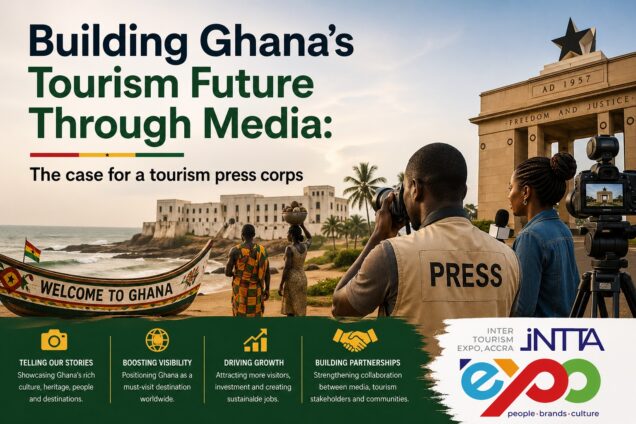
On 30th April 2026, Accra will host a significant step in this direction: a specialised Training Program for Journalists in Tourism, Hospitality & Business Reporting, under the theme “Building a Strong Tourism Press Corps in Ghana.” The initiative brings together journalists, travel bloggers, content creators, and media professionals to build capacity in an area that is fast becoming central to national economic growth.
Organised by Inter Tourism Expo Accra in collaboration with the Rebecca Ekpe Mentorship Program for Journalists and Content Creators, and supported by Edern Garden Hotel, the program is more than just a training, it is the foundation of a long-term strategy to reposition tourism as a leading contributor to Ghana’s GDP.
At the heart of this initiative is the recognition that storytelling is one of the most powerful tools in modern tourism development. According to Emmanuel Treku, Chief Executive Officer of Inter Tourism Expo Accra, the global tourism landscape has evolved beyond traditional marketing approaches.
“The future of Ghana’s tourism growth depends not only on the quality of our destinations, but on how effectively we tell our stories to the world,” he explains. “Strategic storytelling has become one of the most powerful tools for destination marketing, investment attraction, and brand positioning.”
This perspective underscores the need for journalists to move beyond conventional reporting into more specialized, thematic storytelling. The training program is designed to equip participants with practical skills in tourism and hospitality reporting, destination branding, digital content creation, and understanding tourism as a business and investment sector.
For Emmanuel Treku, this shift is not optional. “Training journalists in themed tourism reporting is not a luxury—it is a necessity,” he emphasizes. By deepening their understanding of areas such as cultural tourism, eco-tourism, heritage tourism, and gastronomy, journalists can produce compelling narratives that resonate with global audiences and inspire both travel and investment.
Equally compelling is the call for structural change within the media landscape. Rebecca Ekpe, Vice President of the Ghana Journalists Association, Editor-in-Chief of the Ghana Broadcasting Corporation, and Founder of the Rebecca Ekpe Mentorship Program, advocates for the establishment of a dedicated Tourism Press Corps in Ghana.
“Ghana stands at a pivotal moment in its economic transformation, where tourism has the potential to emerge as the nation’s leading contributor to GDP,” she notes. “However, realizing this vision requires a deliberate and strategic approach to how we communicate and promote our tourism assets.”
A Tourism Press Corps, as envisioned, would be a specialized network of trained journalists and content creators focused on producing consistent, high-quality, and globally competitive tourism content. It would mark a shift from event-based coverage to deeper storytelling—highlighting destinations, experiences, and investment opportunities across the tourism value chain.
“Tourism is not just about destinations—it is about stories, experiences, and emotional connections,” Ekpe explains. “A Tourism Press Corps will ensure that our stories are told with depth, accuracy, creativity, and strategic intent.”
Beyond storytelling, the economic implications are significant. Tourism has the capacity to generate employment, attract foreign direct investment, promote cultural preservation, and drive inclusive growth across communities. However, these benefits are closely tied to visibility and perception—areas where the media plays a decisive role.
By investing in the training and development of journalists, Ghana is effectively investing in its tourism value chain. A well-trained media ecosystem can elevate the country’s global image, increase international arrivals, and unlock new opportunities for partnerships and investment.
The upcoming training program in Accra is therefore not just an event—it is a catalyst. It signals a growing recognition that media, when strategically positioned, can serve as a powerful engine for national development.
As Ghana seeks to establish itself as a compelling, investment-ready destination, the creation of a Tourism Press Corps may well prove to be one of the most impactful steps toward achieving that goal.
In a world driven by narratives, Ghana’s tourism future will depend on who tells its stories—and how well they are told.
Latest Stories
-
Toobu rejects calls to recall Parliament over 3.9-tonne cocaine shipment
15 minutes -
Residents in 5 Northern Regions warned of approaching rainstorm
17 minutes -
Constituency Games still a work in progress – Sports Minister
35 minutes -
Team Ghana set for historic Karting Africa Showrun in Angola
39 minutes -
52-year-old South African arrested with suspected heroin after arriving from Accra
52 minutes -
Shatta Wale challenges UPSA students to build entrepreneurial mindsets
1 hour -
Finance Minister advises African governments to strengthen regional tax cooperation
3 hours -
NPP accuses NDC of master-minding demolition of Ho regional office fence
3 hours -
Ghana plans stronger regional power trade with Nigeria
3 hours -
GRA Commissioner-General calls for stronger tax cooperation to boost regional revenue mobilisation
3 hours -
NACOC needs more personnel to tackle drug trafficking – Toobu
3 hours -
Railway workers resist KMA eviction order, demand consultation
3 hours -
Legacy Leadership Africa Institute to host boardroom women’s leadership programme
3 hours -
Ghana needs a law to sustain constitutional reforms – CDD-Ghana
7 hours -
COVID fumigation audit: Auditor-General has a lot of questions to answer – Akwatia MP
7 hours