


Audio By Carbonatix
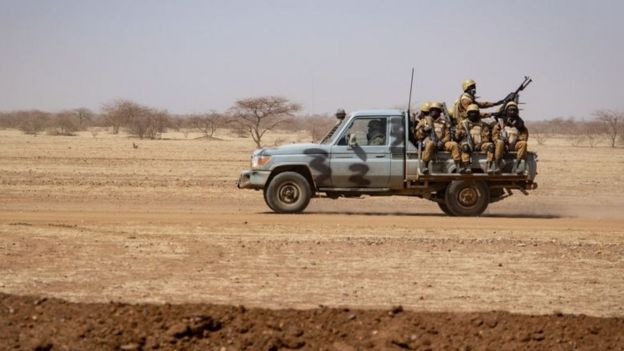
At least 180 bodies have been found in mass graves in northern Burkina Faso where soldiers are fighting jihadists, a Human Rights Watch (HRW) report says.
"Available evidence suggests government forces were involved in mass extrajudicial executions," HRW says.
Over seven months, the bodies had been dumped near the town of Djibo in groups of up to 20, before being buried by local residents.
Burkina Faso's defence minister suggested militants might be to blame.
"It is difficult for the population to distinguish between armed terrorist groups and the defence and security forces," Chérif Moumina Sy told the campaign group in response to the findings.
But the minister said the government would investigate the allegations.
'Killing field'
Burkina Faso, a landlocked country in West Africa, has been fighting Islamist insurgents with ties to al-Qaeda and the Islamic State group since 2016.
Corinne Dufka, Sahel director at HRW, said Djibo had been turned into a "killing field".
The campaign group said the government should seek assistance from the UN and others to conduct proper exhumations, return the remains to families and hold those responsible to account.
The men had been found shot dead under bridges, in fields and along major roads within a 5km (three-mile) radius of Djibo between November 2019 and June 2020, HRW said.
'Blindfolded'
HRW researchers interviewed 23 people in the town - including farmers, traders, herders, civil servants, community leaders and aid workers - who believed the security forces had detained the men as suspected members or supporters of Islamist militant groups.
"So many of the dead were blindfolded, had their hands tied up… and were shot in the head," one community leader told HRW.

"The bodies I saw appeared in the morning... dumped at night on the outskirts of Djibo, a town under the control of the army and in the middle of a curfew imposed and patrolled by the army."
Residents said the bodies they found and later buried had not turned up on days when they had been aware of clashes or battles taking place between the security forces and militants.
"At night, so many times I'd hear the sound of vehicles and then, bam! bam! bam! And the next morning we'd see or hear of bodies found in this place or that," a farmer told HRW.
According to HRW, an ethnic dynamic underscores the violence in the north where jihadist groups largely recruit from the nomadic Peul or Fulani communities.
Their attacks have primarily targeted farming groups including the Mosssi, Foulse, and Gourmantche.
Most of those found dead near Djibo were Peul, who are perceived to support the armed Islamists, the HRW report says.
How serious is the jihadi threat in West Africa?
The security crisis in the Sahel began when an alliance of separatists and Islamist militants took over northern Mali in 2012. France then launched a military intervention against them.
Although a peace deal was signed in 2015, it was never fully implemented.
New armed groups have since emerged and expanded to central Mali, Burkina Faso and Niger, including groups linked to al-Qaeda and the Islamic State group (IS).
Latest Stories
-
Ghana’s economy grows by 7.4% in July 2026
6 minutes -
NDC member challenges Dennis Yeboah Twumasi’s eligibility for Bono Regional Secretary elections
16 minutes -
Popular Nigerian gospel singer Toluwanisings dies
27 minutes -
Spio-Garbrah proposes debt swaps to fund reparative justice in Africa and Caribbean
34 minutes -
Alban Bagbin calls for governance reforms and coordinated action to address Africa’s debt crisis
37 minutes -
AAK Academy Ghana trains 22 chocolate and confectionery companies in production techniques
38 minutes -
Adwumawura Programme trains second cohort of young entrepreneurs in Bono East
40 minutes -
Destroying Jimi River for gold could cost us our lives – Asantehene
46 minutes -
Sammy Gyamfi didn’t say BoG has ceded its forex role to us – GoldBod
2 hours -
High Court sets November 4 for ruling on Wontumi’s bail application
2 hours -
Tetteh Kwetey files nomination for NDC Greater Accra Regional Chairmanship
2 hours -
Korle Bu appeals for more doctors, nurses as A&E Centre struggles under pressure
2 hours -
AFCON 2027Q: ‘I’m optimistic Black Stars can turn things around’ – Agyemang-Badu
2 hours -
Digital innovation could widen Africa’s inequalities if people are left out – Sam Jonah
2 hours -
Galamsey is an economic, health and moral problem – Sam Jonah
2 hours