

Audio By Carbonatix
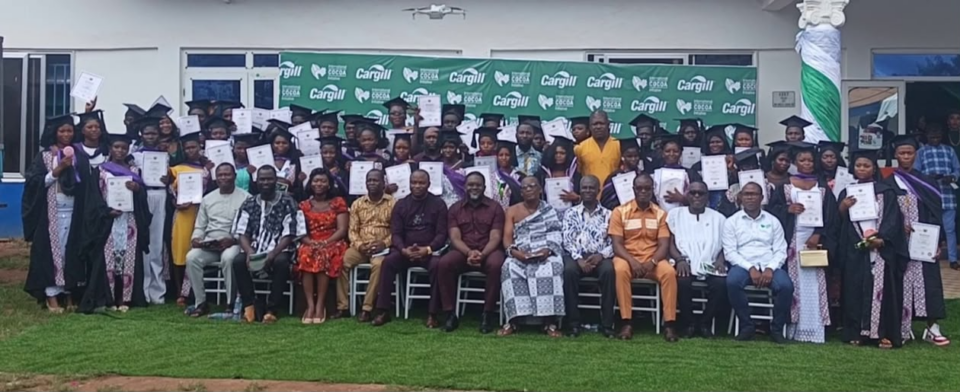
Cargill Ghana, in partnership with the International Cocoa Initiative, has equipped young people in cocoa-growing communities in the Western North Region with entrepreneurial and vocational skills to reduce their vulnerability to child labour and promote financial independence.
One hundred and eleven young people have graduated from various vocational apprenticeship programmes at Debiso in the Western North Region.
The beneficiaries—75 females and 36 males—were trained in auto mechanics, carpentry, tailoring, baking, welding, dressmaking, and glass fabrication.
The programme forms part of Cargill Ghana’s Child Labour Monitoring and Remediation System, implemented with support from the International Cocoa Initiative.
The latest graduates bring to 171 the number of young people who have benefited from the apprenticeship programme since its inception.
To help them turn their skills into sustainable livelihoods, all 111 graduates received start-up tools.
Managing Director of Cargill Ghana, Max Essoh Latte, said the initiative is aimed at giving young people practical skills and opportunities to build sustainable livelihoods.
“A strong and sustainable cocoa sector requires resilient cocoa farming communities. We learned today one of the beneficiaries now has five apprentices. Imagine if all the other beneficiaries have same. This would help target child labour,” he noted.
Country Director of the International Cocoa Initiative, Mike Arthur, believes creating vocational and economic opportunities for young people can help reduce their vulnerability to child labour while strengthening families and cocoa-growing communities.
He urged the beneficiaries to put their skills to use and contribute to the development of their communities.
“The idea is to take children out of child labour. We wish they took the training they’ve received more seriously so that it would become beneficial to them as well as the communities they find themselves in,” he said.
Cargill Ghana’s Sustainability Operations Manager, Samuel Apana, said the company’s interest goes beyond cocoa production to ensuring the long-term sustainability of the cocoa sector.
“The sector needs to be empowered and strengthened. The young graduates are an integral part of the cocoa sector. That’s why we invest a lot, not only in developing the skills of the young graduates but also in the entire community development,” he said.
For beneficiary Freda Anane, the programme has provided more than vocational training—it has given her a pathway towards independence.
Latest Stories
-
I wish to experience childbirth; I’m jealous of women – Okyeame Kwame
9 minutes -
Manhyia South constituents demand apology from EOCO over attempt to ‘unlawfully’ arrest MP
13 minutes -
Twelve women have been killed in one part of South Africa since July. Here’s what we know so far
16 minutes -
OMJ Foundation commits to supporting transport, safety and livelihoods of commercial riders in Akuapem South
19 minutes -
The Reciprocity crisis: Why Ghana welcomes British Professionals while the UK relegates ours
19 minutes -
GNAT rejects gov’t fresh assurances, demands implementation of August 31 agreement
29 minutes -
Gabriel Tanko Kwamigah-Atokple appointed Patron of NDC UK and Ireland Aldershot Branch
34 minutes -
Bawumia engages Ghana Medical Association on health workforce and licensing concerns
37 minutes -
SEC shuts down Nyak-City Hostels over unlicensed investment scheme
39 minutes -
The Ladder Project engages 60 UPSA student leaders on leadership and Ghana’s next chapter
41 minutes -
National Investment Quiz: St. Augustine’s, Prempeh College advance to semi-finals
46 minutes -
Leadership is about responsibility, not titles – Sammi Awuku tells UPSA students
48 minutes -
National Investment Quiz: Corpus Christi, Wesley Girls, advance to semi-finals
52 minutes -
Phone dealer murder: 3 suspects remanded as court adjourns Teshie case
55 minutes -
Seamless Technologies CEO Calls for Strategic AI adoption to transform Ghana’s financial services sector
58 minutes