

Audio By Carbonatix
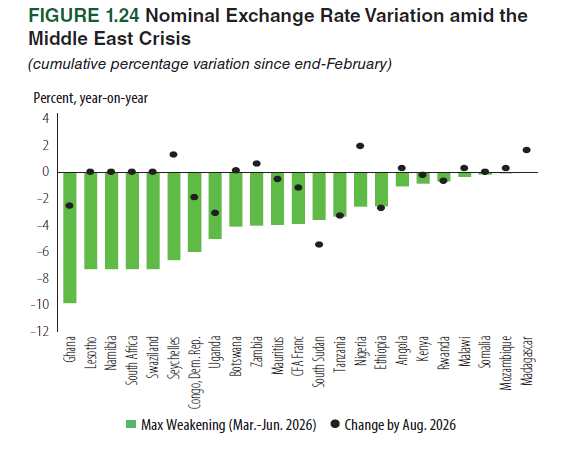
Amid the Middle East conflict, the Ghana cedi was the worst currency in Africa, depreciating nearly 10% against the US dollar between March 2026 and June 2026, the World Bank has revealed in its October 2026 Africa Economic Update.
It was followed by the Lesotho loti (over -6%), the Namibian dollar (over -6%), the South African rand (over -6%) and Swaziland lilangeni (over -6%).
According to the World Bank, the escalation of the conflict in the Middle East initially exerted broad-based pressure on African currencies.
“Most countries with available daily exchange rate data recorded currency depreciations during the second quarter of 2026 relative to end-February, before the conflict intensified. In seven of the 22 countries monitored (excluding the CFA franc zone), the maximum depreciation exceeded 5.0%, including in the Democratic Republic of Congo, Ghana, the Seychelles, and South Africa”.
“By end-August, however, much of this pressure had eased, with only 10 currencies remaining weaker than their end-February levels”, it added.
It continued that the exchange rate response reflected the interaction of external shocks and preexisting domestic vulnerabilities, stressing that the sharp increase in oil and energy prices raised import bills across net energy-importing economies, increasing demand for U.S. dollars, weakening reserve positions, and intensifying depreciation pressures.
At the same time, heightened geopolitical uncertainty triggered a flight to safety in global financial markets, prompting capital reallocation away from emerging and frontier economies.
The World Bank said supply disruptions in the Middle East also pushed up the cost of key agricultural inputs, including fertilisers, adding to imported inflation pressures.
It added that the currency depreciation further amplified fiscal vulnerabilities in countries with significant external debt service obligations, as the local-currency cost of servicing U.S. dollar-denominated debt increased.
Meanwhile, the cedi remained under pressure over the last two weeks, extending its year-to-date depreciation against the US dollar to 10.04%.
In the interbank market, the currency weakened by 1.39% to GH¢11.62 to a US dollar but gained 0.70% and 0.47% against the pound and euro to GH¢15.40 and GH¢13.24, respectively.
Retail forex market performance was similarly mixed, with the cedi appreciating 0.21% against the US dollar and 0.91% against the euro to GH¢11.93 and GH¢13.73, respectively. It weakened 0.31% against the pound to GH¢15.88.
Latest Stories
-
African communities have solutions but lack access – Liberian envoy
46 seconds -
Minority calls for dismissal, prosecution of Sports Minister, GTA CEO over World Cup visa scandal
49 seconds -
Chairman and fellow patriots – Irene Ponu-Brenyah writes to NPP
10 minutes -
Nothing Disappears: What Jamestown Beach reveals about Ghana’s styrofoam ban
11 minutes -
Court delays former NAFCO CEO trial to resolve access to seized gadgets
17 minutes -
Joy FM to offer free LPMs to Super Morning Show advertisers on Oct. 9 to mark Customer Service Week
21 minutes -
Sri Lanka’s ex-first lady arrested over alleged misuse of children’s hospital donations
28 minutes -
La Traditional Council kicks against redevelopment of La Pleasure Beach without consultation
30 minutes -
Some basic schools have just 2 or 3 teachers despite needing 9 – Right To Play
35 minutes -
Mahama to cut sod for SSNIT-funded Accra Convention Centre
36 minutes -
FAO calls for stronger REDD+ systems to unlock climate finance
37 minutes -
Illegal mining pushes Birim River turbidity to 50,000 NTU – Abuakwa South MP
37 minutes -
Bawumia’s opponent in 2028 will face nearly two decades of experience and preparation – Gabby Otchere-Darko
40 minutes -
Community 25 water shortage temporary, GWL assures residents
41 minutes -
‘Standing with teachers means supporting them in classrooms’ – NTC Registrar
44 minutes