

Audio By Carbonatix
The US and China are the two largest economies in the world. They have the two most powerful militaries in the world. The US-China rivalry, in the view of many international analysts, will be the defining global theme of the 21st Century.
But at the moment, only one of the two major party presidential candidates is regularly talking about US-China policy - as he has done consistently for years.
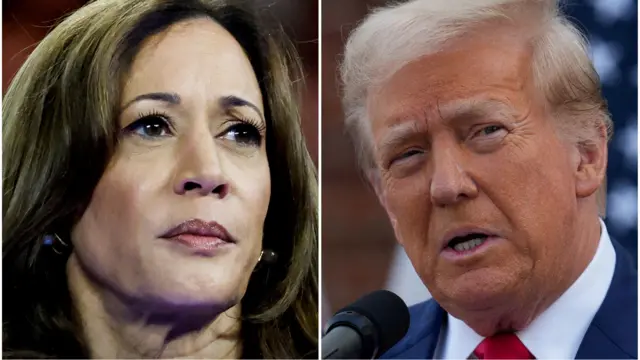
According to a review by BBC Verify, Republican presidential nominee Donald Trump has mentioned China 40 times in his five rallies since the presidential debate earlier this month. In just one hour at a town hall forum last week in Michigan, he brought up the country 27 times.
And when he talks about China, Trump focuses on matters of tension between the two global powers, painting the country and the world’s second-largest economy, as a kind of economic predator.
He has talked about the new tariffs he plans to impose on imports from Chinese companies – and those from other nations - should he return to the White House.
He has said he wants to prevent Chinese-made cars from being sold because he believes they will destroy the American auto industry. He has warned China not to attempt to replace the US dollar as the world’s reserve currency. And he has blamed the Chinese government for the Covid pandemic.
Many economists question the effectiveness of Trump’s tariff plans and warn that they would ultimately be harmful to US consumers. But Trump’s message is tailored to blue-collar voters in the key industrial Midwest battleground states who have felt the impact of increased competition from Chinese manufacturers.
Meanwhile, BBC Verify finds, Democratic presidential nominee Kamala Harris did not mention China at all in her six rallies since the 10 September debate. Although, in a speech on the economy in Pittsburgh, Pennsylvania, on Wednesday afternoon, she made a handful of references to the country.
“I will never hesitate to take swift and strong measures when China undermines the rules of the road at the expense of our workers, communities, and companies,” she said at that event.
Asked for comment, an aide to the vice-president told the BBC that even if Harris does not talk about China regularly, she has a record of working to counter what they described as China’s efforts to undermine global stability and prosperity.
But when it comes to discussing China, the contrast between Trump and Harris on the campaign trail is unmistakable.
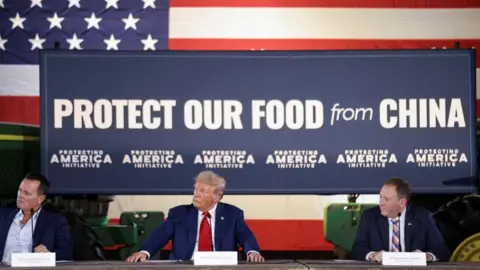
On Monday afternoon, at a barn in Smithton, a small town in rural western Pennsylvania, Trump sat down with a group of local farmers and ranchers for a roundtable discussion specifically about China.
The town may be just an hour outside of Pittsburgh, a Democratic Party urban stronghold, but this was decidedly Republican territory. Cows grazed peacefully on grasslands lined with dozens of “Trump for President signs”, while Trump supporters decorated two donkeys in “Make America Great Again” gear.
The topic of the event, hosted by the Protecting America Initiative, a conservative think-tank, was “the Chinese Communist Party's growing threat to the US food supply”.
The forum ended up being a more open-ended conversation about the threat of China, full stop. The farmers, ranchers and business executives on the panel complained about having to compete with heavily subsidised Chinese imports and about the low quality of Chinese goods.
While the former president didn’t spend much time discussing the perceived dangers of Chinese ownership of US farmland – he instead promised that he would convince Chinese President Xi Jinping to buy more US agriculture exports – he again emphasised that he would use tariffs to shield the American economy from China.
At one point, he spoke of the need to protect the US steel industry - in order to prepare for a hypothetical war with China.
“If we’re in a war, and we need army tanks and we need ships and we need other things that happen to be made of steel, what are we going to do, go to China and get the steel?” he asked. “We’re fighting China, but would you mind selling us some steel?”
Some of the heavier lifting on China during the forum was left to Richard Grenell, a roundtable panelist and senior advisor for the Protecting America Initiative.
He warned the country has “quietly but strategically” worked against the US – particularly when Americans were distracted by other global issues.
“They go after our local and state politicians; they go after our manufacturing,” he said. “There is no question they are looking to, at some point, leverage that investment and activity.”
Grenell, who served as US ambassador to Germany and acting director of national intelligence while Trump was in office, is considered a possible secretary of state - America’s top diplomat - if Trump wins another term in November.
If Harris wins, on the other hand, there may not be a significant change from the current Biden administration, even if the current president has frequently deployed sharper rhetoric to describe the US-China rivalry.
Latest Stories
-
Julius Debrah, ‘man to beat’ as NDC’s James Agbey dismisses Musah Dankwah’s polls
13 seconds -
GPRTU in Savannah Region to protest alleged eviction in Damongo
29 minutes -
Re: Reinsurance does not replace process — A response to the SIGA–SIC defence
44 minutes -
Gender Ministry supports Harriet Amuzu in ongoing abuse case
57 minutes -
AG joins plaintiff to scrap OSP ?: We should be mindful of the mischief in this – Bobby Banson
1 hour -
Samson Lardy Anyenini questions willingness of Attorneys-General to prosecute political colleagues
1 hour -
It is only fair the OSP is heard in Supreme Court case – Bobby Banson
1 hour -
Asiedu Nketia resumes Ashanti tour, second leg kicks off on Sunday
1 hour -
NLA denies salary cut claims, threatens legal action over reports
1 hour -
BoG Governor honoured for stabilising cedi, improve inflation
1 hour -
Kyebi Easter Homecoming 2026: A resounding success!
2 hours -
RNAQ divorce ruling: What the noise is hiding
2 hours -
Trade Minister applauds GUTA as a pillar of economic growth; Prez Mahama honoured
2 hours -
President’s brother’s takeover of Damang Mines is ‘untidy’ – Alhassan Tampuli
3 hours -
It’s not true that gov’t decided not to renew the lease for Gold Fields – Bobby Banson
3 hours