

Audio By Carbonatix
Chinese astronauts working on the country's planned space station carried out their second spacewalk on Friday, according to the China Manned Space Agency.
Since they were sent into space in June, the three-man crew has been working and living on the Tianhe core module of the space station, the largest spacecraft developed by China to date. They plan to have the space station, called Tiangong or Heavenly Palace, fully crewed and operational by December 2022 - an ambitious target for China's rapidly expanding space program.
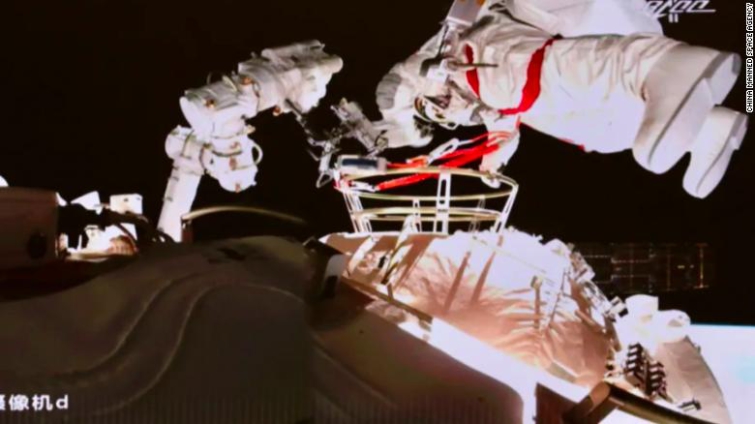
Two of the astronauts, Nie Haisheng and Liu Boming, conducted the spacewalk on Friday morning local Beijing time, leaving the core module to carry out tasks such as installing equipment outside the space station and working on the attached robotic arm, said the space agency on the Chinese platform WeChat. The third astronaut, Tang Hongbo, provided support from inside the cabin.
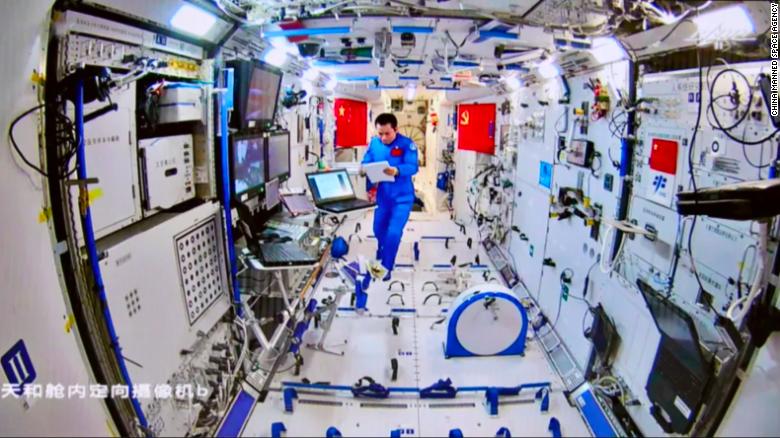
"The astronauts are in good condition," said state-run news outlet Xinhua before the spacewalk, adding that the core module, spacecraft and cargo craft are all "operating stably."
The astronauts carried out their first spacewalk in early July, during which they tested new-generation spacesuits, installed equipment, elevated a panoramic camera and tested the station's robotic arm.
It was also only China's second spacewalk at the time since its first was carried out in 2008.
No other spacewalks are planned for the remainder of their three-month orbital flight -China's longest-ever crewed mission. Their flight is just the first of many to come before the station is complete - after this mission, another three crewed spacecrafts and two laboratory modules will be sent to the space station.
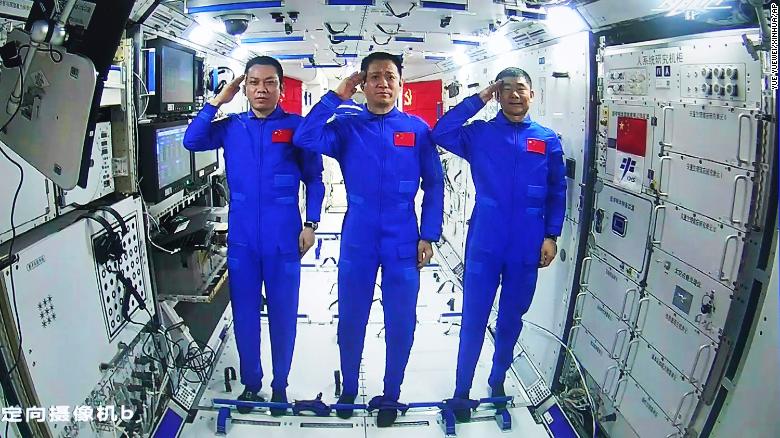
Chinese astronauts, from left Tang Hongbo, Nie Haisheng, and Liu Boming salute from aboard China's space station core module on June 23.
Once complete, the space station is expected to operate for 10 years -- which could be extended to 15. Though won't be as large as the international space station, it's designed to be permanently occupied by astronauts on long-term stays.
Chinese astronauts have long been excluded from the ISS due to US political objections and legislative restrictions. The country's space program has expanded rapidly in the past decade, and has accelerated in the past year alone, scientists successfully landed exploratory rovers on the moon in December and on Mars in May.
Russia, a longtime contributor on the ISS, has also left the project and is now considering launching its own space station by 2030.
Latest Stories
-
Why must I renew my vehicle’s registration number every 2 years?
13 seconds -
Parliamentary Privilege and the Limits of Personal Liberty: A study on the immunity of members of parliament from arrest in Ghana
1 minute -
Kwabenya Court denies bail to six accused in alleged 3.9-tonne cocaine shipment
2 minutes -
Ghana opposes calls to abolish ICC, urges stronger action against crimes against humanity
9 minutes -
Cedi remains under pressure due to Christmas demand; going for GH¢11.90 at forex bureaus
11 minutes -
NDC opens nominations for 2026 regional executive elections on October 6
11 minutes -
Ghanaian nurses to receive higher pay, health insurance and rent allowance under new Saint Kitts and Nevis agreement
19 minutes -
JoyNews’ Emmanuel Adu Gyamfi named ‘Digital Tourism Icon of the Year’ in Ahafo Region
24 minutes -
Hurricane Polo makes landfall on Mexico’s Pacific coast
28 minutes -
US ban on Canadian alcohol and dairy comes into effect as trade war drags on
30 minutes -
GES orders SHS heads to refund unauthorised fees collected from parents
38 minutes -
AFCON 2027Q: ‘We don’t need to cry over spilled milk’ – Damba on Ghana injury concerns
41 minutes -
NDC communicator blames documentation, payroll validation for teachers’ promotion arrears delay
43 minutes -
2026 JoyNews Impact Maker Award winner brings clean water to Yoko Tsume after years of cattle dugout dependence
50 minutes -
Sarkodie commends Mahama for rejecting US health compact
50 minutes