

Audio By Carbonatix
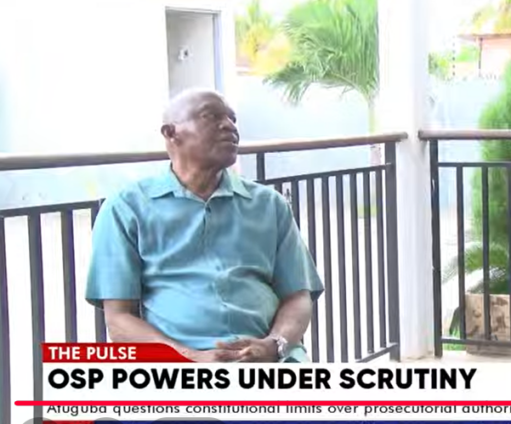
Civil society organisations expressing concern over the legal limitations currently facing the Office of the Special Prosecutor (OSP) are reacting to a law that was enacted on their behalf, retired Supreme Court Justice William Atuguba has said.
Speaking in an interview with Joy News’ Gemma Appiah, Justice Atuguba said while he understands the frustration of civil society groups, their concerns must still be weighed against the requirement to operate strictly within the law.
“Whatever popular the OSP’s cause is, if it is not legally sanctionable, the law is made on behalf of the public by the elected representatives,” he said. “It is not the government’s law. It is their own law that is being enforced.”
His comments come amid growing debate over a recent High Court ruling, which held that the OSP cannot prosecute corruption-related cases without authorisation from the Attorney-General.
Civil society organisations have described the decision as a setback for anti-corruption efforts, warning that it could weaken the independence of the OSP.
Some CSOs argue that the ruling effectively places the Office of the Special Prosecutor under the control of the executive, since the Attorney-General is a government appointee. They warn that this could create a conflict of interest in cases involving public officials.
The OSP, established under the Office of the Special Prosecutor Act during the Akufo-Addo administration, was designed to operate independently in investigating and prosecuting corruption-related offences involving public officeholders.
Justice Atuguba did not dismiss the concerns raised by civil society groups, but stressed that the matter remains before the Supreme Court, which is yet to provide a final interpretation of the constitutional questions at stake.
He explained that the High Court ruling remains valid for now, but could either be upheld or overturned by the apex court. Once that happens, he said, it would form the proper basis for public discussion and policy reflection.
The OSP has already filed an appeal and is seeking a stay of execution of the High Court ruling, which would allow it to continue operations while the Supreme Court deliberates.
For Justice Atuguba, however, the key issue remains adherence to due process.
He maintains that regardless of public sentiment or institutional expectations, constitutional disputes must ultimately be resolved by the Supreme Court, whose ruling will be final and binding.
Latest Stories
-
White vs traditional marriage: Aesthetics above culture?
9 minutes -
Tumu Municipal Hospital receives new delivery bed to boost maternity care
16 minutes -
Telecel Ghana unveils Project X with Black Sherif partnership
26 minutes -
Rev. Kwadwo Bempah defies restriction on preaching on buses; warns it won’t succeed
40 minutes -
French Embassy to partner Kobby Kyei Media for bloggers’ training
43 minutes -
Nestlé and NBA announce multi-year international marketing partnership
57 minutes -
Mahama sends condolences to Nigeria over plane crash that killed 25
57 minutes -
Our lifestyles may be killing us but our spatial planning is too
1 hour -
12 arrested as police seize firearms, suspected drugs in Tamale
1 hour -
Chamber of Mines challenges Reuters report on proposed mining law
1 hour -
LA 2028: Black Queens take first leg advantage with 3-0 win over Mauritius
1 hour -
UG academic calendar could collapse if GAUA strike extends into next week – Awandare
1 hour -
Black Sherif partners with Telecel Ghana to promote Telecel Cash
1 hour -
Nestlé Ghana expands Tema factory, raises evaporated milk production capacity
1 hour -
Telecel Ghana launches CARE Month with customer rewards and community outreach
1 hour