

Audio By Carbonatix
Experts believe the spread of new coronavirus variants in Africa has contributed to an increase in both cases and deaths reported across the continent.
There's also concern that these variants can't easily be tracked because the testing required to identify them isn't widely available.
What's the role of the Indian variant?
The new wave of infections in Africa is thought to be partly associated with the emergence of some variants that are more transmissible.
Uganda was the first country on the continent to confirm the presence of a variant first identified in India late last year, in a sample taken from a traveller.
Kenya, Morocco and South Africa later confirmed cases of this variant.
It has been classified by the WHO as a "variant of global concern" with possible increased transmissibility.
Another variant of the virus which emerged in South Africa last year contributed to record case numbers in the southern African region, according to the World Health Organization (WHO).
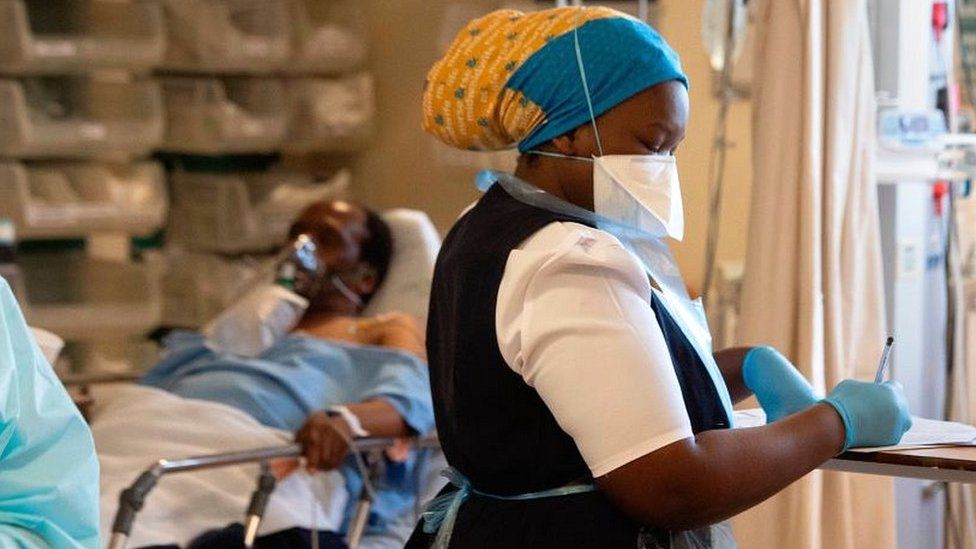
This variant has also been recorded in more than 20 other African countries.
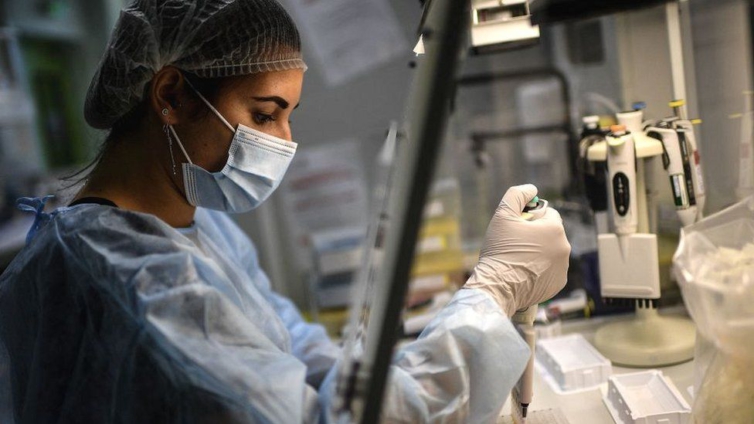
It's highly likely to have reached other countries, but few are able to carry out the specialised genomic sequencing to detect coronavirus variants.
In Nigeria, scientists have also identified a new variant of the virus, although there is currently no evidence to indicate it is contributing to increased transmission.
Twenty countries have also reported the presence of a Covid-19 variant first identified in the UK.
The WHO and the African Centres for Disease Control launched a network of laboratories last year to try to boost the continent's capacity to identify these variants.
It said the emergence of new, and more contagious variants "reinforced the need to step up genomic surveillance."
This involves analysing the code of the virus to understand its genetic makeup.
However, a recent article in The Lancet pointed out that while efforts were underway to expand this type of work, there were issues around funding, as well as shortages of reagents and staff with the skills required.
What's happening to case numbers?
Over the past month, new cases across the continent declined by 5%, according to the CDC.
New cases have been rising in north and central Africa (in countries like DR Congo, Egypt, Libya and Tunisia), but dropping in south and west Africa.
The rate has remained largely the same in central Africa.
"Africa is not out of the woods yet, and complacency is not an option at this time," says the head of immunisation at the WHO Africa office, Richard Mihigo.
Most countries have launched Covid-19 immunisation campaigns, but there are still a few countries yet to roll out or even acquire vaccines.
Death rates have been rising
The number of Covid-related deaths rose by 4% in the past month, according to CDC data.
During the first stage of the pandemic, Africa's overall fatality rate - the proportion of those with Covid who then die - was lower than elsewhere in the world.
There were a number of theories put forward as to why that might be the case, such as the relatively younger population, and possible cross-immunity from other coronaviruses.
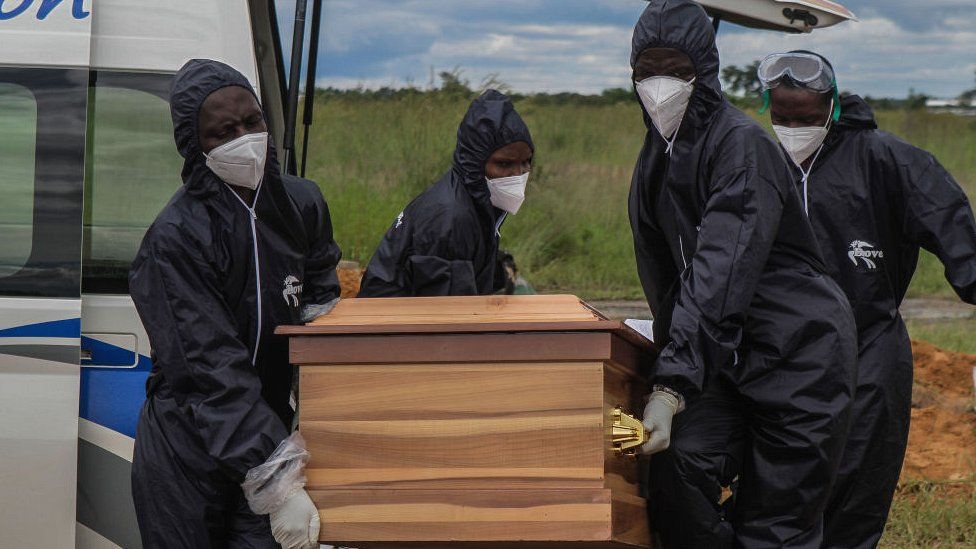
But the Africa CDC has warned about rising fatality rates in the continent, saying that of the 55 countries they monitor, 21 are reporting fatality rates above the current global average of 2.2%.
The fatality rate for Africa has crept up since July last year when it was on average 2.1% - to 2.7% in April this year (measured over the duration of the pandemic).
The global fatality rate has fallen since the start of the pandemic, which in itself would put more African countries above the global average.
And fatality rates are also affected by how much testing is done - a country with low levels of testing will show a higher death rate because many non-fatal Covid cases are going undetected.
More importantly, data for deaths should be treated with caution, given the wide variations in how countries record them.
In South Africa, research into excess deaths - that's the number of deaths in a certain period above what would normally be expected - shows that there were 153,668 more deaths between 6 May last year and 10 April this year.
The official death toll from Covid-19 since the start of the pandemic is just above 53,000.
And South Africa was just one of eight countries on the continent that the BBC found had adequate death registration systems.
So coronavirus deaths across Africa as a whole are likely to be under-recorded.
There are wide variations in testing rates and while some countries have reduced testing, others have maintained or even increased it at different points during the pandemic.
Latest Stories
-
Education is critical to Ghana’s future and development – Haruna Iddrisu
6 minutes -
Who’s Emelia Affi Agbenyo, the 43-year-old newly sworn-in Deputy EC Chair?
39 minutes -
Haruna Iddrisu calls for limits on annual university accommodation fee increases
1 hour -
Today’s front pages: Tuesday, October 13, 2026
2 hours -
Wealth Over Water: How Galamsey Is Threatening Ghana’s Water Security
3 hours -
LA 2028: Black Queens pumped up for second leg of Mauritius tie
3 hours -
LA 2028: Black Queens hold final training session ahead of second leg against Mauritius
3 hours -
Standards are not Seasonal: What the EC appointments teach both sides
4 hours -
King Mohammed VI urges private sector to create youth jobs and spread benefits of growth
4 hours -
KGL U17 Colts 2026: Greater Accra win title after penalties win over Western Region
4 hours -
UK Investment Roadshow opens in London to advance UK-Ghana growth partnership
4 hours -
Assemblies of God requires pastors to resign before entering partisan politics – Rev. Wengam
4 hours -
Ghana targets 20% annual reduction in maternal deaths – Health Minister
4 hours -
Cyber attacks in Africa grow faster than global rate, report finds
4 hours -
Ghana signs UAE deal to create 5,000 overseas jobs
4 hours