

Audio By Carbonatix
The current crisis situation caused by the coronavirus (Covid-19) pandemic is taking a toll on lives globally, with women being the worst hit.
Here we are, a developing country struggling to make ends meet, get all our children into the free senior high school (SHS) system before it passes us by.
Asking ourselves as women what will be the next meal for the family. How do we get our children to improve on their grades in their classes, even as we encourage them to have other extra curriculum activities such as sports, cooking, taekwondo, music, gardening, sports, cycling, swimming and tennis.
In fact, any sport you put your children into, mother is always there to urge them on. But now our focus has shifted 180 degrees even as we are still doing all those chores to the best of our ability. This is because of Covid-19.
Care work
So we ask ourselves what is the burden and scare on women with this COVID-19 economically and socially, in terms of looking after the household, children and family?
However, as postulated by health analysts, it is glaringly evident that COVID-19 as a physical illness appears to affect males more severely than their female counterparts.
For example, as stated by Sabra Klein, who is a scientist and studies sex predilection in viral infections at Johns Hopkins Bloomberg School of Public Health, “Being male is as much a risk factor for the coronavirus as being old. People need to be aware that there is this pattern. Just like being old means you are at a higher risk, so does being male. It is a risk factor.” Which then passes more responsibility on women.
With the pandemic broadening its scope on affected victims, the future still looks bleak for everyone with women more likely to bear the heap of a deadly load, if a swift solution is not found within days or weeks, not months.
Currently, emerging data from Washington Post European health watch and John Hopkins University suggest that 99 per cent of the coronavirus deaths were people over the age of 50 and mostly men. This is being figured out from over 300,000 victims around the world.
Obviously, for a gender with caring responsibilities, women, with multiple tasks as mothers, wives, workers and in many cases single parents, an outbreak of such magnitude can have terrible consequences. Certainly, a pandemic magnifies all existing inequalities, and coronavirus spread provides a clear proof to this, as women fall into a great disadvantage, not only physically, but economically.
Taking into account the adverse impact of the current lockdown following the pandemic, one cannot overlook the indisputable fact that women have also been put in the front line. They are inadvertently risking their lives in the full glare of the snaring viruses with unrelenting work by nurses in particular together with their male counterparts.
Lower-income earners
Here, Dr Clare Wenham, an Assistant Professor of Global Health Policy and Director of the MSc in Global Health Policy who sits on the steering committee of the London School of Economics and Political Science (LSE) Global Health Initiative, posed some very good questions by asking what pandemic patients needed? They obviously require being looked after. What do self-isolating older people need? Looking after. What do children kept home from school need? Looking after.
All this looking after — and most of these would be unpaid caring labour - the burden of which falls more heavily on the female population, and it is all due to the existing structure of the workforce. Unfortunately, this is not just about social norms of women performing caring roles. It is also about practicalities as Dr Wenham stated.
Now, according to the British government’s figures, 40 per cent of employed women work part-time, compared with only 13 per cent of men. Meanwhile, most women are lower-income earners.
If we should factor in the adverse impact of disruptions such as this virus outbreak which led to lockdowns to last for months, rather than weeks, some women’s lifetime earnings will never recover.
Worse are the precautions imposed by the movement restrictions on underprivileged rural farming folks, majority of whom are women, as well as market women and even young women whose subsistence is street hawking.
To state simply and briefly, women are terribly disadvantaged in this coronavirus pandemic as we all face a double-edged sword.
Prudently, any help or funding assistance should direct a considerable chunk to alleviate women from the unfortunate circumstances they find themselves in.
We must recognise women's role in uplifting society's morale in this crucial time.
May God bless them and give them added strength and courage to face greater challenges and help make our world a better and safe place to live in once again.
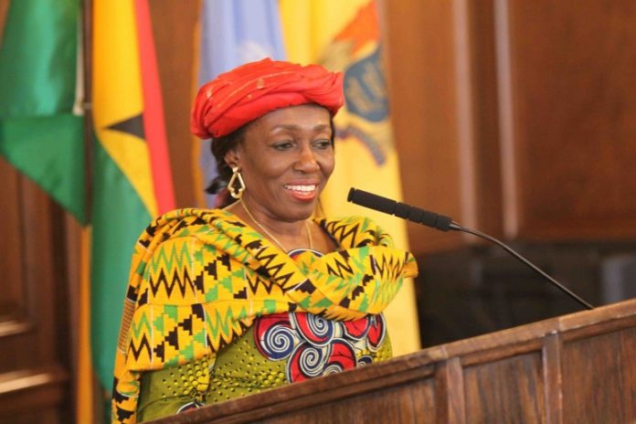
*The writer is a former First Lady of Ghana and founder of the 31 December Women's Movement
Latest Stories
-
NPP had more permanent fuel relief measures than current GH¢2 diesel cut – Amin Adam
13 minutes -
Photos from the 3rd Republic Bank-JoyNews Habitat Fair Clinic
16 minutes -
Ethiopia’s army promises restraint amid fears of new civil war
26 minutes -
Amin Adam calls for review of fuel taxes as diesel prices remain above GH¢18
57 minutes -
World Vision Ghana, Ahafo districts sign MoU for universal WASH coverage
1 hour -
When the gold engine stutters: What Ghana’s Cedi and reserves are telling us about the new economic architecture
2 hours -
Two reportedly die after being trapped in mining pit at Juaboso
2 hours -
Petrosol cleans up Wa Municipal Hospital, to donate medical equipment
2 hours -
‘If NPP was ‘insensitive’ over fuel prices, NDC must accept same description now’ — Amin Adam
2 hours -
KiDi brings the hits to London in sold-out UK headline concert
2 hours -
The last goodbye of Ghanaian shot dead in the US
3 hours -
MCC opens door to Ghana again as MiDA revives development partnership
3 hours -
CSIR moves to turn scientific research into jobs, national growth
3 hours -
More patrons troop in as 3rd Republic Bank-JoyNews Habitat Fair clinic enters final day stretch
3 hours -
German, Russian foreign ministers hold rare talks amid rising tensions
3 hours