

Audio By Carbonatix
Civil society organisations in Ghana have called on policymakers, government institutions, researchers, the media, and other stakeholders to collaborate in strengthening tobacco taxation policies.
They said global evidence and experience showed that increasing excise taxes on tobacco products could reduce affordability, discourage initiation among young people, support quitting among current users, and generate additional resources for national development.
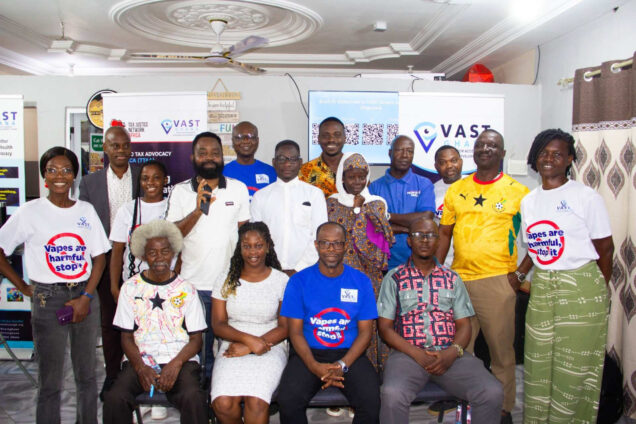
The CSOs made the call at a Strategic Meeting on Tobacco Taxation in Ghana organised by Vision for Accelerated Sustainable Development, Ghana (VAST-Ghana) in Accra on Tuesday.
The meeting forms part of the Tobacco Tax Advocacy in Africa (TTAA) Project III in Ghana funded by the Tax Justice Network Africa to Advance Tobacco Taxation for Improved Public Health in Ghana.
The objectives of the meeting were to review the overall goal, objectives, key activities, implementation timeline and expected outcomes of the Tobacco Tax Advocacy Project.
It was also to strengthen participants’ knowledge and understanding of tobacco taxation as an evidence-based intervention for reducing tobacco use and improving public health outcomes.
Others were to discuss the current tobacco taxation landscape in Ghana and identify policy opportunities, advocacy entry points, and strategic areas for engagement, and to establish a coordinated advocacy framework among participating CSOs to guide engagement with policymakers, government institutions, media, communities, and other relevant stakeholders.
The meeting sought also to promote collaboration, shared responsibility, and collective action among CSOs to support stronger tobacco tax policies that reduce the affordability and accessibility of tobacco products in Ghana.
Labram Musah, the Executive Director of VAST-Ghana, in a welcoming address said tobacco use continued to pose a serious public health and development challenge in Ghana.
“The impact of tobacco-related diseases extends beyond individual health outcomes and affects families, communities, healthcare systems, and national productivity,” he stated.
He said as Ghana continued to address the growing burden of non-communicable diseases, there was the need for stronger and more coordinated policy interventions that could reduce tobacco consumption and protect present and future generations.
Mr Musah noted that tobacco taxation remains one of the most effective policy measures for reducing tobacco use, adding that the WHO Framework Convention on Tobacco Control and its Article six guidelines recognize taxation as a critical component of comprehensive tobacco control.
The Executive Director said while Ghana has made progress in implementing tobacco control measures, challenges, particularly regarding the affordability and accessibility of tobacco products remained.
He pointed out that this creates the need for continued collaboration among civil society organiSations, policymakers, government institutions, researchers, media, and other stakeholders to advocate for stronger tobacco taxation policies.
He said for this reason the strategic meeting marked an important step in the collective effort of CSOs to advance tobacco tax advocacy and tobacco control in general in Ghana.
Mr Musah gave an assurance that through the project, the VAST Ghana would establish a coordinated CSO movement that would generate evidence, strengthen public awareness, engage decision-makers, and promote policy actions to contribute to reducing tobacco-related harm.
He urged the CSO members to let their experiences, expertise, and networks bear on the activities of the project to shape an effective advocacy approach for a meaningful tax policy change in Ghana’s context.
Latest Stories
-
Hawa Koomson pledges experienced and mature leadership of NPP women’s wing
30 minutes -
Young woman found dead at Kasoa Peace Town
1 hour -
Playback: The Law examined lawful arrest in Ghana
1 hour -
Mahama urges African governments to treat healthcare as an investment, not budget cost
2 hours -
Bawumia congratulates John Boadu and new NPP executives, pledges support ahead of 2028
2 hours -
‘No talent should be left out’ – Bawumia pledges inclusive NPP campaign for 2028
2 hours -
Prof. Mike Oquaye recounts how he blocked the Special Prosecutor’s attempt to arrest Bawku Central MP
2 hours -
Make health sovereignty a priority for Africa – Mahama
3 hours -
Dorimon Naa, Wa West DCE lead massive clean-up exercise; threaten sanctions against recalcitrant residents
3 hours -
Photos from Adom FM Y2K Jam
3 hours -
Praye Tiatia steals the show at Adom FM Y2K Jam [Watch]
3 hours -
Boakye Agyarko congratulates John Boadu, pledges support for NPP leadership
3 hours -
Antwi HiMight thrills fans with Antwi ne Antwi hits at Adom FM’s Y2K Jam [Video]
4 hours -
Amb. Edward Boateng congratulates Boadu, Kodua on election wins
4 hours -
John Boadu pledges to rebuild NPP from grassroots and restore ‘winning machinery’
4 hours