

Audio By Carbonatix
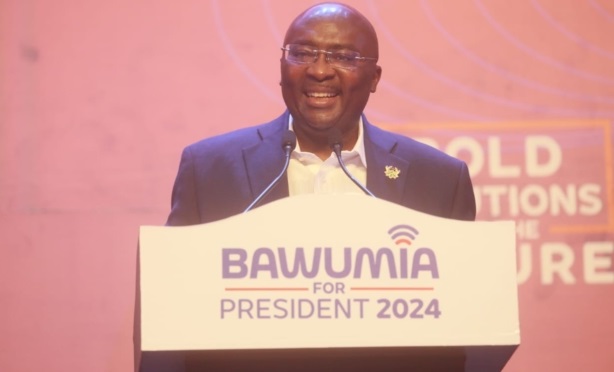
The Vice President, Dr. Mahamudu Bawumia has laid out a four-point vision on agriculture, housing, transportation and power to help reduce rising cost of living under his Presidency.
Speaking at his first major national address to outline his own vision and priorities for Ghana, Dr. Bawumia admitted the rising cost of living globally, including in Ghana, and identified the four key sectors affecting cost of living, which he prescribed "sustainable solutions" for by his government, if elected.
"A major priority of my government will be to reduce the cost of living," Dr. Bawumia declared.
"The cost of living in the world has increased massively following the COVID pandemic and the Russia-Ukraine war. Global inflation increased from 1.55% in 2016 to 8.27% at the end of 2022, a five fold increase!. In particular, the increase in the cost of living has been driven by increases in food prices, energy prices, housing (rents) and transport prices. Any attempt to reduce the cost of living on a sustainable basis must therefore tackle agriculture, energy, housing and transport prices and that is what I am going to do."
AGRICULTURE
On agriculture, Dr. Bawumia outlined a comprehensive, modern agriculture method to ensure food security.
"I want a Ghana where we attain food security through the application of technology and irrigation to commercial large scale farming," he said.
"We will also promote the use of agricultural lime to reduce the acidity of our soils, enhance soil fertility and get more yield from the application of fertilizers. Ghana has an abundance of limestone to do this. I will prioritise the construction of the Pwalugu Dam by using private sector financing to crowd-in grant financing."
PUBLIC TRANSPORTATION
On public transportation, Dr. Bawumia announced that his government intends to promote the use of electric vehicles, which he said will positively impact factors affecting the high cost of public transport in Ghana.
"My administration will endeavour to reduce the cost of public transport between 30-40% with the adoption of electric vehicles for public transportation," he noted.
"The public transport pricing formula is dominated by two key variables; the price of fuel and the price of spare parts. Electric vehicles do not use petrol or diesel and spare parts are minimal. That is what will bring down the fares for EVs. More importantly, transport fares for EVs will be stable and the constant and large increases in fares will become a thing of the past."
HOUSING
Under Bawumia's Housing for All policy as President, his government intends to focus on the provision of public housing in the same manner that Singapore did, he said.
"We will partner with the private sector to build large housing estates without the government having to borrow or spend. Also, the National Rental Assistance scheme which is working so well, will be enhanced to deal with the problem of demands for rent advance of two years and more," he added.
POWER SECTOR REFORM
Dr. Bawumia noted that as part of the effort to reduce the cost of living, "my government will implement policies to have energy self-sufficiency at reduced cost through solar and other renewables with the application of market efficiency to the energy market."
"We will diversify the generation mix by introducing 2000MW of solar power and additional wind power through independent power producers to reduce our dependence on oil and gas by the end of my first term in office. This will significantly reduce the cost of electricity.
"The fact that current residential, commercial and industrial consumer's power is still neither reliable nor cost competitive is a testament that the regulatory and administrative measures so far implemented, have not fully achieved the objectives we have set for ourselves in dealing with the legacy issues the government inherited."
"Therefore, like the telecom market, we shall work to bring efficiency of markets and expand competition from more private sector participation in generation and retail.
"With reliable and cost-competitive power, we will attract more manufacturing capacity into the country, create more jobs, improve services, export more products, and support our AfCFTA strategy to improve the participation of Ghanaian industries in intra-Africa exports and trade."
"To assist in the transition to green energy, there will be no import duty on solar energy," he concluded.
Latest Stories
-
COCOBOD says $1.4bn domestic funding is a strategic shift, not market exclusion
29 minutes -
Richmond Quarcoo appointed Ghana’s Chef de Mission for 2028 Olympics
1 hour -
‘Our missing players are more important’ – Gambia coach fires shot at Ghana
2 hours -
Today’s front pages: Tuesday, September 29, 2026
2 hours -
Ghana ‘showing up differently’ on global stage – Joyce Bawah Mogtari
3 hours -
Ghana’s tuna industry in crisis as 20 hook-and-line vessels collapse
4 hours -
South Tongu MP launches apprenticeship programme for 159 young people
4 hours -
The Pusiga connection behind Gertrude Atongi’s work in New York
4 hours -
Teachers took promotion exams in December to beat government clearance deadline – GNAT
4 hours -
NPA launches 2026 staff welfare week with focus on teamwork and employee wellbeing
4 hours -
Ghana, Saint Kitts and Nevis sign labour deal to strengthen protections for Ghanaian nurses
4 hours -
Delayed promotions put teachers’ retirement benefits at risk – GNAT
4 hours -
No ‘Bawumia candidates’ in NPP executive elections – Anthony Karbo
4 hours -
Over 3,000 displaced as flooding overwhelms Hohoe communities
5 hours -
Sunyani East NPP executives begin reconciliation drive ahead of 2028 polls
5 hours