


Audio By Carbonatix
The Netherlands' King Willem-Alexander has announced that Dutch royals will cease using a historic golden carriage amid a debate over slavery links.
Critics say that one side of the horse-drawn carriage, called De Gouden Koets, is decorated with an image that glorifies the country's colonial past.
Out of use since 2015, the carriage has traditionally been used to carry Dutch monarchs to the opening of parliament.
The move comes amid an ongoing debate in the country over its history.
The controversial image featured on the vehicle is called Tribute from the Colonies, and depicts black and Asian people - one of whom is kneeling - offering goods including cocoa and sugarcane to a seated young white woman who symbolises the Netherlands.
Seated next to her is a man offering a book to a young boy, which the work's painter, Nicolaas van der Waay, said in 1896 was intended to portray the Netherlands' gift of "civilisation" to its colonies.
In an official video announcing the move, King Willem-Alexander accepted that the carriage was offensive to a large number of people and called on the country to face the legacy of its colonial history together.
"There is no point in condemning and disqualifying what has happened through the lens of our time," he said.
"Simply banning historical objects and symbols is certainly not a solution either. Instead, a concerted effort is needed that goes deeper and takes longer. An effort that unites us instead of divides us.
"As long as there are people living in the Netherlands who feel the pain of discrimination on a daily basis, the past will still cast its shadow over our time," he added.
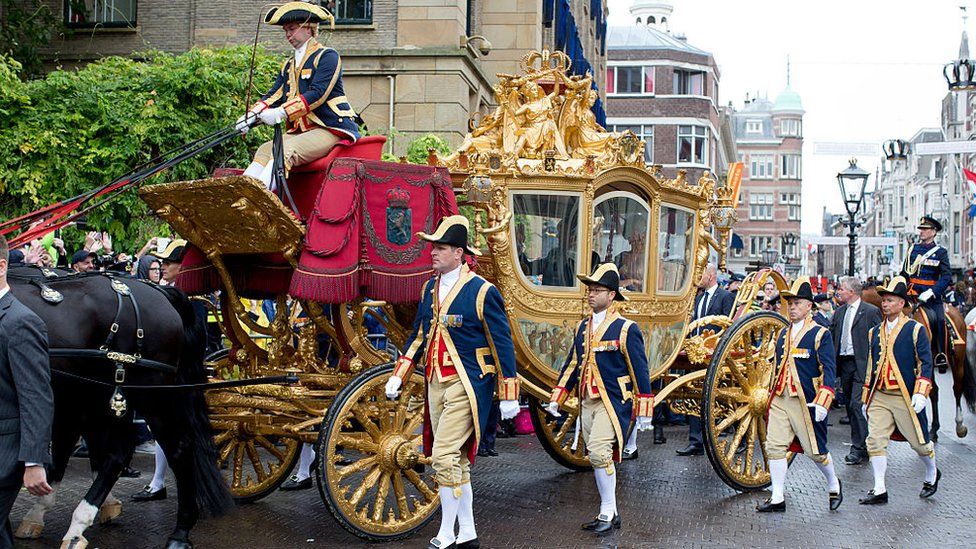
The carriage has been out of use for several years and has resided at the Amsterdam Museum since a lengthy restoration project concluded last year.
Anti-racism campaigners in the Netherlands have welcomed the move, but have called on the king to take further action to face up to the legacy of colonialism.
"He says the past should not be looked at from the perspective and values of the present," said Mitchell Esajas, co-founder of The Black Archives in Amsterdam.
"I think that's a fallacy because also in the historical context slavery can be seen as a crime against humanity and a violent system."
In recent years, many Dutch people have been urging the country to have a reckoning with its colonial past.
During the 17th Century the Netherlands conquered large swathes of territory in regions now known as Indonesia, South Africa, Curaçao and New Guinea, where it became a key player in the transatlantic slave trade.
Last year, the mayor of Amsterdam, Femke Halsema, formally apologised for the city's role in the slave trade.
The move put her at odds with Prime Minister Mark Rutte, who has rejected calls for a formal state apology.
Latest Stories
-
Parliament questions proliferation of unapproved containers in East Legon
21 minutes -
Promotion arrears alone cannot end teachers’ strike — PRETAG
27 minutes -
Ebi Bright alleges assault on driver in dispute with Tema Central MP
33 minutes -
GH¢35m Darkuman 24-hour market to be completed in 16 months — MCE
40 minutes -
NPP risks losing Karaga seat if Amin Adam doesn’t contest – John Boadu
44 minutes -
Ghana Reference Rate falls to 10.04% in October as borrowing costs ease
46 minutes -
53% of NPP delegates backed alternatives to John Boadu in chairmanship race – Mussa Dankwah
49 minutes -
High taxes, water shortages push up hotel operating costs — Hotels Association
50 minutes -
Catholic Bishops demand tougher action on tramadol, marijuana and other drugs
54 minutes -
Government positioning Banda District to become major tourism destination hub – Housing Minister
60 minutes -
Deputy Education Minister appeals to striking teachers to return to classrooms
1 hour -
Government to involve corporate Ghana in street maintenance – Ayariga
1 hour -
No contractor is untouchable because of political links — Agbodza
1 hour -
Contractors to resume work on Phase Two of Kejetia Market Project
1 hour -
Government committed to resolving teachers’ concerns - Vice President
1 hour